Redirect to CHS blog

Friday, September 16, 2016

Stanley Mouse and the Making of an Icon

dt.common.streams.StreamServer.cls.jpeg


Prepare yourselves to see a lot of Stanley Mouse's work during the forthcoming 50th Anniversary of the Summer of Love. This notable 1960s artist will be well-represented in exhibitions all over the Bay Area and beyond in 2017, but do you know the story behind this legend’s most iconic work, displayed 50 years ago this very evening?


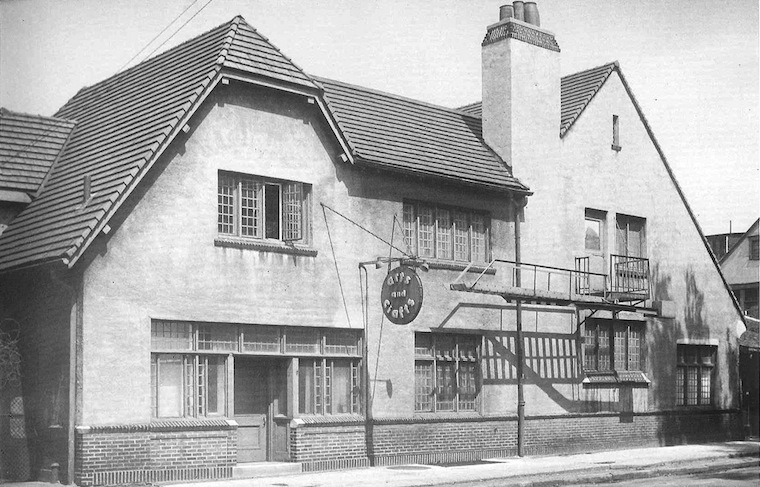
Born Stanley George Miller in California in 1940, this son of a Disney animator spent his formative years in Detroit, Michigan absorbing the city’s Motown and Motor City cultures. He was a quiet kid who often drew in class, earning him the nickname of “Mouse” in seventh grade, and his first taste of fame came from Detroit’s hot rod community, which was wild for his signature “Mouse pin-striping.” This led to T-shirts, and graffiti art, the latter of which prompted his expulsion from Mackenzie High School. He spent a year at Cooley High School, and then finished up at the Art School of the Detroit Society of Arts and Crafts—known nationally as the school that recognized the automobile as an artform.

Arts_and_Crafts.jpg


According to Mouse’s biography, “he dropped out to follow a higher calling to do rock posters in San Francisco during the sixties wartime era of social revolution, political passion and musical innovation.” His return to California in 1965 sent his art on a new trip. There he met Alton Kelley, then affiliated with The Family Dog, and the pair began producing rock posters for Chet Helms shows at the Avalon Ballroom. Mouse liked working with other artists—a penchant he refers to as one of his “Libra traits”—and this began a collaboration that would last into the 1980s.


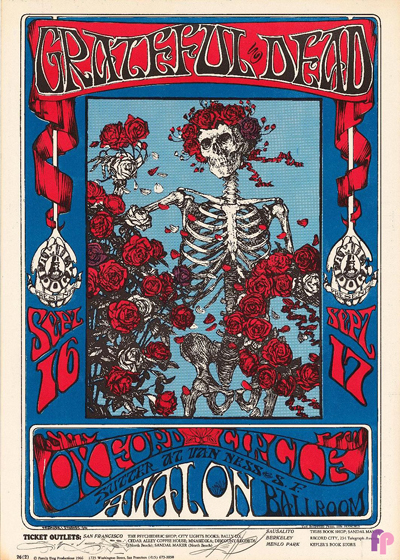
630ac26895ac9c0126fc045a43f60ae0.jpgMouse’s hand, trained from years of t-shirt designing and hot rod striping, and his love of Art Nouveau combined well with Kelley’s of-the-moment style and keen eye for layouts. The two most-remembered Mouse and Kelley collaborations are counterculture complimentary: a play on the ZigZag man familiar to denizens of cigarette rolling papers, and a poster for one of the most famous rock ‘n’ roll acts of all-time. In 1966, the pair were commissioned to make a poster for a show featuring The Grateful Dead. For this band they’d never heard of, Mouse and Kelley first designed a sheet that incorrectly spelled the band’s name as “Greatful Dead;’ for their second attempt, they went to the San Francisco Public Library for inspiration. Mouse recalled: “We would go to the San Francisco library and peruse the books on poster art. They had a back room full of books you couldn’t take out with great references. We were just going through and looking for something. And found this thing and thought, ‘This says Grateful Dead all over it.’” What Mouse found was The Rubaiyat of Omar Khayyam.


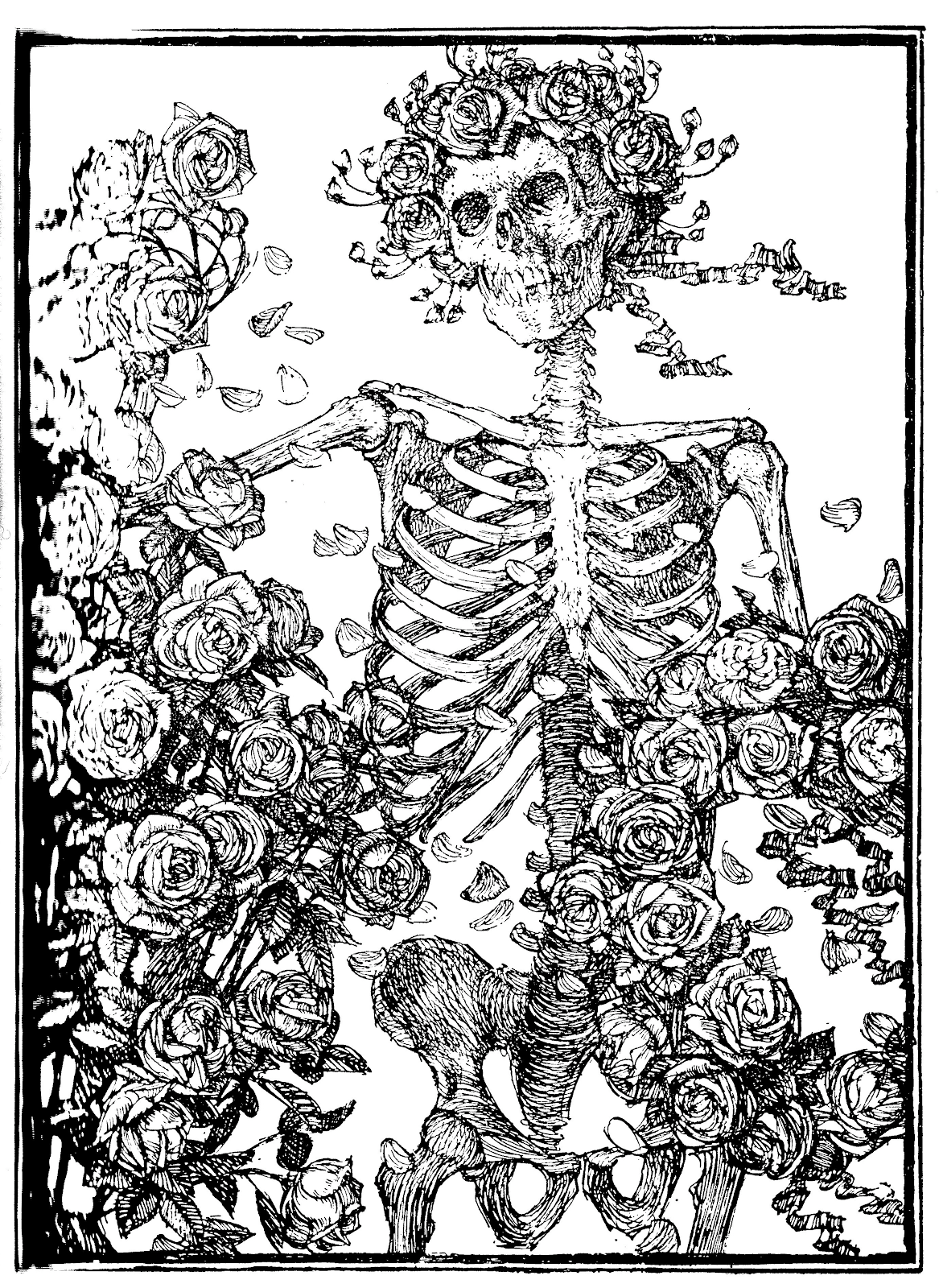
Omar Khayyam was a Persian poet, mathematician and astronomer who lived from 1048-1131, and a rubaiyat is a form of poetry (a quatrain rhyme)—hence The Rubaiyat of Omar Khayyam. The translation best known to English-speakers and found by Mouse and Kelley was done by Edward FitzGerald and illustrated by Edmund Joseph Sullivan, with five editions published from 1859 to 1889 that were more interpretive than they were literal. Mouse was particularly drawn to a Sullivan illustration that accompanied Verse 26, and couldn’t leave it behind. “I hate to say this,” Mouse recalled, “but Kelley cut it out with a pen knife. I always say that we Xeroxed it, but there weren’t Xerox machines then. I finally found it about two years ago, the actual cut-out piece, and I went, ‘Oh, my God’... And the poem that goes with this illustration is fantastic. It’s short and sweet and had to do with wine, women and song.” A perfect match for The Grateful Dead sound.


Kelley appropriated the black-and-white Sullivan illustration, and Mouse colored it in. The resulting poster advertised The Dead’s Avalon Ballroom show with Oxford Circle, September 16-17, 1966, and cemented Mouse and Kelley’s presence in San Francisco’s rock poster scene.


The verse that accompanied the poster’s inspiration was ripe with symbolism for artists marketing to Flower Children. “Oh, come with old Khayyam, and leave the Wise / To Talk; one thing is certain, that Life flies; / One this is certain, and the Rest is Lise; / The Flower that once was blown for ever dies.” Although Mouse’s interpretation of the verse’s meaning might be as liberal as FitzGerald’s “transmogrification” of Khayyam’s original quatrains, it does make a great story and the poster hit its mark—becoming an everlasting icon for both Mouse and the band it advertised.
Stanley Mouse continues to create and sell art through Mouse Studios, and The Dead (or what remains of The Dead) are miraculously still touring. As for this visual piece of rock history, it continues to be appropriated by local apparel manufacturers who shall not be named, and, more importantly, will be given a prominent place in the de Young Museum’s Summer of Love exhibition coming in April of 2017. Be sure not to miss it.

By Nicole Meldahl

Sources not previously linked:

Monday, September 12, 2016

My Summer Vacation: Dennis Searles in the Mohave Desert

Dennis Searles, Searles Marsh, San Bernardino Co., 1890
California Historical Society

For many California youths, summer ends with regret: it’s time to go back to school. For some, “What did you do on your summer vacation?” is a familiar question. In recognition of summers gone by, we offer this account of the months between May 21 and July 4, 1890, when the young Dennis Searles, son of a borax industrialist, was sent to work on his father’s borax works in the Mohave Desert.

Inspired by the image above and Searles’ journal, this account originally appeared as the Spotlight feature in the Fall issue of California History (vol. 93, no. 3). The author has further illustrated it to give a visual sense of the time and place in the life history of Dennis Searles and his family.

Detail, Map of California Saline Deposits, 1902
From Gilbert E. Bailey, The Saline Deposits of California (Sacramento: California State Mining Bureau, 1902)
  
By Shelly Kale
“I took off my city clothes and put on my desert duds,” wrote sixteen-year-old Dennis Searles in his journal on May 24, 1890 (1), the fourth day of his journey from San Francisco to the hot, dry desert in northwestern San Bernardino County. It was an unconventional destination for a teenager of a wealthy family on summer vacation from boarding school, but Dennis Searles had been summoned by his father John to help at the family borax works at Borax Lake.
Searles Lake, San Bernardino County, California
Courtesy California Department of Fish and Wildlife
May 22, 1890—I went to my father’s office [in San Francisco] and was there informed of the fact that my father wanted me to leave that evening for home [Searles Lake]. Of course I was glad to go as I wished to see my father.
In his journal Searles (1874–1916) described ferrying across the bay to Oakland and taking the Southern Pacific Railroad south through the San Joaquin Valley, the Tehachapi Mountains, and, finally, to Mojave.

Railway Depot, Mojave, 1927
Courtesy of Pomona Public Library
May 23, 1890—Mojave is a town of about one hundred population situated in Southern California at the juncture of the S.P. and A. P. railroads. . . . The railroad buildings comprise about half of the town. Of the rest of the town very near every other house is a saloon combined with some other business. My father owns here a large barn, a warehouse and a half of a dozen other houses. The town contains a schoolhouse but the pupils are few and the teachers poor.
At this town on the intersection of the Southern Pacific and Atlantic & Pacific Railroads, Searles learned to his relief that he would be escorted through the Mojave Desert by Robert R. Charlton, manager of John Searles’ Mojave office (Charlton, who was an avid photographer, may have taken the image of Searles “picnicking” in the desert) (2). “Instead of having a wearisome ride of four days [on a 20-mule-team borax wagon],” Searles wrote, “I am going to have a pleasant ride of a day and a half.”

 Twenty-mule Team Hauling Borax out of Death Valley to the Railroad, c. 1900
California Historical Society at University of Southern California
May 24, 1890—These wagons come into Mojave in the morning, load and then go out in the afternoon. These big freight teams are made up of two large wagons, the hind wheels of which are seven or more feet high. There is an oil wagon also connected with the team. It takes about twenty-two animals to draw one of these wagons. The average load is about thirty thousand of Borax.
On May 25 Searles and Charlton began the 75-mile ride to Borax Lake “behind a light team” and on “a very good road.” The travelers arrived three days later at Borax Lake (later Searles Lake), “a large dry lake, as white as snow. . . . On all sides, high mountains rise, completely walling it in, the few large canyons forming its gates.”

Looking towards the Slate Range and Searles Valley, 1947
Courtesy of Searles Valley Historical Society
June 24, 1890—On our right the tall barren mountains rise, at their summits you can see dense beds of sand, someof these beds are hundreds of feet deep. On our left a dry lake shows itself, on its shore salt grass is growing in the sand.
Located at the upper end of the lake was the borax works, established in 1873 by John Searles, a gold rush pioneer and hard-rock miner whose daring feats included a skirmish with a Grizzly bear in 1872 (3).

John W. Searles (1828–1897)
The May 8, 1955 issue of the San Bernardino County Sun called John Searles a “Pioneer among Industrialists” for his discovery and mining of rich borax deposits at Searles Lake.

In 1878 Searles relocated to a new site and named it Borax. There he established the San Bernardino Borax Mining Company, eventually covering 2,000 acres (4). It was the start of a new industry in the county.

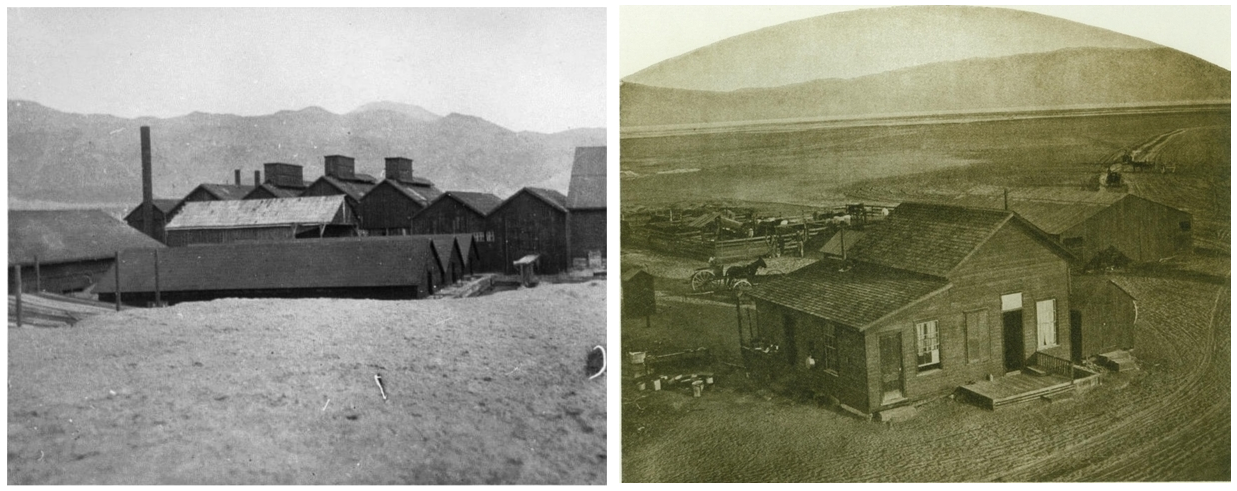
(Left) John Searles’ Borax Plant, Searles Lake, c. 1900
(Right) Searles Dwelling at Borax Works, Searles Lake, 1880
California Historical Society
May 28, 1890—The works for manufacturing the Borax are at the North Western end of the lake. There is somewhere near 30 buildings forming in itself a small town in the heart of the desert.
John Searles was the first to recognize the lake’s potential, but he certainly was not the last. In time, the lake’s saline mineral beds provided a continuing supply of minerals, including borax, sodium sulfate, and soda ash. In 1912, potash—a nutrient form of potassium—was discovered in the lake brine. Among its many uses, the Sausalito News noted, was “the making of glass, soap, bleaches, dyes, photographic chemicals, medicine, explosives, fertilizer,” and in “gold mining and many other industrial processes.” (5)  By 1979, the value of the lake’s mineral deposits was regarded as worth “billions of dollars.” (6)

Collecting from Searles Lake
Courtesy Searles Valley Historical Society
May 30, 1890—Now the regular routine of vacation has commenced, which I get very tired of within a month or so. It is get up in time for breakfast at half past five and then for the rest of the day there is plenty to do but one misses the company somewhat of young me as very near all the men are near onto 60.
Like the eponymous lake, Dennis Searles developed his potential over time. In 1895 he graduated with the first class of Stanford University (along with future president Herbert Hoover), majoring in engineering. He “made a brilliant record,” the San Francisco Call observed. “He had the reputation of being one of the ablest students there. He was probably the wealthiest . . . . Mr. Searles’ friends look to see him make a record in the days to come.” (7)  

His friends would not be disappointed. In addition to playing an active role as a Stanford alumni, Dennis Searles pursued a mining career, serving as vice president of Frank M. Smith’s (“the Borax King”) Pacific Coast Borax Company from 1909 to 1914 (8). He was Smith’s personal assistant in his numerous enterprises and director of the United Properties Company, which, when it was incorporated in 1911, was recognized as the “West’s Biggest Corporation” and “the most powerful corporation ever organized for the development of California, excepting that of the Southern Pacific Company.” (9)

Caroline Stetson Ayres and Dennis Searles, 1903
“Betrothal of Three Young Prominent Society Couples,” San Francisco Call, Sept. 23, 1903
“The engagement of Miss Ayres and Mr. Searles is without doubt one of the cleverest summer coups of Cupid,” wrote the San Francisco Call.
In 1904, Searles married Caroline Stetson Ayres (10). The couple, whose activities filled the society pages of the local newspapers, lived in Piedmont. On November 25, 1916, Dennis Searles, the “Oakland financier, real estate broker and clubman, and former secretary for F. M. Smith” died in an automobile accident when his car skidded off a road and over a 75-foot precipice near Saratoga, California (11).  

Nearly a year later, on September 21, 1917, Caroline Ayres Searles wrote a letter to her daughter, Mary, which she added to the last page of her husband’s journal from that summer of 1890: “Dear Little Mary, Mother is putting this safely away for you, hoping that someday, when you are old enough, you will read it and appreciate what a very fine little boy your dear Daddy was.”

On that “someday,” Mary would ignore her father’s “Hands off! Private” warning and open the cover of his journal. Inside she would learn what the Mojave Desert and borax mining were like in 1890. She would read about shooting coyotes, taking care of animals, sawing borax sacks and other chores, even a description of how to make healing ointment from horn-toads drowned in whiskey—all the features of desert life that filled young Dennis Searles’ days and nights at Borax Lake.

(Left) Dennis Searles with a Chinese worker; (right) Title page
Journal of Dennis Searles, 1890
California Historical Society, MSP 1933
May 25, 1890—As we are walking along I see a coyote standing looking at us about eighty yards away. I jump out of the wagon to get a shot at him but he disappears amongst the brush. He has been shot at before and knows what a man with a gun is.
Shelly Kale
Publications and Strategic Projects Manager
NOTES
  1. All quotes are from the Journal of Dennis Searles, May 21–July 4, 1890, MS 1933, California Historical Society.
  2.  James L. Fairchild, Russell L. Kaldenberg, Searles Valley Historical Society, Around Trona and Searles Valley (Charleston, SC: Arcadia Publishing, 2015), 63. A caption in “20-Mule Team Era Recalled,” San Bernardino County Sun, Dec. 2, 1962, reads “Time for Lunch: Dennis Searles is shown having a noon meal on the desert while he rests his horses. Such was desert travel in his day.”
  3.  James Fairchild and Russell Kaldenberg, Lecture on the History of Trona and Searles Valley, Maturango Museum, https://www.youtube.com/watch?v=PPIOu7wIIX8); Fairchild and Kaldenberg, Around Trona and Searles Valley, 9, 23, 24. In the early 1860s the Slate Range Stage Company brought prospectors and business people on a weekly basis from Los Angeles to this region originally inhabited by the Panamint Shoshone. In 1862 John, his brother (also named Dennis), and two other miners etched their initials on rocks in the Slate Range, a soda-salt marsh where they were mining gold and silver. The next year, having earlier suspected that there was borax in the soda, John attempted to test the mineral’s content in samples he brought to San Francisco. However, tests of the mineral’s existence in the samples were negative. Discouraged, the brothers returned to hard-rock mining, eventually moving to Los Angeles. In 1873, however, they were shown a borax crystal from the Slate Range area and renewed their interest. Claiming land on the salt marsh, they began extracting the mineral from the surface mud along the lake’s western edge.
  4.  George I. Smith, “Subsurface Stratigraphy and Geochemistry of Late Quaternary Evaporites, Searles Lake, California,” Geological Survey Professional Paper 1043 (Washington, DC: Government Printing Office, 1979), 4.
  5. “Concerning San Bernardino Potash Discovery,” San Francisco Call, Apr. 9, 1912; “Extensive Use of Postash,” Sausalito News, January 6, 1912. In March that year President William Howard Taft urged Congress to enact a law protecting the region from private exploitation and five years later, in 1917, with America’s entry into World War I, President Woodrow Wilson signed a bill reserving the Searles Lake district for potash production and use. As the Los Angeles Herald explained the year before, “A famine in potash fertilizer is threatened by the European war.” “Taft Would Protect Potash,” Sacramento Union, Mar. 27, 1912; “Wilson Signs Potash Bill,” Red Bluff Daily News, Oct. 3, 1917; “Experts to Work Calif. Kelp Beds,” Los Angeles Herald, Jan. 4, 1916
  6. Smith, “Subsurface Stratigraphy and Geochemistry,”4
  7. “California Bachelors Are Interesting: Who They Are, How They Live and What They Do,” San Francisco Call, Oct. 15, 1899
  8. “Borax in Death Valley,” Los Angeles Herald, January 20, 1901. Smith’s company, founded in 1890, had absorbed the San Bernardino Borax Co. in 1895, five years after Dennis Searles’ visit, and shortly discontinued its operations; W. D. Hamman, “Potash Solutions in the Searles Lake Region—II,” Mining Science (May 2, 1912), 391.
  9. “Great Enterprises in Merger: West’s Biggest Corporation,” San Francisco Call, Jan. 1, 1911; “Gigantic Financial Concern Plans Big Things: United Properties Company Will Expend Millions in Oakland and Vicinity,” in Evarts Blake, Greater Oakland (Oakland: Pacific Publishing Co., 1911), 50–51
  10. “Betrothal of Three Young Prominent Society Couples,” San Francisco Call, Sept. 23, 1903
  11. “Dennis Searles: Funeral of Dennis Searles to Be Tomorrow,” Oakland Tribune, Nov. 27, 1916
This article originally appeared as the Spotlight feature in the California History journal (Vol. 93, #3), published by the University of California Press in association with the California Historical Society. California History, Vol. 93, Number 3, pp. 101–103, ISSN 0162-2897, electronic ISSN 2327-1485. © 2016 by the Regents of the University of California. All rights reserved.

Friday, September 9, 2016

This Day on September 9, 1850: California Joins the Union


Grand Admission Celebration, Portsmouth Square, October 29, 1850
California Historical Society
In our high-speed information age, celebrations are instantaneous. But the celebrants in the image above were 50 days late to the party. Only 11 days earlier, on October 18, 1850, news of California’s admission to the Union had arrived in San Francisco with the Pacific Mail steamship Oregon. It had taken 40 days for the news to travel from Washington, D.C., where, on September 9, 1850, President Millard Fillmore signed a bill into law proclaiming California the Union’s 31st state.

View of San Francisco, 1850
Courtesy of the Bancroft Library, University of California, Berkeley
The celebrations on October 29 formalized those held earlier. As the 1855 Annals of San Francisco described:
When, on the 18th instant, the mail steamer “Oregon” was entering the bay, she fired repeated preconcerted signal guns which warned the citizens of the glorious news. Immediately the whole of the inhabitants were afoot, and grew half wild with excitement until they heard definitely that the tidings were as they had expected. Business of almost every description was instantly suspended, the courts adjourned in the midst of their work, and men rushed from every house into the streets and towards the wharves, to hail the harbinger of the welcome news. When the steamer rounded Clark’s Point and came in front of the city, her masts literally covered with flags and signals, a universal shout arose from ten thousand voices on the wharves, in the streets, upon the hills, house-tops, and the world of shipping in the bay. . . . Flags of every nation were run up on a thousand masts and peaks and staffs, and a couple of large guns placed upon the plaza [Portsmouth Square] were constantly discharged. At night every public thoroughfare was crowded with the rejoicing populace. Almost every large building, all the public saloons and places of amusement were brilliantly illuminated—music from a hundred bands assisted the excitement—numerous balls and parties were hastily got up—bonfires blazed upon the hills, and rockets were incessantly thrown into the air, until the dawn of the following day.
California Learns It’s the 31st State, October 18, 1850
Courtesy of Friends of the California Archives 
The official celebration of statehood followed two weeks later. As the Annals reported:
For the past fifteen days the papers have been full of announcements and notices and the walls have been plastered with enormous posters. . . . No effort has been spared to make it a success and two thousand persons have subscribed for the dinner and ball at one hundred francs each. At sunrise the cannon was fired off, and the celebration inaugurated. Shouts and noises were heard from every quarter of the city, interspersed with shots from guns and pistols. While this was going on the various organizations assembled, banners in hand, and formed a large procession which was to parade the streets.
At the end of the procession rode a chariot, drawn by six horses, with 30 children wearing bonnets, including 6-year-old Mary Eliza Davis (1845–1929), the “Queen of the 1850 Admission Day Parade,” the first Anglo-American child born in San Francisco.

Francis Marryatt (artist), Admission Day in San Francisco, 1850
Courtesy of Library of Congress

Child’s Cap Worn by Mary Eliza Davis on October 29, 1850
California Historical Society
At the celebration, the historian Hubert Howe Bancroft wrote, “a new star was added to the flag which floated from the mast in the center of the plaza, and every species of amusement and parade was made to attest the satisfaction of the citizens of the first American state on the Pacific coast.” There were a number of designs for the 31-star flag, which became the official United States flag on July 4, 1851.

U.S. 31 Stars Flag Commemorating California's Admission into the Union, September 9, 1850
Courtesy of Zaricor Flag Collection
Of special note at the celebration was an ode written for the occasion by Elizabeth Maria Bonney Wills, whose family came from New England to San Francisco earlier that year. Distributed among other printed pieces to the crowds from a typographical press mounted on a float, it was sung in Portsmouth Square as part of the ceremonies.

Ode Sung at San Francisco October 29, 1850, at the Celebration on Hearing of the Admission of California into the Union as a State, 1850
California Historical Society; photo by Cheryl Maslin
Wills’s inspiring ode closed with her sentiment:
In the Band of the Union, oh, long may it be
The hope of th’ oppressed, and the shield of the free.

Hers was a sentiment that remained contested for hundreds of year. As the black journalist Delilah Beasely chronicled:
Was this to be a free State in every sense of the word? . . . . At first, it was not, for a good many slaves were brought in to the State. On April 1, 1850, an advertisement appeared in the Jackson Mississippian referring to California, the Southern Slave Colony and inviting citizens of slave-holding States, wishing to go to California, to send their names, number of slaves, time of contemplate departure, etc., to the Southern Slave Colony, of Jackson, Mississippi. The design was to settle in the richest parts of the State and to secure an uninterrupted enjoyment of slave property. The colony was to comprise about 5,000 white persons and 10,000 slaves. 
In 1852 Peachy of San Joaquin introduced a resolution to allow fifty southern families to immigrate in to California with their slaves. Some of them came without permission but on finding that they could not legally hold their slaves, they sent a part of them back while others became free.
Nevertheless, admittance to the Union was undeniably a cornerstone in the state’s growth and prosperity. Today Admission Day is a legal state holiday.

California Counties Maps, c. 1850 and c. 1880
Courtesy of California State Association of Counties
Shelly Kale
Publications and Strategic Projects Manager

Sources


  • Hubert Howe Bancroft, History of the Pacific States of North America, vol. VI, California, 1848–1859 (San Francisco: The History Company, 1888)
  • Delilah L. Beasley, The Journal of Negro History 3, no. 1 (Jan., 1918)
  • Katherine H. Chandler, “San Francisco at Statehood,” San Francisco Chronicle, September 9, 1900
  • Ernest de Massey, A Frenchman in the Gold Rush; the Journal of Ernest de Massey, Argonaut of 1849, trans. Marguerite Eyer Wilbur (San Francisco: California Historical Society, 1927)
  • H. R. 5419, “State Admission Day Recognition Act of 2006,” The Lincoln Highway
  • Frank Soulé, John H. Gihon, M.D., and James Nisbet, The Annals of San Francisco (New York/San Francisco/London: D. Appleton & Company, 1855)


Thursday, September 8, 2016

Admission without Compromise: William H. Seward Stands against Slavery

 Seal of California
Courtesy of Department of Education, Sacramento, California

Tomorrow we celebrate the 166th anniversary of California’s admission to the Union as the 31st state. California was admitted at a time of controversy—when territories and states were either for or against slavery. To many, its admission came with a price—with passage of the Compromise of 1850, a package of legislative bills that designated California a free state while also mollifying an increasingly rebellious South.

Map of Free, Slave, and “Open to Slavery” States and Territories, c. 1856
Courtesy of Library of Congress

In the collections held by CHS is an original copy of the passionate argument made against the Compromise by then-New York Senator William H. Seward. Often called the “Higher Law” speech, it was Seward’s first speech to the U.S. Senate. Senator Robert Byrd has describe it as one of the most “significant ‘maiden’ speeches in the history of the Senate,” and it established Seward as a leading opponent of slavery.


Speech of the Hon. W. H. Seward on the Admission of California,
and the Subject of Slavery, 1850
California Historical Society


William H. Seward (1801–1872)
Courtesy of Library of Congress
Seward, who had been the governor of New York and later became Abraham Lincoln’s Secretary of State, was not an abolitionist, per se. But he was known for seeking legislation establishing rights for African Americans, and he and his wife, Frances, aided escaping slaves via the Underground Railroad at their home in Auburn, New York.

Charles T. Webber, The Underground Railroad, c.1893
Courtesy of Library of Congress

About one of the provisions of the Compromise of 1850, a Fugitive Slave Law, Seward wrote:  “We deem the principle of the law for the recapture of fugitives, as thus expounded, therefore, unjust, unconstitutional and immoral; and thus, while patriotism withholds its approbation, the consciences of our people condemn it.”

Although not an attention-grabber at the outset, within weeks of its writing 100,000 copies of the speech were printed and widely distributed. In it, Seward noted all of California’s advantages to the Union—its rapidly growing population, recent discovery of gold, abandonment of its military government and its new constitution. He strongly encouraged its admission as a state. He said:

“To-day, California is a State, more populous than the least and richer than several of the greatest of our thirty States. This same California, thus rich and populous, is here asking admission into the Union, and finds us debating the dissolution of the Union itself.”


Effects of the Fugitive-Slave-Law, 1850
Courtesy of Library of Congress

According to Robert Byrd, “Seward acknowledged that the Constitution’s framers had recognized the existence of slavery and protected it where it existed, but the new territory was governed by a ‘higher law than the Constitution’—a moral law established by “the Creator of the universe.” The New York senator, opposing all legislative compromise as ‘radically wrong and essentially vicious,’ demanded the unconditional admission of California as a free state. He warned the South that slavery was doomed and that secession from the Union would be futile.”

Trusting implicitly in the strength of the Union, however, Seward felt that slavery would “gradually give way, to the salutary instructions of economy, and to the ripening influences of humanity.”

Five Generations on Smith's Plantation, Beaufort, South Carolina, 1862 (printed later)
Courtesy of Library of Congress

“Let, then, those who distrust the Union make compromises to save it,” Seward wrote, “I shall not impeach their wisdom, as I certainly cannot their patriotism; but indulging no such apprehensions myself, I shall vote for the admission of California directly, without conditions, without qualifications, and without compromise.”

At the conclusion of his speech, Seward urged his fellow Senators to vote against compromise and to return the American ground to its pre-slavery state: “You found it free, and conquered it to extend a better and surer freedom over it. Whatever choice you have made for yourselves, let us have no partial freedom; let us all be free; let the reversion of your broad domain descend to us unencumbered, and free from the calamities and the sorrows of human bondage.”

Historic Stagville Plantation, Durham, North Carolina 2016
Courtesy of Alison Moore

In the end, the Compromise was enacted, California was admitted to the Union and civil war was forestalled for a decade more. At the same time, continued concessions to the Southern states consigned enslaved Americans to ten more years of government sanctioned hardship, torture, and injustice.

African American Family Portrait, 1870
Courtesy of Los Angeles Public Library
Alison Moore
Strategic Initiatives Liaison

Sources

Robert C. Byrd, The Senate, 1789-1989: Classic Speeches, 1830-1993. Washington, D.C.: Government Printing Office, 1994. http://www.senate.gov/artandhistory/history/common/generic/Speeches_Seward_NewTerritories.htm

The Compromise of 1850
http://www.ushistory.org/us/30d.asp; https://en.wikipedia.org/wiki/Compromise_of_1850

William H. Seward, Speech of William H. Seward on the Admission of California delivered in the Senate of the United States, March 11, 1850 (Washington: Buell & Blanchard, 1850) https://archive.org/details/williamhspeech00sewarich

William H. Seward
https://en.wikipedia.org/wiki/William_H._Seward