Redirect to CHS blog

Showing posts with label San Francisco. Show all posts

Monday, April 15, 2019

Photographing Disaster: Depicting the Aftermath of the 1906 Earthquake

This blog post originally appeared in California History Journal, Vol. 96 No. 1, Spring 2019

An earthquake is a visual event. Photographs taken in San Francisco in the aftermath of the 1906 earthquake reveal an almost unrecognizable image of the young city, showing piles of rubble and coils of melted iron swirling serpent-like from the hollow frames of collapsed buildings. One such image shows the charred remains of the Dana Building—the first Art Nouveau building in San Francisco—juxtaposed against the steel skeleton of the unfinished Union League Building. The façade of the Dana Building stands like a ghostly shell, its shattered windows and collapsed walls producing the effect of a building turned inside-out. The building’s sleek white surface is dappled not with light but with ash, a vestigial trace of the flames that had licked its walls and left the building in ruins. The building looks like it was destroyed in a flash.

Stockton Street between Geary and Post Streets. San Francisco Subjects, Photography Collection, PC-SF-EQ (1906), California Historical Society 
What would it be like to wake up and find your city unrecognizable? To find unstable ground not only beneath your feet, but in front of your eyes? The philosopher William James described how in the aftermath of the earthquake, his students at Stanford University slept outdoors in order to “get the full unusualness out of the experience.”1 The photographer Arnold Genthe remarked that the streets “presented a weird appearance . . . many ludicrous sights met the eye: an old lady carrying a large bird cage with four kittens inside . . . a man tenderly holding a pot of calla lilies, muttering to himself; a scrub woman, in one hand a new broom and in the other a large black hat with ostrich plumes; a man in an old-fashioned nightshirt and swallow tails, being startled when a friendly policeman spoke to him, ‘Say, Mister, I guess you better put on some pants.’ ”2

But these “unusual” and “ludicrous” sights were not the visuals that San Francisco’s civic leaders sought to promote. Intent on rebuilding the city as quickly as possible, pol- iticians, boosters, and industrial magnates propagated an image of San Francisco as re- silient and organized—a phoenix worthy of modern development and international investment. Compare the photograph of the Dana Building to an image better aligned with this booster rhetoric, taken by the photographer George Lawrence. Entitled “San Francisco in Ruins,” it is an aerial view of the aftermath, taken from a kite suspended 2,000 feet above the city. Lawrence’s panorama is perhaps most impressive in its ability to show the fire’s devastation not as ruinous, but as a contained event. Buildings may be smoldering, but the city’s roads and ports—symbols of industrial potential—remain. In the upper righthand corner, the clouds part to reveal the sun shining brightly on the city below, symbolizing its ordained rebirth.

By contrast, the photograph of the Dana Building depicts the aftermath as a period of precariousness and uncertainty. If the intact frame of the Union League Building conveys the city’s industrial ambition, the crumbling remains of the Dana—with its Art Nouveau walls standing jagged like loose teeth, ready to fall at any moment—read as a humbling reminder of the city’s fragility. The piles of rubble, brush, and planks lining the street symbolically dis- mantle the city before our eyes. Even the man riding through on his cart evokes a sense of contingency, his blurred face reminding the viewer that this photograph, and the landscape that it depicts, could look completely different if it had been taken in any other moment. The photograph compels the viewer to conceptualize the earthquake not as a propelling and productive force of modernization, but as a harbinger of uncertainty and radical possibility.

San Francisco in Ruins from Lawrence Captive Airship, 2,000 feet above San Francisco Bay. PC-PANO_001
California Historical Society
Reflecting on the 1906 earthquake on its centennial, the writer Rebecca Solnit suggests that images of ruins and decay help us to remember that history is not teleological, but rather an ebb and flow of progress and decline. She writes: [Decay] is the negative image of history and a necessary aspect of it. To erase decay or consciousness of decay, decline, entropy, and ruin is to erase the understanding of the unfolding relation between all things, of darkness to light, of age to youth, of fall to rise.3 Read alongside this photograph of the ruins of the Dana Building, Solnits description allows us to see the structure as its own negative image of his- tory, its exterior melding visually with the interior to form a negative image of a building designed to symbolize modern progress and aesthetics.

In this way, the photograph also evokes a different sort of negative: a 35-millimeter film neg- ative, a technology that would be patented in America just two years later. Notice how the empty window frames are stacked neatly in rows resembling a film strip, as if to suggest the myriad ways in which the disaster could have been pictured and remembered. This photo- graph was likely taken by an amateur photographer, newly able to photograph their city after the first affordable snapshot camera was introduced by the Eastman Kodak Company just six years prior. It is through such amateur photographs that we are able to see a different view of the earthquake’s aftermath, one taken not from the point of view of a booster but from that of a citizen processing the realities of the disaster. Looking through the window frames—depicted within the frame of this forgotten photograph—we can crane our necks to imagine what it would have been like to experience the disaster as a citizen, the visual landscape of the city changing before our eyes.

-- 
Written by Natalie Pellolio, Assistant Curator at California Historical Society

Friday, March 29, 2019

The Life of Elaine Black Yoneda, In Her Own Words

The concept for Women’s History Month was born in California, beginning as a local, week-long celebration in Santa Rosa in 1978. The idea quickly spread across the country as other communities adopted their own versions of the celebration, and in 1980 President Jimmy Carter issued a proclamation instituting a nationwide “Women’s History Week.” This eventually evolved to encompass an entire month, observed annually, and designated each year by Presidential proclamation. Every March, we take the opportunity to recognize the achievements, struggles, and experiences of women by telling their stories and exploring individual contributions to history as well as contemporary life.


--

Examining the past can allow us to understand and appreciate the people, places, and events that have made up our history, inform our present, and inevitably shape our future. Studying what came before can help route the course for a world that is more inclusive and equitable. It’s common to learn the stories behind well-known names, the key players in text books, interpretations of the past that are well-loved and often repeated. These stories are important, yes, and their reappearance in our lives in no way diminishes their significance, but what about the other, less talked about stories?

Recently I made a trip downstairs to visit CHS’s North Baker Research Library, feeling a bit overwhelmed by my task of identifying a source around which to compose a Women’s History Month blog. There are a lot of women of gumption ingrained into the story of our state…so where to begin? Luckily, my colleague, Lynda Letona, had recently stumbled upon the oral history of Elaine Black Yoneda, a gem in our collection because of the figure behind the name but also unique because the history is oral and publicly available online.

A complete typed transcript of Yoneda’s oral history is stored in our vaults as well, so Lynda hauled the thick volume up for me to peruse. Within a few minutes I was entranced by this woman and elbows deep in her life. Across 7 days and 14 hours in the late 1970’s, at Elaine’s apartment in the Outer Mission District of San Francisco, the interviewer proceeds with a purpose to “obtain Yoneda’s background, schooling, early life, marriages, and involvement in the left wing movement of the thirties. Then to develop her activities and motivations as an official of the International Labor Defense, and as a member of the Communist Party, particularly her thinking and opinions as a woman leader during that period.” 

Transcript of  Elaine Black Yoneda's oral history, 1978
The thing I love about Elaine’s oral history is that it’s told from her first person perspective and speaks to her political activism, but also includes descriptions of her personal life, things she experienced as a woman, daughter, sister, and mother, as well as how those experiences affected and were affected by her public life and work. It is compelling because so much of it is relatable and provides insight into the little things that make up a life, the things that make us human and connect us across time and diversity of experience. Her work was radical for her era, especially as a woman, and echoes battles still being waged across the nation and world today.

Elaine Black Yoneda was born in 1906 in New York City to Russian Jewish immigrant parents. Her family moved to California in the 1920's and Elaine’s political awareness emerged after she experienced police brutality at a mass unemployment demonstration in Los Angeles. From there she quickly became a civil rights leader with the International Labor Defense (ILD), an organization for the defense of political and trade union prisoners, including deportees. She earned the nicknames “Red Angel” during the 1934 waterfront strike and General Strike in San Francisco, and “Tiger Girl” in Salinas during an agricultural strike. She was arrested many times, and used the courtroom as a forum to bring to light civil rights violations, including the right of free speech and the right to assemble.

Like many good stories, this one includes love and drama. Yoneda’s oral history outlines both of her marriages, including her second marriage to a Japanese American activist named Karl “Hama” Yoneda, whom she met when she bailed him out of jail as part of her duties working for the ILD. (He changed his name in honor of Karl Marx). They married in Seattle, as anti-miscgenation laws still in place at the time made it illegal for them to marry in California. As Japanese Americans, Karl and their son Tommy were sent to Manzanar Interment Camp following the attack on Pearl Harbor. Elaine insisted on joining them. 

The Yoneda family at Manzanar Internment Camp in 1942, credit: TradingCardsNPS 

Throughout her oral history one can garner a sense of Elaine’s passion for the labor movement, her convictions about civil liberties, tenderness towards her children and family, and snippets of wisdom gleaned from 70 years of life experience. She discusses her childhood as a second generation American with revolutionary parents, her hopes for her daughter, and her participation in the Salinas Lettuce Strike, National Scottsboro Week, and the Spanish Civil War relief. She discusses being the only woman on the steering committee of the 1934 San Francisco Strike, her unsuccessful campaign for a seat on the San Francisco Board of Supervisors in 1939, and examples of male chauvinism within the Communist Party in the 1930’s. It’s engaging, informative, inspiring. 

Elaine Black Yoneda with “Free the Scottsboro Boys” Activists, 1934
California Historical Society
Elaine Black Yoneda died on May 29, 1988, one day after attending a longshoreman’s rally in support of Reverend Jesse Jackson’s presidential campaign. She leaves us with some wisdom to be passed on to future political activists:

“Sometimes some of them have a tendency (perhaps I did at that age) to think that the revolution should have happened yesterday. There may be many tomorrows. You have to work with the people, and you have to discuss their needs, not just your own needs, and see it from a wider perspective than just a narrow path. Things do not happen overnight. It takes a long period of working for an objective and if it’s the right one, eventually you’ll get it.” … “ I think for a while they tended to disregard everything that is so-called history. 'We don’t need history, that’s ancient.' But more and more, are beginning to see the need to at least know that history so that they don’t commit some of the same errors that others committed.”


--
by Katie Peeler, Marketing Associate at California Historical Society

Monday, January 7, 2019

The Legacy of Carleton Watkins

Carleton Watkins is something of an enigma. Very few letters written in his own hand survive, leaving historians and early photography enthusiasts to fill in the gaps of his life and career. This makes some of the concrete details of his life surprisingly hard to pin down. According to various sources, he is either the oldest of eight children or the youngest of five. He arrived in San Francisco in 1851…or was it 1849? Accounts of his life are filled with hedges (“1855-61: Photographed New Idrea and New Almaden mines and Mission Santa Clara (according to Turill)’’ says one chronology) and guesses. Information presented as fact may not actually be, which can make writing an account of his life (my task as Project Archivist at California Historical Society) somewhat difficult.

His name, when placed next to that of his contemporary, Eadweard Muybridge, recedes. Muybridge, an Englishman whose motion studies of Leland Stanford’s horse Occident and moving zoopraxiscope are often credited as the beginning of motion pictures, seems to get all of the glory. Muybridge was a more colorful character. He changed his name several times, from Edward James Muggeridge to Edward Muygridge to Eadward Muybridge, in what seems to be the slow and iterative perfecting of how he would prefer to be known – as if he at all times had one eye fixed on his own greatness. At one point, he signed his photographs “Helios” (“Titan of the Sun”). He murdered his wife’s lover but was acquitted for what, at the time, was considered “justifiable homicide.”

Interestingly, the differences between the two artist’s statures seem to be archival matter. Watkins famously lost the contents of his San Francisco photography studio during the 1906 earthquake, just before he was to transfer the archive to Stanford University. Tyler Green writes, “In fact, just a week before the earthquake, a curator from the university had visited Watkins…in preparation for the university’s apparent acquisition of Watkins’s archives, the first time an American university or museum would recognize a photographer’s importance in such a way.” An amazing photograph exists showing Watkins as a bearded elderly man with a cane, suit, and top hat on the streets of San Francisco shortly after the earthquake, a massive cloud of smoke visible in the background.

River View, Cathedral Rock, Yosemite [CEW 31], 1861; Carleton E. Watkins photograph collection, PC-RM-Watkins; Box 1, Folder 5; California Historical Society
  Much of Watkins’ studio was lost, including the massive mammoth glass plates used to create his famous photographs of the Yosemite Valley and other parts of the West as it was being settled. Complicating the issue is the fact that, due to poor financial decisions earlier in his career, Watkins had lost many of his original negatives to a group of creditors which required him to reshoot many of his original photographs (his “New Series” is the result of this). Watkins’ photographs are dispersed widely and held by numerous archives and private collectors around the country. Chief among these are the Bancroft Library, the Society of California Pioneers, and the California Historical Society. Perhaps unsurprisingly, Muybridge did manage to eventually transfer his archive to Stanford. In fact, Leland Stanford – a railroad baron – was Muybridge’s greatest champion and supporter, much as Collis Huntington was Watkins’. Some have suggested that this matter of the photographers’ archives is the reason that Muybridge is better known today.

Rebecca Solnit, in her book River of Shadows: Eadweard Muybridge and the Technological Wild West, also compares the two men. she writes, “In the 1860s and 1870s, landscape was a western business, but Watkins came first, and he stood alone.” Over the years, his subjects varied from mining camps to railroads and Spanish missions up and down the California coast. Watkins photographed famous artists, writers, and professors, native plants of California and the Southwest, and the newly built Mormon Tabernacle in Salt Lake City – a great dome that looks like it recently descended from space.

Watkins’s gorgeous nature photographs still stun viewers and his style is almost instantly recognizable from his beautifully composed photographs with a certain discernable focus and clarity. This is even more amazing given the incredibly labor intensive process that created them and involved a team of mules, giant glass plates, and a travelling “dark room” in a covered wagon. Still, Solnit writes: “They are radiant with a mysterious serenity.”

Nevada Fall, Yosemite [CEW 90], 1861; Carleton E. Watkins photograph collection, PC-RM-Watkins; Box 3, Folder 6; California Historical Society.  
The California Historical Society is making the entirety of its Watkins collection available for the first time, and its contents are revealed in a detailed finding aid. More selections will also soon be available on the CHS digital library. This work was made possible by Teaching California – a statewide initiative developed to bring primary sources into California’s classrooms. There are also a number of Watkins photographs (including a panorama of San Francisco) currently on view in our galleries as a part of the Boomtowns exhibition.


Bibliography:

Green, Tyler. Carleton Watkins: Making the West American. Oakland: University of California Press, 2018.

Solnit, Rebecca. River of Shadows: Eadweard Muybridge and the Technological Wild West. New York: Viking, 2003.

--

Written by Erin Hurley, Teaching California Project Archivist at California Historical Society

Thursday, November 15, 2018

Forty Years After Jonestown, Letting the Poisons Disperse

Archives are full of poisons. I used to work in the archives of a medical hospital where we kept a jar for making radium water, and where someone once casually sent my boss a bag of insulation pads dusty with old asbestos. But even without drugs and decaying industrial matter, many materials become dangerous as they age. Archivists can tell that old film is dangerously deteriorating by its distinctive smell of vinegar (actually corrosive acetic acid), and many plastics start to off-gas and turn brittle within a human lifetime.

The materials in the collection we’re processing right now—Peoples Temple photographs and documents—are no exception. Some photo negatives have turned acidic, and most of the rest are encased in fragile plastic which in the worst cases is permanently stuck to the images underneath.

We can avert this decay by putting the photos into new, safer plastic sleeves. This is how we will spend the first few weeks of our time with these twenty thousand images: carefully cutting apart brittle plastic to rescue the photos and give them safe homes.

In the context of the Peoples Temple, I see this as powerfully symbolic of what archivists do. We are removing the poison from the collection. We are making it safe for people to look at. Trauma is radioactive—it has a half-life—but by taking these slides from their rusted paperclips and decaying binders, we can clean up the damaged soil so that something can grow again.

Man and boy welding, Jonestown, circa 1977-1978], Photographs of Peoples Temple in the United States and Guyana, PC 010, California Historical Society.


What do I hope will grow? Personally, I hope that these images will present a broader image of the Temple than the usual tight focus on Jim Jones. These photographs were taken and compiled by the Temple’s Publications Department, so there’s quite a bit here that was intended to honor Jones, but they also show the rank upon rank of passionate, intelligent people who felt inspired by the Temple to be their best selves. Bus trips, ecstatic church services, the first joyous work on the utopian colony of Jonestown—these images show us Temple life outside of the rusty and jagged boundaries of Jones’ mind, even as he was already planning on some level for the ultimate act of control.

Many of the photos are of marginalized people, especially the African Americans who were inspired by the charged Temple atmosphere to build a new world in Guyana. The most familiar images of Jonestown are of corpses. In these images, we see living people, idealists who had stories to tell that weren’t about Jones, and who were able to empower themselves with the stories he told—about faith, about politics. 

Young Peoples Temple members resting on bus trip, possibly in Philadelphia, Pennsylvania, Photographs of Peoples Temple in the United States and Guyana, PC 010, California Historical Society 
He betrayed them, of course. He weaponized appropriation, he played on the despair of marginalized people but stole their hope for himself, and he talked without listening. What I hope to do, by rescuing these photos from their poisonous clothing, is to create an archive of images that reverses those sentences: “They were betrayed, of course. Their faith and their despair and their hope was stolen, was appropriated. They were spoken to and never listened to.” Reversing a sentence this way makes it less grammatical, but sometimes more honest. In the search for reparative justice, the object—the person who is made an object by another—is more important than the subject.

Let’s not forget Jones. We know what he thought about those who forget history; that was one of his late lucid moments. But let’s remember something bigger, something airier, something that lets the poison disperse into a more generous sky. Let’s remember Christine Miller, who passionately protested the killings at Jonestown, and who once faced down a gun-wielding Jones by saying, “You can shoot me, but you will respect me.” Let’s remember Ever Rejoicing, former follower of Father Divine, who lived for ninety-seven years before dying (not “only to die”) at Jonestown. Let’s remember the survivors—Monika Bagby, Christopher Keith O’Neal, Al and Jeannie Mills—who lived past 1978, but did not live long lives. And of course, let’s listen to the survivors who did, like Yulanda D.A. Williams, who electrified us on November 7th (when CHS hosted a panel discussion exploring the complex ways Peoples Temple was interconnected with and influenced by social, cultural, and political movements occurring at the time of its existence) with her testimony about cultism in America. Let’s listen to what the victims and the survivors have said. Let’s release the poison.
--
This blog was written by Isaac R. Fellman, CHS's Project Archivist to the Peoples Temple collection

The processing of this collection was made possible by funding from the National Historical Publications and Records Commission (NHPRC)

Monday, November 5, 2018

Sears and the Demise of Middle-Class San Francisco

Few retail industry experts were surprised by Sears’ bankruptcy filing last month. Once America’s leading retailer, the 125-year-old business has been in steep decline lately, taking on unsustainable debt and shuttering underperforming stores. In the main, Sears’ decline is a parable – a familiar one for a while now -- of the fate of brick-and-mortar stores in the age of Amazon. But, in San Francisco, the decline of Sears is also a window into the lost era of middle-class San Francisco.

Sears was a major institution in San Francisco since it opened its flagship store at Army (Cesar Chavez Street since 1995) and Mission in 1929. “We feel sure that our entry into San Francisco,” Sears boasted in a full-page advertisement in the San Francisco Call, “will be welcomed in the friendly spirit always manifested by one of the greatest cities in the world.” And, indeed, it was: Sears soon became the commercial hub of the Mission District, employing about 250 full time, unionized, workers. But in 1975, the Mission Sears closed its doors. The store had been roiled by an eight-month strike, but there was more going on beneath the surface, as a Sears spokesman told the New York Times: “We weren’t competitive here with the convenient suburban malls.” Indeed, the expansion of suburbs in the East and South Bay challenged San Francisco’s regional retail dominance, and the Mission Sears paid the price. Furthermore, the largescale movement of generally-low income Latin American immigrants into the Mission significantly diminished local purchasing power.

Sears, Roebuck & Company, Geary Boulevard and Masonic Avenue, August 1964. San Francisco History Center, San Francisco Public Library. 
Meanwhile, San Francisco’s second Sears lumbered onward. Opened in 1951 at Geary and Masonic in the Anza Vista neighborhood, it quickly became Northern California’s biggest Sears. It outlived the Mission store by fifteen years but in 1990, it closed because of sluggish sales and the high cost of essential building maintenance. The closures of both stores resulted in the loss of about 500 blue collar jobs in San Francisco.

But more broadly, the closure of those stores represented the end of an era in San Francisco in which a significant proportion of San Franciscans still worked with their hands, and in which few product names commanded more respect than Craftsman, first launched by Sears in 1927. Known principally for its American-made ratchets, wrenches, and sockets, Craftsman became a household name in households where manual work prevailed. The American steel used by Craftsmen compared favorably to the “soft steel” used by many Chinese tool makers beginning in the late 1980s which was infamous for its weakness.

I was born in 1972, at the tail end of this era, and raised in a small rent-controlled apartment in the Sunset District, where my mother still lives. The Sears at Masonic was important to my family, and not just because of the Icee’s and popcorn that my father would occasionally buy me. It was important because that is where you bought the best tools to get the job done. In 1990, just as the Masonic store was closing, my father and I built a roof rack for our 1983 Toyota Tercel in order to cart my luggage off to freshman year at UC Davis. We used Craftsman sockets, 1 x 4 boards from the local lumber company (long since replaced by a condominium complex), and we changed the oil and filter ourselves with a Craftsman wrench. 

Sears, Roebuck & Company Store, Army and Mission Streets. San Francisco History Center, San Francisco Public Library. 
Since 2010, most Craftsman tools have been manufactured in China and Taiwan. Happily, the brand has retained it famous durability as Chinese manufacturing has improved, and today Craftsman remains the official tool of NASCAR and the DIY Network. When my father died in 2016, I inherited his Craftsman tools and I am teaching my own son and daughter to use them properly, even though they will not likely need them to prosper. For as many services are now available at the touch of an app, there is still a virtue in knowing how to fix a thing yourself.
--

Written by Josh Sides, Editor of California History.

Monday, October 15, 2018

Celebrating Women's Stories During National Hispanic Heritage Month

Each year, starting on September 15 and continuing for 30 days, the history, culture, and contributions of those whose ancestors came from Spain, Mexico, the Caribbean, and Central and South America is celebrated during National Hispanic Heritage Month. The date of September 15 is significant because it marks the anniversary of independence for Costa Rica, El Salvador, Guatemala, Honduras, and Nicaragua. Mexico and Chile celebrate independence on September 16 and 18, respectively.

In honor of this important month, we dug into our archives to explore some of the incredible stories and individuals that enliven our state’s history. One of these characters is Hipolita Orendain de Medina (c.1847-c.1922), a Mexican-born San Franciscan socialite and author, whose portraits, correspondence, and miscellaneous materials are part of the CHS collection.

Early in her life, Hipolita moved to San Francisco with her her sister, Virginia, and their widowed mother, Francisca Tejada de Orendain. According to family tradition, Francisca inherited a fortune from her late husband, Jesus Orendain, who owned a Mexican silver mine. She invested her wealth in Oakland waterfront property, married Virginia native Humphrey Marshall, and provided financial support to a company of men fighting to liberate Mexico from French rule. Marshall died in the American Civil War, and the Orendain family lost much of their fortune. To help support the family, Hipolita and her sister Virginia worked as dressmakers in San Francisco.

In October 1869, Hipolita married Emilio (or Emigdio) Medina, a professional musician, diplomat, and editor of the Spanish-language newspaper La Republica. Emilio was sent by the President of Mexico to Europe, South America, and beyond to help forge a closer relationship between the United States and Spanish speaking countries. Together, Hipolita and Emilio had four daughters, Josefina, Virginia, Zarina, and Mercedes. In 1880, the couple separated, and later Hipolita referred to herself as a widow. She died circa 1922, and was buried in Los Angeles.
Francisca Tejada de Orendain and daughters, Hipolita and Virginia, Portraits from the Hipolita Orendain de Medina correspondence and miscellany, MSP 1441

The Hipolita Orendain de Medina collection offers a glimpse into the domestic, cultural, and political life of a cosmopolitan, multilingual community of native Californios and Latino immigrants in San Francisco in the second half of the nineteenth century. The personal notebooks, letters, poems, sheet music, cards, photographs, and other remembrances are full of delightful tidbits that provide an intimate glimpse into the life of a woman who was clearly revered and respected by the many with whom she came into contact. In our collection, we see many loving letters and photographs from visitors addressing her as friend.

The following journal entries are from Hipolita’s personal notebook:
[Notebook, undated]; Hipolita Orendain de Medina correspondence and miscellany, MS 1441; Box 1, folder 4; California Historical Society.

English translation:
I will be severe with myself
Duty is a moral monster; every time one does not fulfill one’s moral duty, one does not fulfill the others either

[Notebook, undated]; Hipolita Orendain de Medina correspondence and miscellany, MS 1441; Box 1, folder 4; California Historical Society.

English translation:

Neither all the sorrows nor all the happiness on earth can tear us apart; perhaps it is a defect (…), because (...) you will offer your soul and will pursue between the space left by pain and they will always be there (...)

Perfect happiness derives only from virtue
---
The collection also gives insight into the political and historical forces that were influential at the time – references to the Franco-Mexican War and Mexican and Latin American nationalism abound.

Below is an excerpt from a hymn titled “Hymn to Zaragoza” written by Hipolita’s husband, Emilio Medina. Below the image of the original newspaper clipping of the hymn in Spanish are two stanzas translated in English.

Himno a Zaragoza, May 4, 1879; Hipolita Orendain de Medina correspondence and miscellany, MS 1441; Box 1, folder 3; California Historical Society.
Himno a Zaragoza – Hymn to Zaragoza

Of Hidalgo the beloved homeland

Admiringly contemplates your footprints,

And history in its beautiful pages

There inscribed you with eternal burin


Because you are the comet that shines

In the pure sapphire of sky

You, the flower that perfumes the ground

You, the brave and gentle warrior


Your memory is the sacred fire

That lifts the sons of Mexico

And in darkest hour of torment

Your invoked name is heard:


Its influence reanimates them,

Your name kindles their chests

And your clean fame is written

In the sky, in the air, and the sea.

--Translated by Lynda Letona

---

While their writings express different preoccupations, there is a poetic quality to them that invoke a force greater than ourselves and a sense of duty as a rigorous journey that elevates the human spirit.

Citations:

Notebook, undated; Hipolita Orendain de Medina correspondence and miscellany, MS 1441; Box 1, folder 4; California Historical Society.

Himno a Zaragoza, May 4, 1879; Hipolita Orendain de Medina correspondence and miscellany, MS 1441; Box 1, folder 3; California Historical Society.

Monday, October 8, 2018

Looking at Hollywoodland and How Photography Shaped Los Angeles and San Francisco

Here at the California Historical Society, we’ve been busy installing the upcoming exhibition Boomtowns: How Photography Shaped Los Angeles and San Francisco. Drawn from CHS’s extensive photography holdings, the show looks back at the first one hundred years of photography in San Francisco and Los Angeles to consider how the medium shaped both our impressions of these cities and the bricks and mortar of the cities themselves.

The new medium of photography arrived in California just in time to witness the state’s dramatic, and often violent and inequitable, transformation at the hands of Americans. But photographs do not simply bear witness to events unfolding before the camera: they also interpret these events and imbue them with meaning. Sometimes subtle compositional choices can convey complex attitudes and ideas. Consider, for example, this photograph of the original “Hollywoodland” sign, taken by an unknown photographer in Los Angeles circa 1924–29 (fig. 1). At first glance, it seems straightforward—an objective record of what Hollywood looked like before it was fully developed, and before the “land” was dropped from its name. But it has so much more to say.
Photographer unknown, Hollywoodland, c. 1924-29. Gelatin silver print. California Historical Society.
Let’s look closely at the composition. To make this image, the photographer was likely standing on a dirt bluff adjacent to a newly built road. This might seem like an innocuous detail, but it prompts the question: Why didn’t they shoot from a closer vantage? Why show the sign so far in the distance, with the vast valley sprawling out before them? We may never know for sure, but the viewpoint conveys a burgeoning city rife with potential for developers, industrialists, and new residents. In the foreground, the out-of-focus shrubs and undeveloped land suggest that the region is wild and uninhabited, and thus ready to be built up. At the same time, the newly built roads weaving through the frame, and the small number of impressive houses being constructed throughout, convey that the city is not without infrastructure. Come to Hollywoodland, the image seems to say, and be a part of the exciting changes already taking place.

In the 1920s, a syndicate of developers, including Harry Chandler of the Los Angeles Times, planned a subdivision in the hills above Beachwood Canyon near Griffith Park. Anticipating that the Mulholland Highway, then under construction, would eventually connect to the site, the group erected what was meant to be a temporary fifty-foot-high sign across the top of Mount Lee advertising the development. It would become, after the last four letters were removed in 1949, one of the most iconic landmarks in the world. Laborers with steam shovels graded roads connecting the neighborhood’s streets with Mulholland Drive. Photographs much like this one appeared in real estate brochures, suggesting that this picture may have been taken to appeal to developers or to sell homes.

In photography, what is not pictured can often be as revealing as what is. The perception of Los Angeles as an empty canvas required obfuscating any signs of an indigenous history, despite the fact that the region had been occupied by humans for more than ten thousand years. This myth of Los Angeles as an empty canvas is propagated by our Hollywoodland image, which suggests that these newly built houses—and the bright white sign watching over them—are the first-ever human marks on the chaparral-covered land. Similarly, the storybook homes dotting the wooded canyons, designed in the Spanish, French, and English styles, imply that Los Angeles emerged as if from a fairy tale. All of this smooths over the turbulent and often violent events underlying the region’s development, which involved unchecked violence by Anglos against Mexicans, Native Americans, and Chinese.

Belying the grotesque social realities of the day, this image would have come across as nostalgic, evoking the pastoral rusticity of an imagined Spanish past. But look closely and you can see how it, like so many other photographs in Boomtowns, reveals that nothing about the construction of California’s cities was inevitable. They were built and rebuilt by labor, force of will, profit imperatives, and the frame of the camera. We encourage you to visit this exciting exhibition in person, and see what a crucial role the camera played in building our state.

Boomtowns: How Photography Shaped Los Angeles and San Francisco runs October 12 and March 10, 2018.  

--
by Natalie Pellolio, Assistant Curator, and Erin Garcia, Managing Curator of Exhibitions


Wednesday, December 7, 2016

Day of Infamy, 75 years later

Troops in Vehicles Lining Crissy Field, 1941
Courtesy of National Park Service
Articles

FOCUS: How the attack on Pearl Harbor changed the course of California

http://www.ocregister.com/articles/infographic-737460-focus-california.html

http://files.onset.freedom.com/ocregister/news/2016/focus/FOCUS_Cal_and_Pearl/cal-after-Pearl.gif

----

http://www.sandiegouniontribune.com/military/honor/

http://www.sfgate.com/news/article/Ansel-Adams-Japanese-internment-WWII-6206027.php

http://www.sfgate.com/bayarea/article/Tora-Tora-Tora-over-SF-When-Japanese-10652456.php

http://www.latimes.com/opinion/readersreact/la-ol-le-pearl-harbor-75th-anniversary-20161207-story.html

http://www.latimes.com/travel/deals/la-tr-hawaii-pearl-harbor-75th-anniversary-20161123-story.html

http://www.smdailyjournal.com/articles/lnews/2016-12-07/memories-of-pearl-harbor-san-mateo-man-reflects-on-surviving-infamous-attack/1776425172438.html

http://www.eastbaytimes.com/2016/12/06/pearl-harbor-survivor-chuck-kohler-makes-up-for-lost-time-spreading-the-word/

http://people.com/human-interest/oldest-surviving-pearl-harbor-vet-to-visit-base-on-75th-anniversary-i-hope-people-never-forget/

http://blog.constitutioncenter.org/2016/12/pearl-harbors-role-in-a-historic-supreme-court-decision/

Previous California Historical Society pieces related to Pearl Harbor and its aftermath

http://californiahistoricalsociety.blogspot.com/2016/02/day-of-remembrance.html

http://californiahistoricalsociety.blogspot.com/2015/12/this-day-in-history-bombing-of-pearl.html


Thursday, November 17, 2016

Voices from the Underworld: The Barbary Coast

By Ivy Anderson and Devon Angusrsovon Angus
In Alice: Memoirs of a Barbary Coast Prostitute (winner of the California Historical Society 2015 Book Award), we have brought to light the personal account of a sex worker’s life in Progressive Era California for the first time in over a century.  Alice’s story, which moves through various landscapes of vice across the state of California, reveals much about poverty, crime, and sex, and how people managed these aspects of life in the public sphere in 1913. While citizens around the state argued the benefits and drawbacks of the Red Light Abatement Act, a law that aimed to end the quasi-legal brothel system, which had flourished in California since the days of the Gold Rush, the voices of sex workers themselves were for the most part ignored or manipulated for use in propaganda. By publishing  sex worker Alice Smith’s memoir “A Voice From the Underworld,” and 114 letters written by other self proclaimed sex workers during the summer of 1913, the San Francisco Bulletin newspaper became a platform for society’s pariahs to voice their stance on a question that would significantly impact their lives and livelihoods: what shall we do with the infamous vice districts of California, such as the Barbary Coast? And what shall happen to the women of the vice districts?
Pacific Street, 1913. SAN FRANCISCO HISTORY CENTER, SAN FRANCISCO PUBLIC LIBRARY

The Barbary Coast, which today is the downtown district situated between Chinatown, North Beach, the waterfront and the Financial District, was San Francisco’s primary center for vice by the 1860’s. Named after a notorious stretch of North African coastline famous for piracy,  the Barbary Coast developed a reputation that rivaled any vice district in the United States, and like Storyville in New Orleans or New York’s Bowery, this jumble of gambling halls, brothels, and saloons was tacitly accepted as a necessary aspect of the urban landscape. But in San Francisco, this vice district made up almost the entirety of the urban landscape, which developed in a number of haphazard stages spurred by the immediate influx of money and single men during the gold rush years. Men seeking their fortunes, far from the social constraints of their families, spent freely on gambling and prostitution. Outnumbering women 50 to 1 in the early years of the Gold Rush, men would turn to the prostitutes of the city to fulfill important social roles, and for a few years prostitutes and madams could acquire both money and status, though this varied widely: women of color, especially Chinese and Native American women, faced exploitation in ways that white women simply didn’t. All of this happened throughout the city; gambling and prostitution could be found in almost any corner of San Francisco. This laissez faire approach to morality began to shift as “proper” women began moving in, serving their role as “civilizers” to the rough and tumble shantytown metropolis. During the 1860’s, as families and businessmen began conceiving of San Francisco as a city of global importance, moralizing forces attempted to sequester all gambling, sex, crime, and lascivious entertainment into the the newly segregated district of the Barbary Coast.

Interior of the Moulin Rouge nightclub in the Barbary Coast, 1911. SAN FRANCISCO HISTORY CENTER, SAN FRANCISCO PUBLIC LIBRARY
The development of the Barbary Coast differed from other vice districts in other American cities. In other cities, vice districts were created to deflect the uncontrollable passions of male sexuality away from “proper” women towards the “fallen” women of the brothels and the street corners. According to popular belief, prostitutes were born flawed and irredeemable. They were to be kept in vice districts to serve as safety valves, keeping “proper” women safe from sexual assault. San Francisco, on the other hand, didn’t create a vice district so much as it shrunk the morality of the Gold Rush days into a district: the Barbary Coast. Thus the ‘Coast, as it was nicknamed, was both an unsavory symbol of the lawless days of ‘49 that had been “civilized” by the good people of the city and a center of nostalgia for those romantic and tumultuous early years. This nostalgia seems to live on even in today’s San Francisco; in North Beach alone, a number of new businesses have adopted names and decor reminiscent of that lawless time: the Belle Cora wine bar, for instance, and the Devil’s Acre, named after a particularly notorious stretch of the neighborhood.

Women in the Barbary Coast, 1890's. SAN FRANCISCO HISTORY CENTER, SAN FRANCISCO PUBLIC LIBRARY
During the Progressive Era, major changes in the American political landscape created new ideas about vice and how to manage it. A new concept of prostitution emerged informed especially by idealistic Progressive reformers, eugenicists, feminists, clergy, and journalists and the mass media, and prostitutes were suddenly seen not as a necessary evil, but as either victims in need of rescue or a disease in need of eradication. Supporters of the Red Light Abatement Act argued that dismantling the California’s segregated districts, like the Barbary Coast, would destroy the undesirable industry of prostitution while allowing its denizens an opportunity for a new reformed life. But what we find when we read the letters written by sex workers themselves, their relationship to the Barbary Coast was much more complicated than these reformers could have imagined. While many prostitutes that wrote into the Bulletin sought out assistance, several bristled under the label of “victim,” seeking to keep their own sense of dignity and agency within the confines of their life in the “underworld”. Alice Smith was one of these women. 
The following excerpt is from Alice: Memoirs of a Barbary Coast Prostitute. Having been a freelancer,  a brothel worker, and a madam throughout California, Alice Smith looks at the Barbary Coast through a critical lens:
I’m just going to draw a few pictures of what I saw in the San Francisco segregated district.
Never will I forget my first night in the house. My great memory is of the crowd that kept reeling and surging through the parlor, where we girls sat waiting. It was a morbid mob—boys from the high school, kids in their teens, who were probably office boys, well dressed men, hoboes, old diseased wrecks; failures and fun seekers, clubmen and criminals, the foul-minded young and the foul-minded old, all mixed together in one unhealthy, sickening mass.
Not one in twenty came to stay. Not one in fifteen came even to spend money on drinks. I felt that I had ceased to be just a prostitute, and had become an animal in a menagerie, to be stared at and called foul names.
Most of the men and boys would stand there in the doorway and stare slowly around at each of the girls in turn, with grins on their faces and that beastly look in their eyes that makes you hate all men. And the talk they would use! I was accustomed to hearing cursing and swearing, in a certain amount and degree, but before I had sat in that parlor an hour I heard things said that I had never heard before. When I had learned the filth that dropped from the lips of those men and boys—the boys hurt the worst, to hear mere kids talk that way—I began to understand a little more what prostitution really was. We were the men’s big show; put there by men; kept there for the use of by men, to be used as they chose and talked to as they chose, meant forever to be the satisfaction and the victims of their worst hours. Our business in life was to help men when they were at their lowest. Our trade was not our own; it wasn’t even invented by us; it was created by the men when they had a mind to be lower than animals.
And they were lower than animals. I don’t know whether animals have speech; but if they have, they don’t use it as men do. And animals don’t have prostitution. It took men to achieve that.
The house I was in wasn’t one of the worst in the district. We had a locked front door, and the men and boys had to knock before they could come in. many of the places in the district just have a swinging door, and the crowd that looks the girls over is, of course, just so much worse. I don’t like to picture what it is for the girls in those places.
Ivy Anderson and Devon Angus will be publicly presenting their research on two occasions this week. They will be speaking at UC Berkeley on Thursday, November 17th as a part of the California Studies Department Dinner Series. On Saturday, November 19th they will be leading a free walking tour through San Francisco’s Barbary Coast; this tour is hosted by City Lights Booksellers and Publishers. Both events require RSVPs. For more information on upcoming events, where to purchase the book, and more, visit www.voicesfromtheunderworld.com


For more information, see this new article from the SFGate: 

Tuesday, November 1, 2016

Halloween 1966: The End of One Era, and the Beginning of Another

From Foundsf (http://www.foundsf.org/index.php?title=Free_City_Puppets) 

Halloween in 1966 was a significant day in the march towards the Summer of Love in 1967. Two significant events happened.


First, the Diggers, as noted in this piece below, had one of its first significant public displays of activity. On Halloween day, the radical collective that recently had branched off from the San Francisco Mime Troupe staged the Full Moon Public Celebration at the intersection of Haight and Ashbury Streets. At 5:30 p.m. they installed the Frame of Reference on a street corner, and distributed about 75 smaller frames with attached neck straps so participants could look at the happening through their own frames of reference. The oversized Frame was complemented by 8-foot-tall puppets controlled by Diggers that performed an ad lib play called “Any Fool on the Street.” Then, spectators were asked to play the Intersection Game to claim ownership of the streets--clogging Haight Street.Curious commuters disembarked from buses and abandoned their cars in the street to join the fun. Some 600 people took part in the effort, which drew several cop cars. The puppeteers and and three Diggers were arrested. The coming weeks would only bring more public efforts from the Diggers and its followers, including a major effort in December.


From, http://www.collectorsweekly.com/articles/rare-acid-test-posters-flying-high/

But the day marked the ends of sorts of another era as Ken Kesey and his Merry Pranksters held the last of their "Acid Tests" with an Acid Test Graduation on Halloween night, 1966. The event was originally supposed to take place at the Winterland Ballroom, but promoter Bill Graham (who rented the Ballroom at the time) cancelled the event. Instead the Grateful Dead (listed on the posted) played at the California Hall that night, and Kesey and his followers held their event at a warehouse
in San Francisco's SoMa district. The event was only a moderate success, and with the Haight-Ashbury neighborhood's momentum building, the "Acid Test" era (a colorful one that bridged the 'Beat' era and the Hippie era) came to close. This past weekend in Oregon, many of the original Merry Pranksters came together to honor the final graduation ceremony. Read more, here: 


Monday, October 31, 2016

Who Saw the Summer of Love? Part I - Merchants & Diggers

SF0112.jpg
Photo by William Gedney, Courtesy of Duke University

San Francisco has always been a boomtown, and California has always called to people from far-flung parts of the country. The massive migration to California during the Summer of Love in 1967 was much like the 1849 Gold Rush: everyone came here looking to enrich themselves. Young hippies who came to San Francisco with flowers in their hair were as diverse as the 49ers, all with their own needs and desires, each harboring different hopes.

As we enter into the final months of 2016, we look forward to the forthcoming 50th anniversary of the Human Be-In held in Golden Gate Park on January 14, 1967. Organized by Allen Cohen and Michael Bowen of The San Francisco Oracle, it was advertised as a “gathering of the tribes”-- appropriating Native American symbolism to signify the happening as one of loving union. Contrary to popular belief, the hippie movement was not uniform even if it was cohesive, so we thought it wise to explain how the different factions of 1960s counterculture differed and how they overlapped as we work our way into the new year.

This post is the first in a series attempting to explain Sixties stakeholders--beginning with the Haight Independent Merchants and The Diggers.

1024x1024.jpg
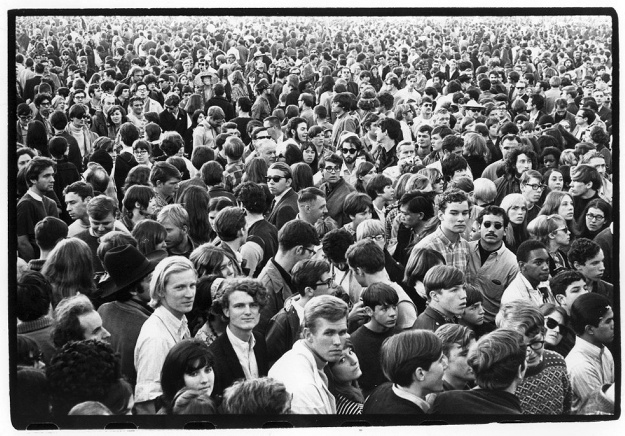
Hip crowd at the Fillmore Auditorium, early 1967. / Courtesy of Michael Ochs Archives via SFGate

There would be no story here if the Sixties had nothing to sell. Summer of Love style may have seemed strange to outsider straights, but its development is indicative of a cycle that continues to recur. Cultural fads originate among the poor, the young, the disenfranchised because necessity is the mother of invention. The beauty of youth is the gift of fresh perspective and the ability to experiment with minimized consequences. This combination manifests differently within individual people or groups, and is most evident in visual expressions such as art, fashion, and design. Each generation takes what has come before to forge the future, and underground trends see mainstream light because capitalism lives by folding the fringe into the middle. For example, the 1990s are back in fashion now because those frocks have been cheap and readily available in second-hand stores--discarded by our parents as they downsize into retirement, just as the latest millennials (who can’t vividly remember that decade) enter into young adulthood and seek to make their mark in a sluggish economy.

wnp28.0122.jpg
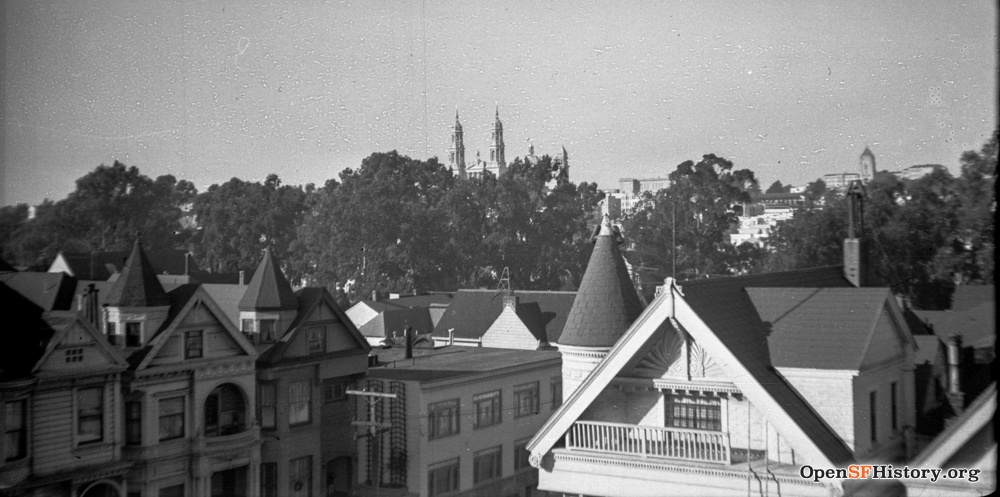
View from a rooftop at Page and Ashbury, c. 1940s. / Courtesy of a Private Collector, OpenSFHistory.org

The same was true for Haight Street hips in the Sixties. Haight-Ashbury became ground zero for 1960s counterculture; filled with Beats defecting from North Beach, the neighborhood was close to San Francisco State College and the University of San Francisco, and, most importantly, rents were cheap. Incoming residents were young, they were educated, and they lived together in huge Victorian homes outfitted with gas lamps and decorated with art nouveau furnishings purchased at secondhand stores--that generation’s version of 1990s discards. As the hip aesthetic became more defined and concerts increased in frequency, so did shops catering to the hippie lifestyle. Haight Street merchants sold sandals and incense to locals but also to waves passing through on their way to Golden Gate Park happenings--just as retailers target music festival-goers with flower crowns and diaphanous dresses today. As Charles Perry remembered, “life was aesthetic, life was stoned...life was an adventure,” and one Haight Street store was in the middle of it all: the Thelin brothers’ Psychedelic Shop.

The Psychedelic Shop on Haight Street, by Herb Greene.png
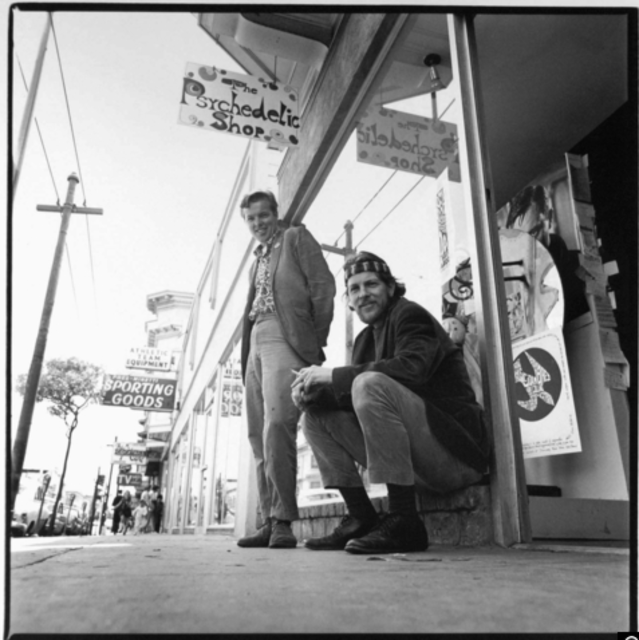
Jay and Ron Thelin outside The Psychedelic Shop, c. 1966. / Courtesy of Music Futurist.

Ron and Jay Thelin were California kids: born in Oakland, but raised in various cities throughout the Golden State. In 1964, Jay Thelin was introduced to LSD at a San Francisco State College lecture by Richard Alpert--the Harvard compatriot of Timothy Leary. Intrigued, he and brother Ron (an Eagle Scout and Korean War veteran) tried the mind-expanding drug together, and were inspired to open the Psychedelic Shop at 1535 Haight Street on January 3, 1966. While there were a few hip businesses operating in the Haight-Ashbury at the time, The Psyche Shop was one of the earliest and most influential in the neighborhood. It provided informational literature on popular drugs like LSD; books on eastern religion and metaphysics; and other paraphernalia necessary for a “good, enlightened, and safe trip” such as records, posters, madrases, incense, beaded necklaces, and pipes. While the Thelins’ store outfitted much of the counterculture community for a price, it also served as a safe space in a neighborhood experiencing growing pains. Customers placed flyers on the Shop’s bulletin board seeking/offering work and housing, advertising events or organized activities, and left notes to friends and lovers in an age before omnipresent digital access. People came to purchase, talk politics, and share their experiences. The brothers truly believed that psychedelic drugs were they key to peace and equality, but were adamant that people needed to be properly prepared and given a supportive environment to experience them with friends, listening to the right music, in a space with the right lighting, and so on. The Psychedelic Shop would be that place; it would be a well-known agent for social change.

opsyroc129p1.jpg
The Psychedelic Shop at 1535 Haight Street, 1966. / Photo by Ted Streshinksy, Courtesy of Kids Britannica

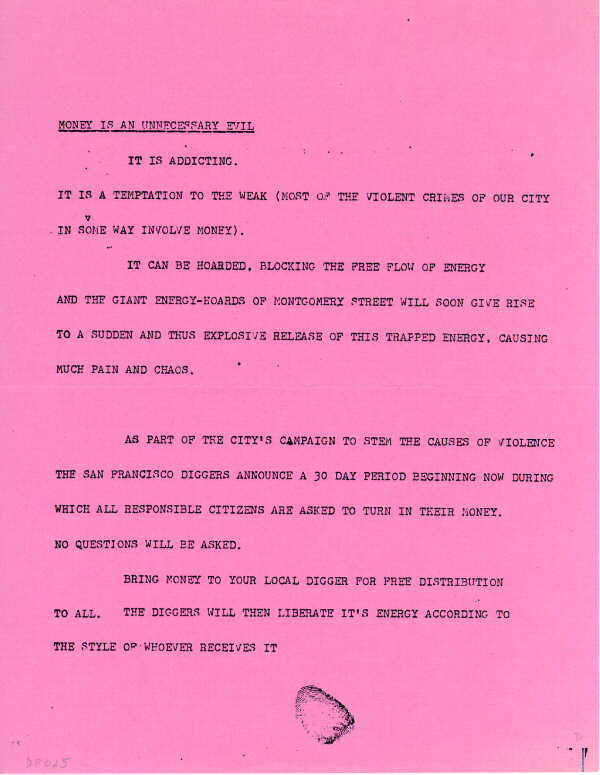
The desire for social change was a universal theme within 1960s counterculture, but each group approached its realization from different perspectives and with different methodologies. Merchants provided for the community by selling goods, but another group emerged from the San Francisco Mime Troupe that eschewed the exchange of money in favor of  revolution. Named after a 17th-century English sect of religious communists, The Diggers began with a core group of Mime Troupe defectors--Emmett Grogan, Peter Cohon and Peter Berg--who formed the socio-political revolutionary outreach group in 1966. They, along with “cagey Billy Murcott,” continued to support the Troupe, but believed its form of political satire was too stiff and didn’t capitalize on the “dramatic potential” of large crowds starting to congregate on Haight Street. They commandeered the Students for a Democratic Society mimeograph (left in the Mime Troupe loft) to disseminate their message of “radical personal freedom” through a series of broadsides that would combat the “Learyite” tone of the Oracle. These Digger Papers were authored under the fictitious name of George Metevsky, and addressed a growing dissatisfaction with the emptiness of psychedelic life through aggressive sarcasm and politicized intellectualism. As one broadside noted, dropouts still needed to return to society after a stoned walk in the woods--”to the silent-crowded uptight sidewalks with our pockets full of absurdity and compromise between cowardice and illusion.”
Digger_manifesto--money_is_an_unnecessary_evil_Dp025_m.jpg
Courtesy of the Digger Archive via FoundSF

The marketplace for social change took many forms. One Digger broadside admitted that even hips strove for success, “the supreme success of combining the pleasures of liberation from middle-class inhibitions with the reassurance of a close community.” This was also a belief held by the Haight Street merchants, however, The Diggers felt that successful commercial enterprises were part of a soul-killing “middle-class humanism” and they countered this through an Ideology of Failure. One week after the Love Pageant Rally in the Panhandle of Golden Gate Park, The Diggers staged their first public act as agents for a moneyless, communal economy: they handed out free food in the park...not because it was charity, but “because it was yours.” They did this daily, acquiring food from local grocer donations or through old-fashioned pilfering, and recipients (about 55 on weekdays, and up to 200 on weekends) walked through a thirteen-foot yellow window called the Frame of Reference. Giving Haight Street hopefuls their daily bread through these Digger Feeds reframed the group’s public presence, transforming them from anonymous intellectual subversives into charitable providers.   

Food-distribution-outside-of-home_00080004_Chuck-Gould.jpg
Digger Feed, c. 1966. / Photo © Chuck Gould, Courtesy of FoundSF

Meanwhile, they continued to challenge Haight Street merchants in their broadsides, and began orchestrating large theatrical events. Fifty years ago today they staged the Full Moon Public Celebration on Halloween at the intersection of Haight and Ashbury Streets. At 5:30 p.m. they installed the Frame of Reference on a street corner, and distributed about 75 smaller frames with attached neck straps so participants could look at the happening through their own frames of reference. The oversized Frame was complemented by 8-foot-tall puppets controlled by Diggers--possibly resembling local Congressmen--that performed an ad lib play called “Any Fool on the Street.” Then, spectators were asked to play the Intersection Game to claim ownership of the streets--clogging Haight Street with participants from a crowd of approximately 600 whom crisscrossed the street in polygon patterns. Curious commuters disembarked from buses and abandoned their cars in the street to join the fun. Not surprisingly, the police responded to the congestion--five squad cars and a paddy wagon.  Comically, one cop began addressing the puppets directly, and the Berkeley Barb recalled the scene a few days later:

Cop: "We warn you that if you don't remove yourselves from the area you'll be arrested for blocking a public thoroughfare."

Puppet: "Who is the public?"

Cop: "I couldn't care less; I'll take you in. Now get a move on."

Puppet: "I declare myself public -- I am a public. The streets are public. The streets are free."

The puppets then walked on, whereupon the cops grabbed them and the puppeteers under them and arrested them. They threw the puppets and five of the Diggers in the paddy waggon. One Digger reported that there were two signs in the wagon saying, "VOTE FOR REAGAN!"

About 200 people outside the wagon started booing, then chanted, "FRAME -- UP, FRAME -- UP!" The Diggers inside responded with "PUB -- LIC, PUB -- LIC!" Some of the chanters on the outside looked through their frame mandalas and switched to "CHECK YOUR FRAMES OF REFERENCE!"

But the Celebration continued as the Intersection Game resumed, and people danced in the street while a phonograph played on. The arrested Diggers sang an Italian Communist rallying song “Avanti Populi” and called for revolution from their cells before they were released under their own cognisance; all charges were eventually dropped on November 29th. Now well on their way to becoming a recognizable psychedelic political movement, The Diggers renovated a garage on Page Street and opened the 24-hour Free Frame of Reference where people could get necessities at all hours beginning November 4, 1966. The group’s notoriety was spreading: a week later, the Diggers received their first mainstream media mention in Ralph Gleason’s San Francisco Chronicle column about the “New Youth,” and were featured on the front page before the month was over; spin-off groups emerged across the Bay; and they hosted their first Thanksgiving “Mealfeast” from their Page Street outpost.

Socially conscious groups like the Diggers and hip merchants were not well-received by the Haight-Ashbury Merchants Association, which disliked their loitering clientele and socialist sympathies; consequently, the psychedelic merchants began their own organization--the Haight Independent Proprietors (HIP). One of their first formative acts as an organization was to improve relations between the counterculture community and police officers at Park Station near the Haight. The Diggers responded with criticism in their broadside, claiming that HIP was trying to bribe the police. In reality, merchants were attempting to arbitrate escalating tensions between beat cops and the Haight-Ashbury community. The merchants even approached the Chief of Police with a mantra (“ikimasho ikimasho ikimasho go go”) and hand gesture devised by Allen Ginsberg for beat cops to help peacefully disperse counterculture congregants.

SF0138.jpgLitersf1$love-book-press-conference.jpg
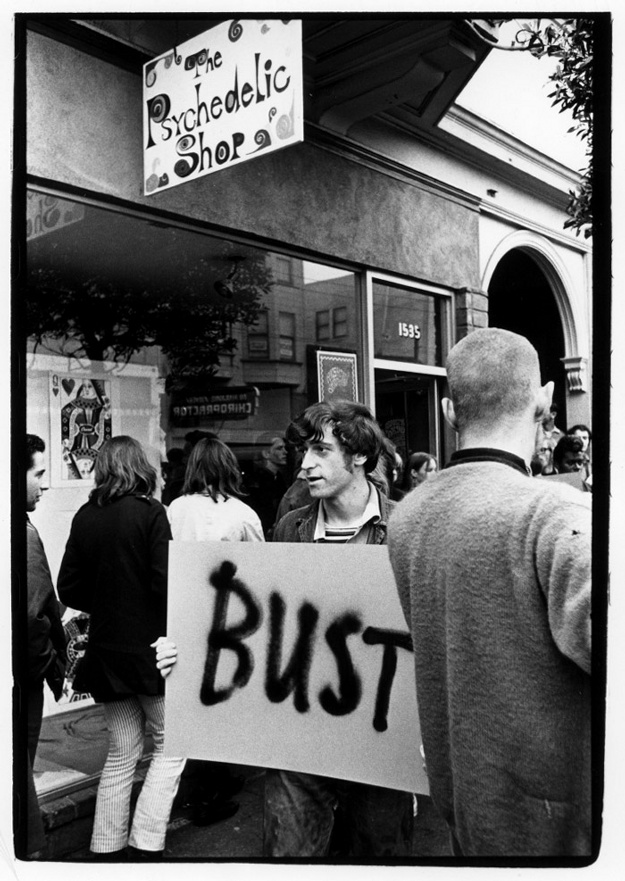
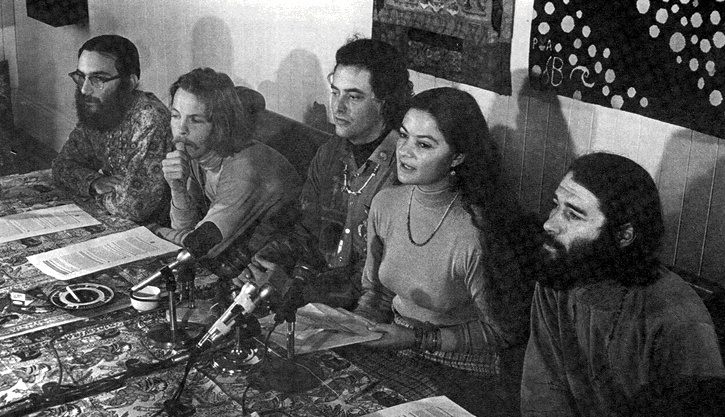
LEFT: Protesters outside The Psychedelic Shop after Allen Cohen is arrested for selling The Love Book, November 1966. / Photo by William Gedney, Courtesy of Duke University. RIGHT: Allen Cohen and Ron Thelin to the far left as Lenore Kandel addresses a press conference, 1967. / Courtesy of the San Francisco Chronicle via FoundSF

Ron Thelin agreed with The Diggers that modern capitalism was destructive despite his status as a successful Haight Street merchant,. “The economy, the tyranny of money, the fight for material things has become the American dream--and the dream of the Declaration of Independence is completely washed up in an advertising gimmick.” Views such as this did not increase his popularity with the mainstream. On November 15, 1966, the Psych Shop was raided and Allen Cohen (Ron’s partner in the San Francisco Oracle) was arrested as the clerk on duty for selling an obscene book: The Love Book by Lenore Kandel. The subsequent trial that brought charges against Cohen, Thelin and a clerk at City Lights Bookstore in April of 1967 was the City’s longest criminal trial in San Francisco up to that time.* Ron Thelin grew increasingly disenchanted with the trappings of running a profitable business, and more committed to impacting the safety of the neighborhood--which was quickly degenerating with the influx of weekend hippies and harder drugs. After an upstairs fire destroyed much of their merchandise, the Thelins created a meditation space in the store called the Calm Center, which frequently hosted members of the nearby Hare Krishna temple. To their chagrin, many people used the Center as a place to sleep, smoke marijuana and sell drugs.

25b_l.jpg
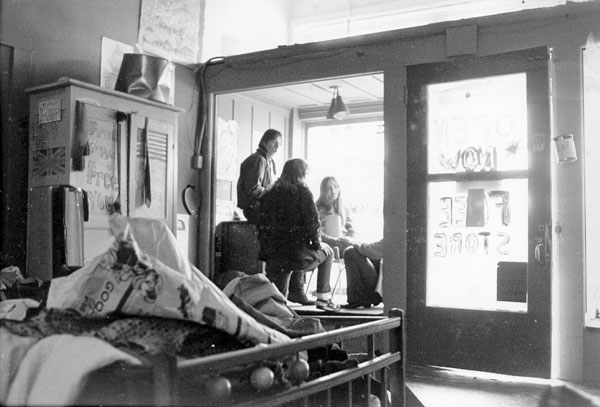
The Diggers Free Store at 520 Frederick Street, c. 1967. / Courtesy of The Digger Archives

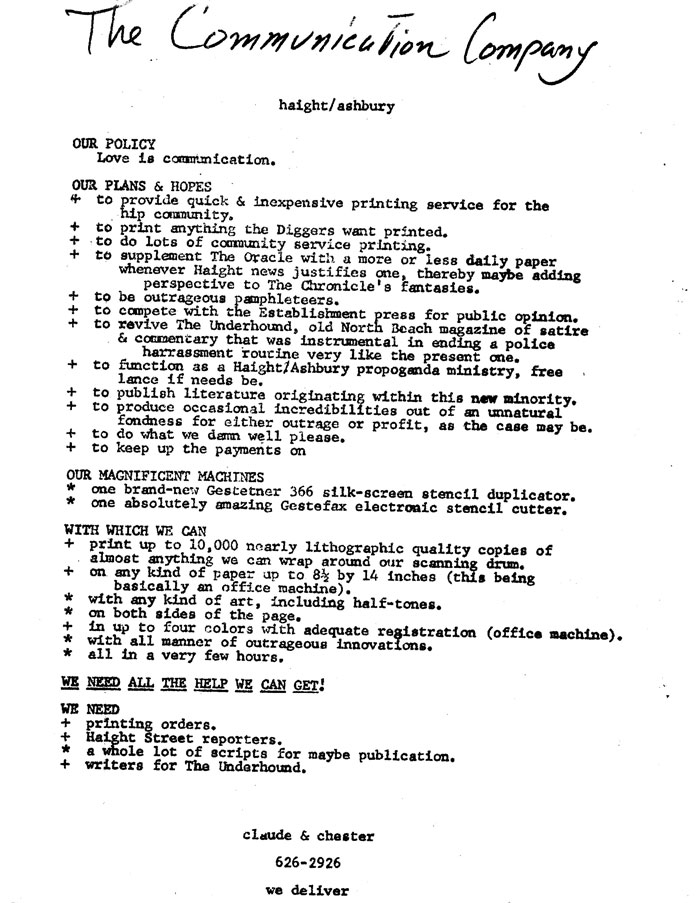
Meanwhile, The Diggers staged the Death of Money and Rebirth of the Haight Parade, reaching residents beyond the Haight and solidifying a relationship with the Hells Angels (a partnership we’ll explore further in a post commemorating this event’s 50th anniversary on December 17th). That same month, the Free Frame of Reference on Page Street was cited for health code violations and shut down; The Diggers tore the place apart, and officials dismantled the Frame of Reference to shore up what was left. They rented a new place at 520 Frederick that was inconveniently close to Park Station, resulting in a high frequency of police visits to their new digs. They persevered through persistent harassment to provide social services for the Haight community that grew exponentially in size as 1967 marched onward. The Diggers housed homeless youth, hosted clothing drives, and offered street survival classes. Through it all they found kindred support from Beat poets whom appreciated the group’s intellectualism. One Beat Generation connection, Chester Anderson, worked closely with The Diggers through The Communication Company--a radical press that functioned as an information ministry for the anarchic group. The first Com/co announcement heralded that love was communication, and that it would print anything the Diggers wished as a supplement to The San Francisco Oracle and The San Francisco Chronicle.

cc001_opt_m-1.jpg
Courtesy of The Digger Archives

The Diggers, so immersed in supporting the underground, were among the first to note the beginning of the end to good times. Things started to change in 1967 as publicity surrounding the forthcoming Summer of Love drew more attention to the Haight from around the nation. The Diggers, integral members of the Council on the Summer of Love, warned of the dangers of an oncoming hippie-hopeful invasion as they saw plans progressing. Haight Street businesses that emerged in The Psychedelic Shop’s likeness were more than mere consumer spaces, they also functioned as churches and community centers, as places of refuge in an otherwise straight world. However, the massive influx of hippie hopefuls would strain many of these establishments’ resources. In the spring of 1967, The Diggers convinced Lou Gottlieb of Morningstar Commune to devote 35-acres of farmland to growing Digger food in anticipation of soon feeding more mouths. Morningstar became known as the Digger Farm and access was denied to no one. A free bus ran every Thursday from the Digger Free Store on Frederick to the Farm, but the demand became too much and members of the community were asked to forego multiple trips. The Summer of Love would change the world, but it would also change the Haight forever.

SF0033-1.jpg
Photo by William Gedney, Courtesy of Duke University

Concurrently, fewer customers were coming into The Psych Shop to actually buy merchandise so the Thelins reduced their open hours. Plans to convert the store into a non-profit co-op and sell shares to “people on the street for practically nothing” were announced in the Berkeley Barb in May, but the brothers were stymied by a $6,000 debt that needed to be paid before incorporation. In September, Emmett Grogan escorted Michigan Governor George Romney and his wife through the Panhandle to “meet” hippies; the writing was on the wall. On October 6, 1967, a group of 80 people--including much of the Psyche Shop’s staff--participated in a three-day commemoration for the “death of a hippie”--but you’ll have to check in with us next year if you want to hear more about that. At the end of the procession, Ron Thelin announced the permanent closure of the Psychedelic Shop, and gave away the store’s entire inventory in the spirit of Henry Thoreau...unbeknownst to his brother. As Ron said at the time: “The mass media made us into hippies. We wanted to be free men and build a free community, but the word hippie turned everyone off...the hippies are dead now.” According to Ron, police pressure and press hysteria turned the Haight into a confining zoo--a spectacle in which counterculture residents were looked at like captive animals.

1024x1024.jpg 1024x1024.jpg
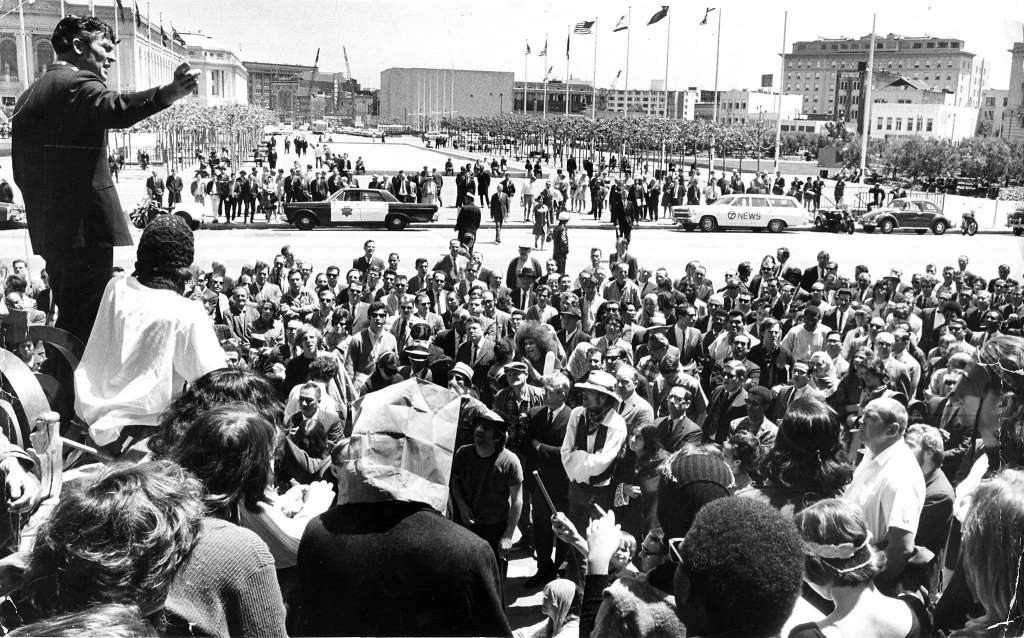
LEFT: Crowds at City Hall are addressed by Attorney Terence Hallinan during The Diggers’ Mask-In, April 5, 1968. / Photo by Jose Rosenthal, Courtesy of The San Francisco Chronicle. RIGHT: Hallinan with Ron Thelin before his trial for reading poetry while masked, May 23, 1968. / Photo by Duke Downey, Courtesy of The San Francisco Chronicle

The Diggers remained active after the summer that brought the world to San Francisco, but in different capacities and no longer beholden to the Haight. Ron Thelin, a merchant frequently excoriated in the Digger Papers, became an active Digger in 1968--epitomizing the fluidity of counterculture community divisions. Less than a year after closing the Shop, Ron participated in a Digger press conference to publicize the group’s attempt to work with the mayor in making a “better city.” They spent a month reading poetry and distributing food while wearing masks on the Polk Street steps of City Hall before participants of this so-called “Mask-In” were arrested (including Ron) on a variety of charges, from defaming the flag (which was worn as a shirt) to wearing a mask in public. When Ron passed away in 1996, The Digger Archives posted a heartfelt memorial that chronicled his life and funeral. In the end, the merchants and the Diggers weren’t really so different, they just stood on opposite sides of the line for a brief period of time.

1-percent-free-blue.gif
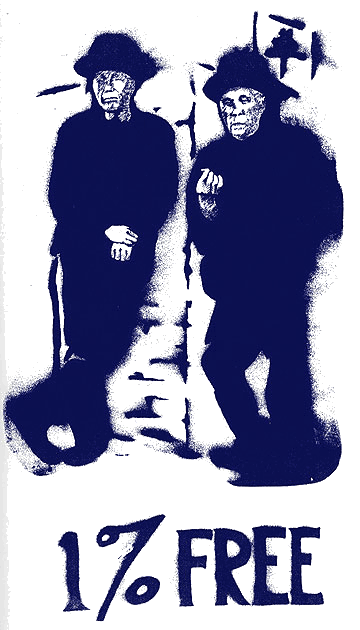
Courtesy of The Digger Archives via FoundSF

If you think that hippie mercantilism and the Diggers’ communal ethos is something left in the 1960s, then you couldn’t be more wrong. The most obvious purveyor of both is Craigslist--a marketplace for the unmediated exchange of goods and services, connecting needs with wants for something or nothing since it was created in San Francisco’s Sunset District in 1995. Digger phrases like “Do your thing” and “Today is the first day of the rest of your life” are now commonplace, and millennials practice these sentiments in almost everything they do. Don’t like mainstream hotel/motel chains? Use a company that enables you to pay for the use of a spare residential bedroom. Want to provide checks and balances to the mainstream media, and meet like-minded revolutionaries? Read a tweet, send a tweet. This decade we’ve seen Occupy Wall Street raise national awareness to the dangers of corporate greed, and the 99% were awakened to the inherent inequity of stockpiling most of the country’s wealth within 1% of its population. All of these things are the direct descendants of the marketplaces created by the Haight Independent Proprietors and The Diggers, in one form or another. So as you do your thing on Halloween this 2016, remember the people who built the future in 1966 and make a mental note of gratitude.

*The defendants were eventually found guilty, although the verdict was reversed in 1971.

By Nicole Meldahl

Sources not hyperlinked in text:
  1. “At Death’s Door” in the Warren-Times Mirror and Observer (Warren, Pennsylvania), 6 October 1967
  2. “Psyche Shop Co-Op After the Books,” in the Berkeley Barb, May 5-11, 1967
  3. “Obituary--Ron Thelin” by Michael Taylor, SFGate, March 22, 1996
  4. “From Eternity to Here” by Charles Perry, Rolling Stone Magazine, February 26, 1976