San Francisco has always been a boomtown, and California has always called to people from far-flung parts of the country. The massive migration to California during the Summer of Love in 1967 was much like the 1849 Gold Rush: everyone came here looking to enrich themselves. Young hippies who came to San Francisco with flowers in their hair were as diverse as the 49ers, all with their own needs and desires, each harboring different hopes.
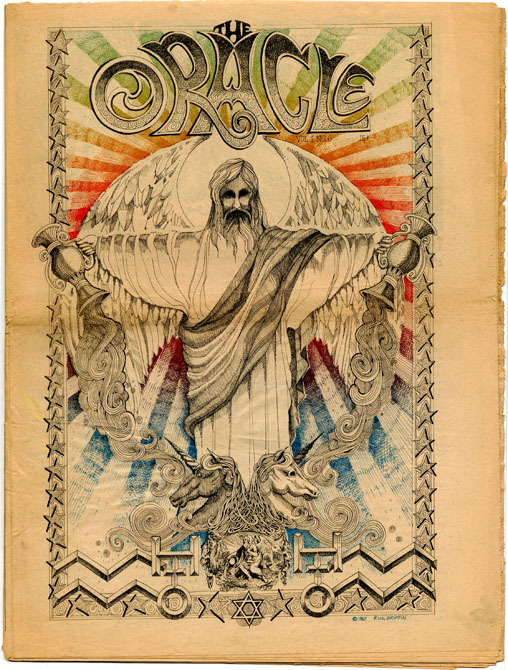
As we enter into the final months of 2016, we look forward to the forthcoming 50th anniversary of the Human Be-In held in Golden Gate Park on January 14, 1967. Organized by Allen Cohen and Michael Bowen of The San Francisco Oracle, it was advertised as a “gathering of the tribes”-- appropriating Native American symbolism to signify the happening as one of loving union. Contrary to popular belief, the hippie movement was not uniform even if it was cohesive, so we thought it wise to explain how the different factions of 1960s counterculture differed and how they overlapped as we work our way into the new year.
This post is the first in a series attempting to explain Sixties stakeholders--beginning with the Haight Independent Merchants and The Diggers.
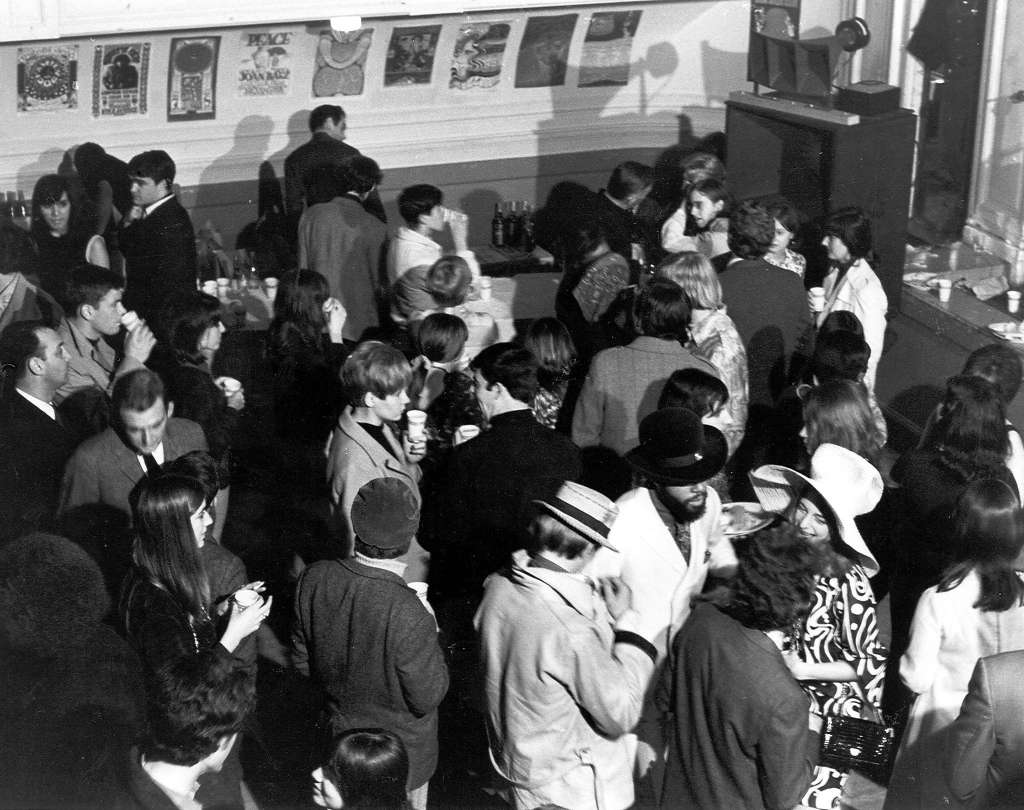
Hip crowd at the Fillmore Auditorium, early 1967. / Courtesy of Michael Ochs Archives via SFGate
There would be no story here if the Sixties had nothing to sell. Summer of Love style may have seemed strange to outsider straights, but its development is indicative of a cycle that continues to recur. Cultural fads originate among the poor, the young, the disenfranchised because necessity is the mother of invention. The beauty of youth is the gift of fresh perspective and the ability to experiment with minimized consequences. This combination manifests differently within individual people or groups, and is most evident in visual expressions such as art, fashion, and design. Each generation takes what has come before to forge the future, and underground trends see mainstream light because capitalism lives by folding the fringe into the middle. For example, the 1990s are back in fashion now because those frocks have been cheap and readily available in second-hand stores--discarded by our parents as they downsize into retirement, just as the latest millennials (who can’t vividly remember that decade) enter into young adulthood and seek to make their mark in a sluggish economy.
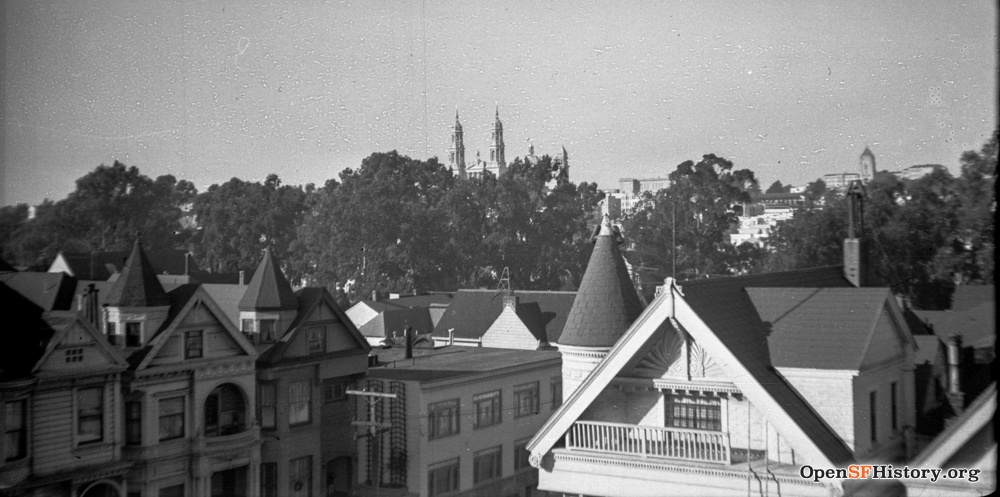
View from a rooftop at Page and Ashbury, c. 1940s. / Courtesy of a Private Collector, OpenSFHistory.org
The same was true for Haight Street hips in the Sixties. Haight-Ashbury became ground zero for 1960s counterculture; filled with Beats defecting from North Beach, the neighborhood was close to San Francisco State College and the University of San Francisco, and, most importantly, rents were cheap. Incoming residents were young, they were educated, and they lived together in huge Victorian homes outfitted with gas lamps and decorated with art nouveau furnishings purchased at secondhand stores--that generation’s version of 1990s discards. As the hip aesthetic became more defined and concerts increased in frequency, so did shops catering to the hippie lifestyle. Haight Street merchants sold sandals and incense to locals but also to waves passing through on their way to Golden Gate Park happenings--just as retailers target music festival-goers with flower crowns and diaphanous dresses today. As Charles Perry remembered, “life was aesthetic, life was stoned...life was an adventure,” and one Haight Street store was in the middle of it all: the Thelin brothers’ Psychedelic Shop.
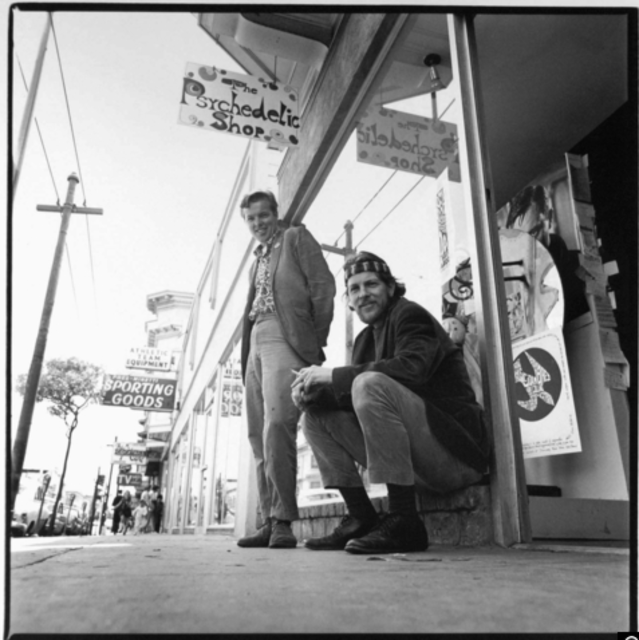
Jay and Ron Thelin outside The Psychedelic Shop, c. 1966. / Courtesy of Music Futurist.
Ron and Jay Thelin were California kids: born in Oakland, but raised in various cities throughout the Golden State. In 1964, Jay Thelin was introduced to LSD at a San Francisco State College lecture by Richard Alpert--the Harvard compatriot of Timothy Leary. Intrigued, he and brother Ron (an Eagle Scout and Korean War veteran) tried the mind-expanding drug together, and were inspired to open the Psychedelic Shop at 1535 Haight Street on January 3, 1966. While there were a few hip businesses operating in the Haight-Ashbury at the time, The Psyche Shop was one of the earliest and most influential in the neighborhood. It provided informational literature on popular drugs like LSD; books on eastern religion and metaphysics; and other paraphernalia necessary for a “good, enlightened, and safe trip” such as records, posters, madrases, incense, beaded necklaces, and pipes. While the Thelins’ store outfitted much of the counterculture community for a price, it also served as a safe space in a neighborhood experiencing growing pains. Customers placed flyers on the Shop’s bulletin board seeking/offering work and housing, advertising events or organized activities, and left notes to friends and lovers in an age before omnipresent digital access. People came to purchase, talk politics, and share their experiences. The brothers truly believed that psychedelic drugs were they key to peace and equality, but were adamant that people needed to be properly prepared and given a supportive environment to experience them with friends, listening to the right music, in a space with the right lighting, and so on. The Psychedelic Shop would be that place; it would be a well-known agent for social change.

The Psychedelic Shop at 1535 Haight Street, 1966. / Photo by Ted Streshinksy, Courtesy of Kids Britannica
The desire for social change was a universal theme within 1960s counterculture, but each group approached its realization from different perspectives and with different methodologies. Merchants provided for the community by selling goods, but another group emerged from the San Francisco Mime Troupe that eschewed the exchange of money in favor of revolution. Named after a 17th-century English sect of religious communists, The Diggers began with a core group of Mime Troupe defectors--Emmett Grogan, Peter Cohon and Peter Berg--who formed the socio-political revolutionary outreach group in 1966. They, along with “cagey Billy Murcott,” continued to support the Troupe, but believed its form of political satire was too stiff and didn’t capitalize on the “dramatic potential” of large crowds starting to congregate on Haight Street. They commandeered the Students for a Democratic Society mimeograph (left in the Mime Troupe loft) to disseminate their message of “radical personal freedom” through a series of broadsides that would combat the “Learyite” tone of the Oracle. These Digger Papers were authored under the fictitious name of George Metevsky, and addressed a growing dissatisfaction with the emptiness of psychedelic life through aggressive sarcasm and politicized intellectualism. As one broadside noted, dropouts still needed to return to society after a stoned walk in the woods--”to the silent-crowded uptight sidewalks with our pockets full of absurdity and compromise between cowardice and illusion.”
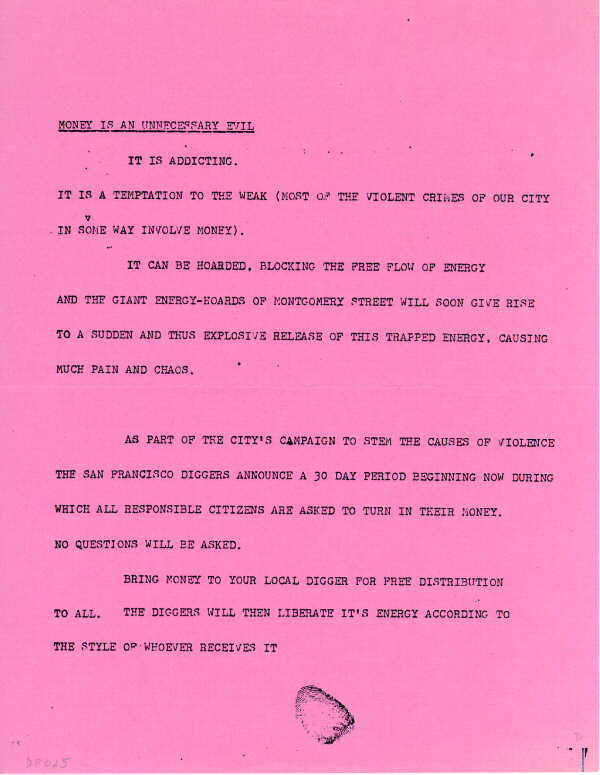
Courtesy of the Digger Archive via FoundSF
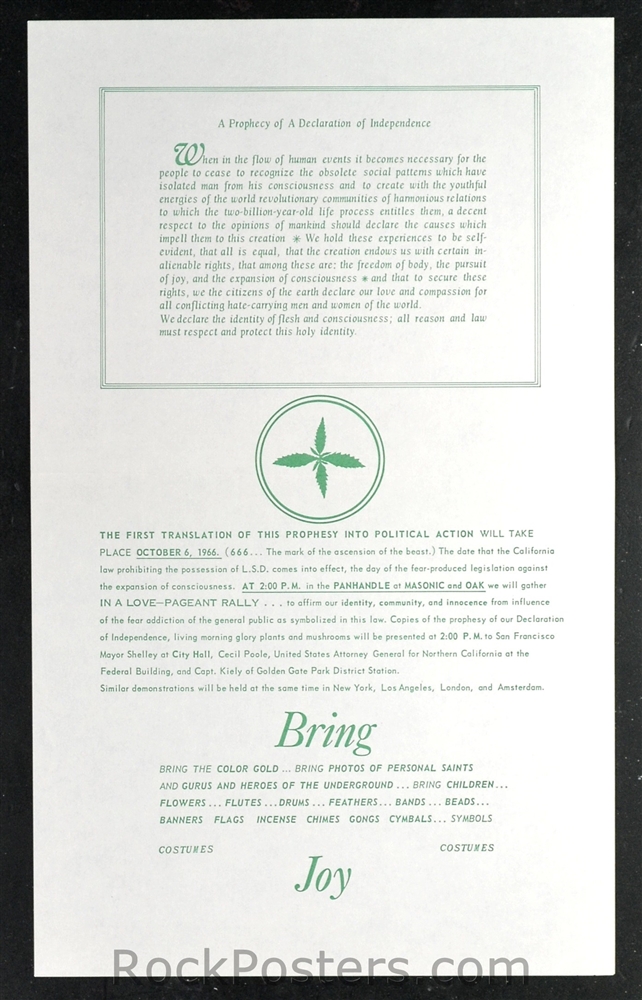
The marketplace for social change took many forms. One Digger broadside admitted that even hips strove for success, “the supreme success of combining the pleasures of liberation from middle-class inhibitions with the reassurance of a close community.” This was also a belief held by the Haight Street merchants, however, The Diggers felt that successful commercial enterprises were part of a soul-killing “middle-class humanism” and they countered this through an Ideology of Failure. One week after the Love Pageant Rally in the Panhandle of Golden Gate Park, The Diggers staged their first public act as agents for a moneyless, communal economy: they handed out free food in the park...not because it was charity, but “because it was yours.” They did this daily, acquiring food from local grocer donations or through old-fashioned pilfering, and recipients (about 55 on weekdays, and up to 200 on weekends) walked through a thirteen-foot yellow window called the Frame of Reference. Giving Haight Street hopefuls their daily bread through these Digger Feeds reframed the group’s public presence, transforming them from anonymous intellectual subversives into charitable providers.

Digger Feed, c. 1966. / Photo © Chuck Gould, Courtesy of FoundSF
Meanwhile, they continued to challenge Haight Street merchants in their broadsides, and began orchestrating large theatrical events. Fifty years ago today they staged the Full Moon Public Celebration on Halloween at the intersection of Haight and Ashbury Streets. At 5:30 p.m. they installed the Frame of Reference on a street corner, and distributed about 75 smaller frames with attached neck straps so participants could look at the happening through their own frames of reference. The oversized Frame was complemented by 8-foot-tall puppets controlled by Diggers--possibly resembling local Congressmen--that performed an ad lib play called “Any Fool on the Street.” Then, spectators were asked to play the Intersection Game to claim ownership of the streets--clogging Haight Street with participants from a crowd of approximately 600 whom crisscrossed the street in polygon patterns. Curious commuters disembarked from buses and abandoned their cars in the street to join the fun. Not surprisingly, the police responded to the congestion--five squad cars and a paddy wagon. Comically, one cop began addressing the puppets directly, and the Berkeley Barb recalled the scene a few days later:
Cop: "We warn you that if you don't remove yourselves from the area you'll be arrested for blocking a public thoroughfare."
Puppet: "Who is the public?"
Cop: "I couldn't care less; I'll take you in. Now get a move on."
Puppet: "I declare myself public -- I am a public. The streets are public. The streets are free."
The puppets then walked on, whereupon the cops grabbed them and the puppeteers under them and arrested them. They threw the puppets and five of the Diggers in the paddy waggon. One Digger reported that there were two signs in the wagon saying, "VOTE FOR REAGAN!"
About 200 people outside the wagon started booing, then chanted, "FRAME -- UP, FRAME -- UP!" The Diggers inside responded with "PUB -- LIC, PUB -- LIC!" Some of the chanters on the outside looked through their frame mandalas and switched to "CHECK YOUR FRAMES OF REFERENCE!"
But the Celebration continued as the Intersection Game resumed, and people danced in the street while a phonograph played on. The arrested Diggers sang an Italian Communist rallying song “Avanti Populi” and called for revolution from their cells before they were released under their own cognisance; all charges were eventually dropped on November 29th. Now well on their way to becoming a recognizable psychedelic political movement, The Diggers renovated a garage on Page Street and opened the 24-hour Free Frame of Reference where people could get necessities at all hours beginning November 4, 1966. The group’s notoriety was spreading: a week later, the Diggers received their first mainstream media mention in Ralph Gleason’s San Francisco Chronicle column about the “New Youth,” and were featured on the front page before the month was over; spin-off groups emerged across the Bay; and they hosted their first Thanksgiving “Mealfeast” from their Page Street outpost.
Socially conscious groups like the Diggers and hip merchants were not well-received by the Haight-Ashbury Merchants Association, which disliked their loitering clientele and socialist sympathies; consequently, the psychedelic merchants began their own organization--the Haight Independent Proprietors (HIP). One of their first formative acts as an organization was to improve relations between the counterculture community and police officers at Park Station near the Haight. The Diggers responded with criticism in their broadside, claiming that HIP was trying to bribe the police. In reality, merchants were attempting to arbitrate escalating tensions between beat cops and the Haight-Ashbury community. The merchants even approached the Chief of Police with a mantra (“ikimasho ikimasho ikimasho go go”) and hand gesture devised by Allen Ginsberg for beat cops to help peacefully disperse counterculture congregants.
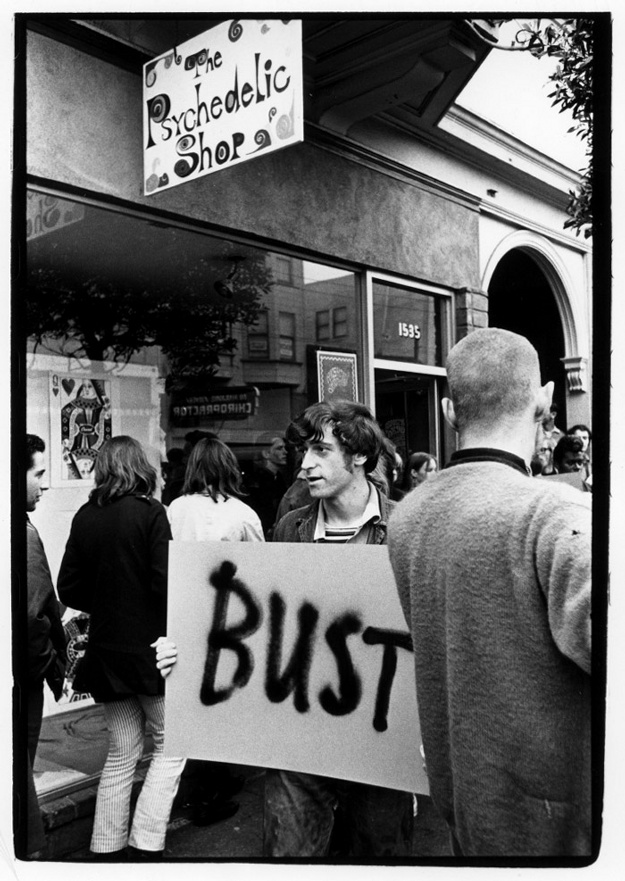
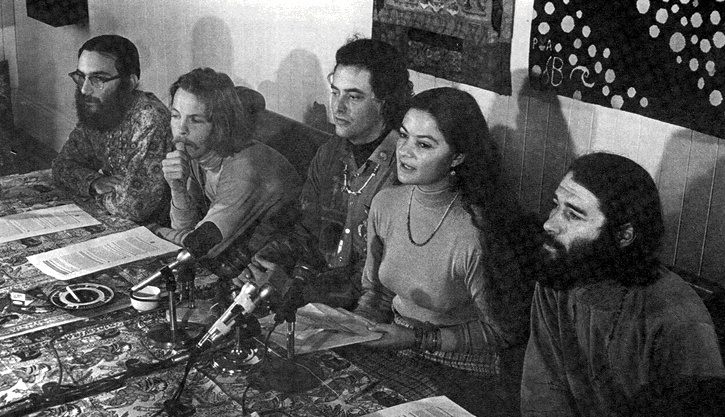
LEFT: Protesters outside The Psychedelic Shop after Allen Cohen is arrested for selling The Love Book, November 1966. / Photo by William Gedney, Courtesy of Duke University. RIGHT: Allen Cohen and Ron Thelin to the far left as Lenore Kandel addresses a press conference, 1967. / Courtesy of the San Francisco Chronicle via FoundSF
Ron Thelin agreed with The Diggers that modern capitalism was destructive despite his status as a successful Haight Street merchant,. “The economy, the tyranny of money, the fight for material things has become the American dream--and the dream of the Declaration of Independence is completely washed up in an advertising gimmick.” Views such as this did not increase his popularity with the mainstream. On November 15, 1966, the Psych Shop was raided and Allen Cohen (Ron’s partner in the San Francisco Oracle) was arrested as the clerk on duty for selling an obscene book: The Love Book by Lenore Kandel. The subsequent trial that brought charges against Cohen, Thelin and a clerk at City Lights Bookstore in April of 1967 was the City’s longest criminal trial in San Francisco up to that time.* Ron Thelin grew increasingly disenchanted with the trappings of running a profitable business, and more committed to impacting the safety of the neighborhood--which was quickly degenerating with the influx of weekend hippies and harder drugs. After an upstairs fire destroyed much of their merchandise, the Thelins created a meditation space in the store called the Calm Center, which frequently hosted members of the nearby Hare Krishna temple. To their chagrin, many people used the Center as a place to sleep, smoke marijuana and sell drugs.
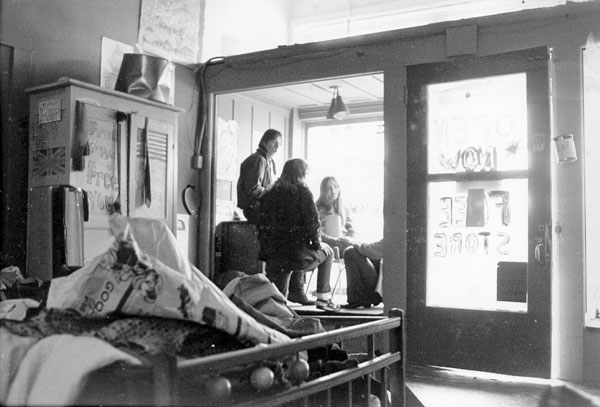
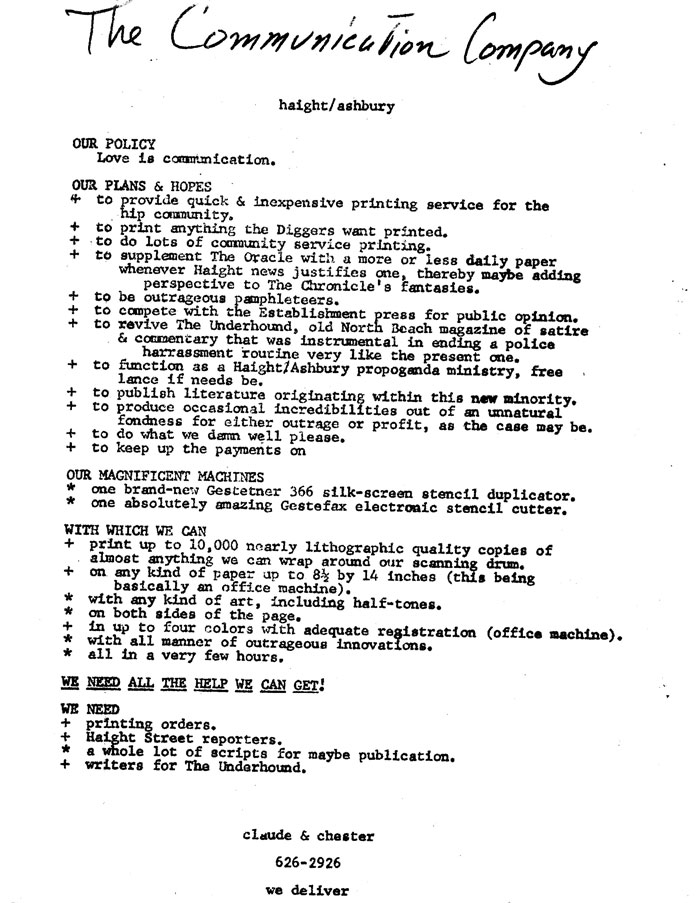
Meanwhile, The Diggers staged the Death of Money and Rebirth of the Haight Parade, reaching residents beyond the Haight and solidifying a relationship with the Hells Angels (a partnership we’ll explore further in a post commemorating this event’s 50th anniversary on December 17th). That same month, the Free Frame of Reference on Page Street was cited for health code violations and shut down; The Diggers tore the place apart, and officials dismantled the Frame of Reference to shore up what was left. They rented a new place at 520 Frederick that was inconveniently close to Park Station, resulting in a high frequency of police visits to their new digs. They persevered through persistent harassment to provide social services for the Haight community that grew exponentially in size as 1967 marched onward. The Diggers housed homeless youth, hosted clothing drives, and offered street survival classes. Through it all they found kindred support from Beat poets whom appreciated the group’s intellectualism. One Beat Generation connection, Chester Anderson, worked closely with The Diggers through The Communication Company--a radical press that functioned as an information ministry for the anarchic group. The first Com/co announcement heralded that love was communication, and that it would print anything the Diggers wished as a supplement to The San Francisco Oracle and The San Francisco Chronicle.
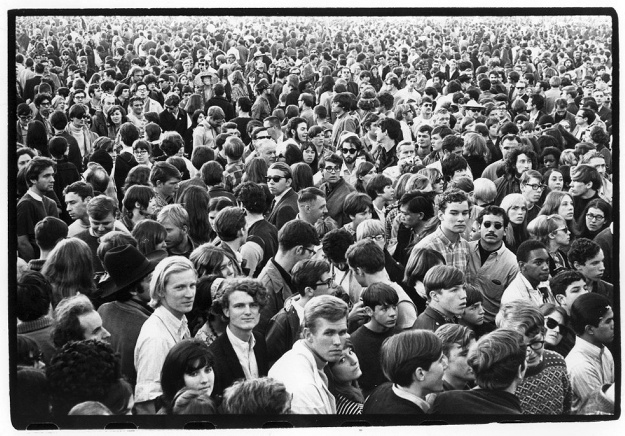
The Diggers, so immersed in supporting the underground, were among the first to note the beginning of the end to good times. Things started to change in 1967 as publicity surrounding the forthcoming Summer of Love drew more attention to the Haight from around the nation. The Diggers, integral members of the Council on the Summer of Love, warned of the dangers of an oncoming hippie-hopeful invasion as they saw plans progressing. Haight Street businesses that emerged in The Psychedelic Shop’s likeness were more than mere consumer spaces, they also functioned as churches and community centers, as places of refuge in an otherwise straight world. However, the massive influx of hippie hopefuls would strain many of these establishments’ resources. In the spring of 1967, The Diggers convinced Lou Gottlieb of Morningstar Commune to devote 35-acres of farmland to growing Digger food in anticipation of soon feeding more mouths. Morningstar became known as the Digger Farm and access was denied to no one. A free bus ran every Thursday from the Digger Free Store on Frederick to the Farm, but the demand became too much and members of the community were asked to forego multiple trips. The Summer of Love would change the world, but it would also change the Haight forever.
Concurrently, fewer customers were coming into The Psych Shop to actually buy merchandise so the Thelins reduced their open hours. Plans to convert the store into a non-profit co-op and sell shares to “people on the street for practically nothing” were announced in the Berkeley Barb in May, but the brothers were stymied by a $6,000 debt that needed to be paid before incorporation. In September, Emmett Grogan escorted Michigan Governor George Romney and his wife through the Panhandle to “meet” hippies; the writing was on the wall. On October 6, 1967, a group of 80 people--including much of the Psyche Shop’s staff--participated in a three-day commemoration for the “death of a hippie”--but you’ll have to check in with us next year if you want to hear more about that. At the end of the procession, Ron Thelin announced the permanent closure of the Psychedelic Shop, and gave away the store’s entire inventory in the spirit of Henry Thoreau...unbeknownst to his brother. As Ron said at the time: “The mass media made us into hippies. We wanted to be free men and build a free community, but the word hippie turned everyone off...the hippies are dead now.” According to Ron, police pressure and press hysteria turned the Haight into a confining zoo--a spectacle in which counterculture residents were looked at like captive animals.
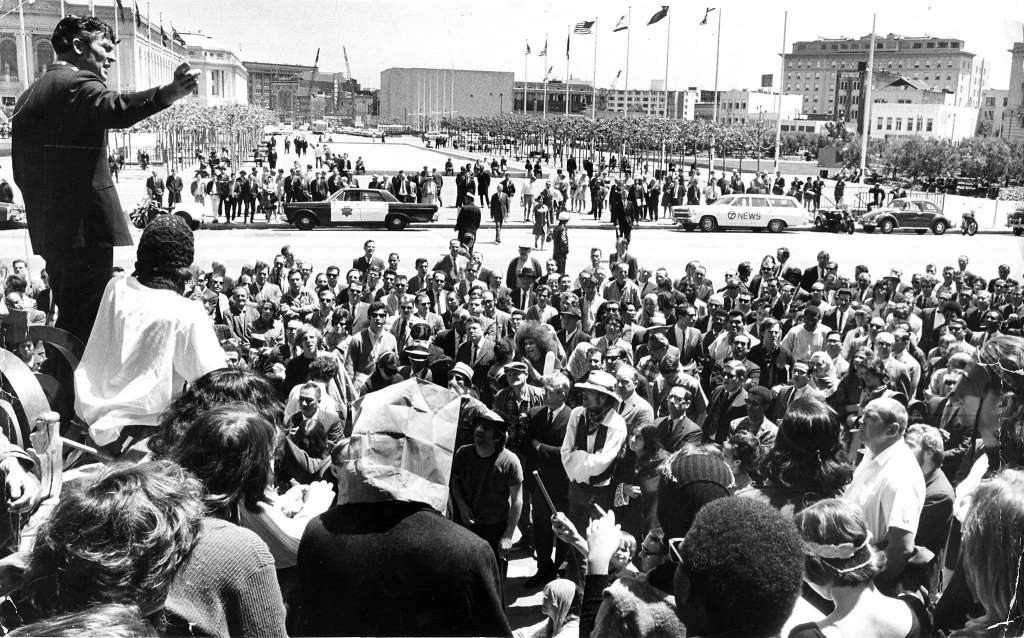

LEFT: Crowds at City Hall are addressed by Attorney Terence Hallinan during The Diggers’ Mask-In, April 5, 1968. / Photo by Jose Rosenthal, Courtesy of The San Francisco Chronicle. RIGHT: Hallinan with Ron Thelin before his trial for reading poetry while masked, May 23, 1968. / Photo by Duke Downey, Courtesy of The San Francisco Chronicle
The Diggers remained active after the summer that brought the world to San Francisco, but in different capacities and no longer beholden to the Haight. Ron Thelin, a merchant frequently excoriated in the Digger Papers, became an active Digger in 1968--epitomizing the fluidity of counterculture community divisions. Less than a year after closing the Shop, Ron participated in a Digger press conference to publicize the group’s attempt to work with the mayor in making a “better city.” They spent a month reading poetry and distributing food while wearing masks on the Polk Street steps of City Hall before participants of this so-called “Mask-In” were arrested (including Ron) on a variety of charges, from defaming the flag (which was worn as a shirt) to wearing a mask in public. When Ron passed away in 1996, The Digger Archives posted a heartfelt memorial that chronicled his life and funeral. In the end, the merchants and the Diggers weren’t really so different, they just stood on opposite sides of the line for a brief period of time.
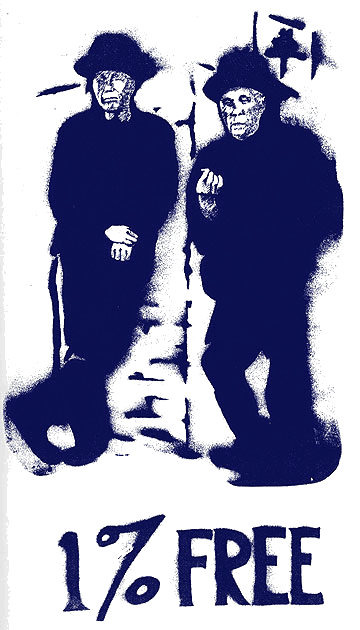
Courtesy of The Digger Archives via FoundSF
If you think that hippie mercantilism and the Diggers’ communal ethos is something left in the 1960s, then you couldn’t be more wrong. The most obvious purveyor of both is Craigslist--a marketplace for the unmediated exchange of goods and services, connecting needs with wants for something or nothing since it was created in San Francisco’s Sunset District in 1995. Digger phrases like “Do your thing” and “Today is the first day of the rest of your life” are now commonplace, and millennials practice these sentiments in almost everything they do. Don’t like mainstream hotel/motel chains? Use a company that enables you to pay for the use of a spare residential bedroom. Want to provide checks and balances to the mainstream media, and meet like-minded revolutionaries? Read a tweet, send a tweet. This decade we’ve seen Occupy Wall Street raise national awareness to the dangers of corporate greed, and the 99% were awakened to the inherent inequity of stockpiling most of the country’s wealth within 1% of its population. All of these things are the direct descendants of the marketplaces created by the Haight Independent Proprietors and The Diggers, in one form or another. So as you do your thing on Halloween this 2016, remember the people who built the future in 1966 and make a mental note of gratitude.
*The defendants were eventually found guilty, although the verdict was reversed in 1971.
By Nicole Meldahl
Sources not hyperlinked in text:
“At Death’s Door” in the Warren-Times Mirror and Observer (Warren, Pennsylvania), 6 October 1967
-
-
-
-
-
-
-
-
-








#/media/File:Flower_Power_by_Bernie_Boston.jpg)