On this day 50 years ago, the first issue of The San Francisco Oracle was hot off the presses and being distributed in San Francisco's Haight-Ashbury neighborhood. Revolutionary in content and form, The Oracle tapped the best naked minds of its generation to distill and manufacture current events, and its founder, Allen Cohen, funneled all the art and optimism of his generation into a psychedelic periodical that lives on as an irreplaceable archive of 1960s “advocacy press." It was also part of a network that disseminated counterculture news across continents, exporting California culture in the process. Since the Golden State undeniably influenced the cultural and political climate of the United States in the 1960s (and into the present), then the proof is in the pudding: so goes San Francisco, so goes the country.
Although some believed otherwise at the time, The Oracle and its peers did not invent the concept of counterculture journalism; in fact, a vibrant underground press is actually an American tradition that dates back to Colonial New England. Pamphleteers flamed revolution in 1776, abolitionist broadsides championed equal freedoms during the Civil War, and leftist print demanded (nay, incited!) labor reform at the turn of the 20th-century. Counterculture newspapers may not have been new in concept, but they entered a golden era following Sheppard v. Maxwell--a 1966 Supreme Court decision that broadly defended freedom of the press and created space for dissenting print by reinforcing the 1st Amendment. Into this space emerged the much-beloved Oracle founded by Allen Cohen.
After graduating from Brooklyn College in 1962, Cohen crossed the country by car to San Francisco--riding a wave of inspiration from Jack Kerouac’s On The Road. He moved to North Beach, searching for Beat poets, and soon befriended Allen Ginsberg, Gary Snyder and Lawrence Ferlinghetti, among others. But, despite some survivors, the counterculture community of lore he was chasing had largely left North Beach by the 1960s, and regrouped in San Francisco’s Haight-Ashbury district. Cohen followed suit and eventually found work at Ron and Jay Thelin’s Psychedelic Shop, located at 1535 Haight Street. Perhaps this gainful employment accounts for The Oracle’s origin story, which is almost as colorful as the newspaper itself. In many subsequent interviews, Cohen recalled a “telescoping vision of a newspaper with rainbows on it. In this dream, [he] was flying around the world to places like France, Russia, China and New York and everywhere [he] went, [he] saw people reading this rainbow newspaper.” Word spread and the Thelin brothers loaned him $500 with which Cohen secured a Frederick Street storefront to conduct his new business. His dream became a reality on September 3, 1966 when his first publication, titled P.O. Frisco, hit the streets of San Francisco.
After some internal reorganization and a new editorial direction, Cohen’s paper was renamed The San Francisco Oracle to more accurately reflect its prophetic idealism. It was meant to serve as “a guide for young people who wanted to step outside the realms of the type of conventional thinking that was so prevalent in their parents’ and earlier generations,” Cohen said. “It provided them with a different avenue through beautiful artwork and words, which rang with truth and transcendence. Each issue served like a map of consciousness for those who were seeking a different, more exciting and better way of life.”
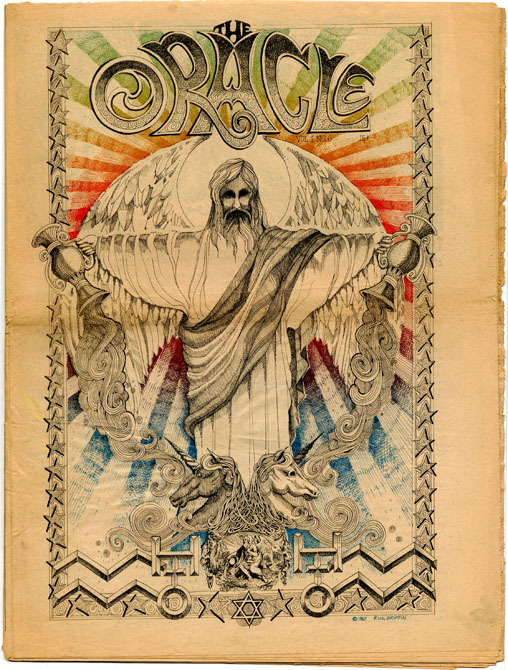
With Allen Cohen and Michael Bowen at the helm as editor and art director, respectively, The Oracle was a worker-owned cooperative that created a newspaper in which the form was as radical as the content. Advancements in offset printing, that was inexpensive and easy for amateurs, enabled the newspaper to “break free of the militaristic columns of traditional newspaper layout.” Lines were left unjustified or ragged, copy ran around pictures and psychedelic drawings, and articles were arranged in the form of mandalas or pyramids. Collages and full spreads of experimental photography were common, and the layout become more psychedelic as The Oracle crew became more adept at their craft. Using cutting-edge printing techniques, they utilized special screens, overlays and unique inks to create a signature psychedelic look. The Oracle pioneered the use of split-fountain printing in which colors leaked from under wood blocks separating the fountains, thus bleeding into one another to create the rainbows envisioned by Cohen in his dream. The Oracle also “escap[ed] the confines of print” by advocating a spiritualist mind expansion through the marriage of content and design. Cohen recalled, “To achieve the oracular effects we wanted we would give the text, whether prose or poetry, to artists and ask them to design a page for it not merely to illustrate it, but to make an organic unity of the word and the image.” Function followed form, and form followed content.


The first issue of the reconstituted Oracle, known as Oracle #1, was published on September 20, 1966. It was printed in black and white and did not feature the eye catching front page of later issues; however, its promise was present. Much of the issue pertained to Beat author Michael McClure, who was featured alongside a review of his controversial play, The Beard, and letters of support for the same from Allen Ginsberg, Norman Mailer, and Robert Creeley. Other articles highlighted topics prescient to the Haight-Ashbury neighborhood: they spoke of the criminalization of drug users; they affirmed humanness in the chemical age, and encouraged readers to follow the advice of Dr. Timothy Leary to “Turn on, Tune in, Drop out;” they noted the death of a prominent Zen figure; and they offered thoughts on music, photography, collage art and comics. These are all interesting to historians for their quintessential 1960s ethos, but two articles in this issue would define The Oracle’s role in the community for the next two years. The first is an anonymous editorial that argues the importance of “new media,” outlined The Oracle’s purpose, explained its place within a network of underground newspapers, and noted the cultural climate of California--a place of radical change. The second article is perhaps even more important.
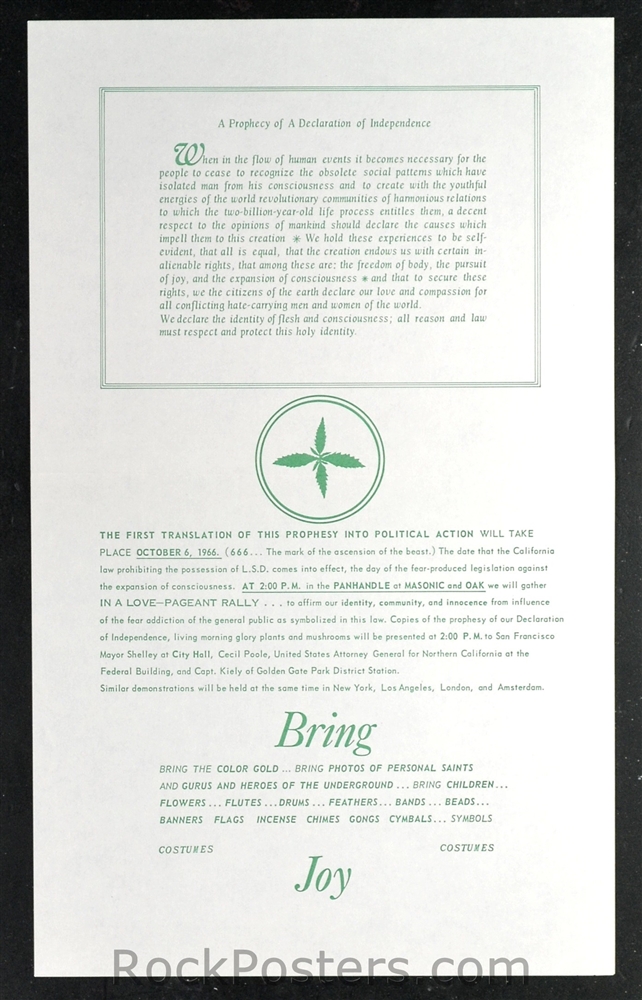
Featured almost inconspicuously on the back page, Allen Cohen boldly outlined a prophesy and called for its political enactment in “A Declaration of Independence.” Readers were called to attend this enactment, or gathering, in the Panhandle of Golden Gate Park on October 6, 1966 to note the passing of a California law that declared Lysergic Acid Diethylamide (better known as LSD) illegal. People attending this Love Pageant, as it came to be called, were told to bring the color gold, photos of personal saints and gurus and heroes of the underground, children, flowers, flutes, drums, feathers, bands, beads, banners, flags, incense, chimes, gongs, cymbals and symbols of joy.
Oracle #1 (September 1966) versus the psychedelic look of Oracle # 5 , below(January 1967).
The Love Pageant proved invaluable training for future large-scale gatherings promoted by The Oracle, such as the Human Be-In in January of the following year, and solidified The Oracle’s stature within the Haight-Ashbury counterculture community. These types of events also significantly increased the newspaper’s circulation. From printing 3,000 copies of Oracle #1 in September of 1966, circulation grew to 50,000 for the Human Be-In issue (Oracle #5) in January of 1967 and over 100,000 copies were printed for each of the remaining seven issues. Oracle-sponsored events featured free copies of the paper, posters reformatted from cover art, and performances from frequent contributors. The Oracle’s media blitz preceding the Human Be-In placed Haight-Ashbury and its hippies on a national stage, and the event’s success precipitated a move to larger offices in Michael Bowen’s former flat on Haight Street near Masonic. As Cohen remembered: “the disaffected, the disenchanted, the mafia, the mad, the CIA, the FBI, the sociologists, poets, artists, American Indian shamans, East Indian Gurus, TV and movie crews, magazine and newspaper reporters from all over the world, and tourists” all descended on the neighborhood. Everyone was coming to San Francisco in the late 1960s, and, because of The Oracle, many of them wore flowers in their hair.
But, as they say, it takes a village, and The Oracle didn’t achieve this success in a vacuum. Underground newspapers in the U.S. had formed a loose coalition called the Underground Press Syndicate (UPS) in June of 1966--emphasis on loose, at least at the beginning. The story goes that Walter Bowart, editor of the East Village Other (EVO), was speaking to a reporter from Time over the phone, and was asked what this new organization was called. Seeing a United Parcel Service truck passing, he said: “Uh, UPS,” and defined it, when pressed, as the Underground Press Syndicate. The Syndicate’s purpose was “to warn the civilized world of its impending collapse...To offer as many alternatives to current problems as the mind [could] bear…[and] to consciously lay the foundations of the 21st century.” Incredibly, this last statement would prove to be fairly true.
The first gathering of underground papers under the UPS umbrella was held at the Stinson Beach home of The Oracle’s Michael Bowen in March of 1967. Representatives from the L.A. Free Press, the East Village Other (EVO), Berkeley Barb, Detroit’s Fifth Estate, Chicago’s Seed, Mendocino’s Illustrated Paper, and Austin’s Rag, as well as counterculture “celebrities,” such as Chet Helms of The Family Dog, were in attendance. Participants Thorne Dreyer and Victoria Smith remembered it as a chaotic and predominantly symbolic meeting in which attendees spoke of their own beauty, lauded the “coming of a new era,” and vowed to create an illusory coordinated network of “freaky papers, poised for the kill.” Benefits of Syndicate members took form at a more formal conference hosted by UPS in Middle Earth, Iowa in June. Members could reprint each other’s content, exchange gratis subscriptions, and a directory of participating periodicals was disseminated to all. This enabled regional counterculture views to spread over a broad swath of territory, and UPS membership grew from 14 papers in 1966 to 271 papers in 1971, reaching Canada and Europe in addition to the United States.
There were two main types of underground newspapers to emerge in the 1960s: those that focused on the political, and those that focused on art and spirituality...although there was crossover in both. The Berkeley Barb and The San Francisco Oracle were two of the most prominent newspapers in the Bay Area, with The Barb falling into the political camp and The Oracle into the art camp. A September 1967 article in the Lodi News-Sentinel titled “San Francisco’s Newest Industry: Hippie Underground Newspapers” compared the two papers with a healthy dose of disdain:
[Image Caption: Newspaper hawker selling issues of The Berkeley Barb and The San Francisco Oracle on the corner of Haight and Ashbury, 1967 / © Larry Keenan.]
“The new San Francisco periodicals are radically different from other underground papers such as the nearby older Berkeley Barb. The Barb is the special favorite of bitter left-wing activists given to sit-in demonstrations and other protests against the Vietnam War. Flower children, being more interested in love and ‘doing your thing,’ think the best place for a sit-in is beside the pools of Golden Gate Park. Thus, many Barb readers regard hippies as proselytizers for political apathy...While the Barb is editorially indignant, the Oracle is poetic, ecstatic and mystical...Its bearded editor, Allen Cohen, says the Oracle is ‘the artists’ vision of the present and the future. The commercial press has restricted the idea of what is news...news today is a state of mind.”
Regardless of which camp they fell into, underground newspapers inevitably caught the attention of the United States Government, and 1967 was a brutal year for those in the business of counterculture news. In a move that foreshadowed the Nixon Administration’s Interagency Committee on Intelligence, the Central Intelligence Agency (CIA) and the National Security Agency (NSA) combined forces to enlarge a program aimed at finding “foreign influences” on domestic unrest in 1967. The Armed Forces intelligence program was also expanded to include civil disorder, and military personnel began spying on civilians as enemies of the state. Even the Internal Revenue Service (IRS) was used as a surveillance tool, jumping into the fray by investigating Ramparts financials after the magazine connected the CIA to the National Student Association. The Detroit Artists’ Workshop Press was raided by local, state and federal narcotics officers, as well as U.S. Customs agents, and 56 members were arrested including John Sinclair, who was sentenced to ten years in jail for having two-joints worth of marijuana in his possession--the longest term ever given for that type of offense in Michigan. The list could go on and on. This type of government intervention and the consistent strain of legal fees proved to be a death knell for many publications, even while this attention simultaneously justified their work. The 1960s may have been a golden era for underground journalism, but the radical enlargement of domestic surveillance in the 1970s soon saw to its demise.
For its part, The Oracle never saw the light of 1970; publication ceased in 1968, and Allen Cohen moved to a commune near Mendocino where he lived in a teepee. In 1970, Cohen co-wrote a poetic, photographic account of the natural birth of his son, River, titled Childbirth is Ecstasy. He returned to San Francisco in 1975 and worked at the Schlock Shop on Grant Ave., wrote poetry, and compiled a collector’s edition of The Oracle which can be referenced in the California Historical Society’s collection (or purchased on Ebay for anywhere from $400 to $1,900). In later years he gave lectures on the 1960s scene in San Francisco, performed poetry readings, organized digital be-ins, and worked with local kids as a public school teacher and operator of a daycare center, which he ran with his wife.

Allen Cohen died at his Walnut Creek home in 2004, but the ethos of his publication and his generation continues to reverberate within contemporary culture. The popularity of newspapers like Cohen’s Oracle was not only due to trippy visuals, edgy articles, and geographic spread. Publications like The Oracle encouraged relationships between readers, staff and publishers that broke the third wall of traditional journalism. Staff were generally volunteers, not unlike the intern army found in many offices today, and articles advocated for change or expressed authors’ opinions rather than presenting unbiased facts; this dynamic challenged the static one-way transmission of information by making the creation and digestion of news communal. The “new journalism,” as it would later be called, significantly increased the political power of hippies and directly influenced the way in which 21st-century consumers prefer to generate and absorb content. Modern blogs and zines (even Twitter and Facebook), with their DIY emphases and reliance on user-synthesized news, directly track back to the underground press of the 1960s.
On this, the 50th anniversary of Oracle #1, let us remember that the work of Allen Cohen and his brethren is not done. “Our dream of peace, love and community never died,” Cohen said. “We, as human beings, yearn for the dream of the Sixties, and despite many disappointments and failures, our dream...will live on forever.” So dream on, Californians, and do what you can to make your own personal rainbow newspaper a reality.
By Nicole Meldahl
Sources not hyperlinked in text:







#/media/File:Flower_Power_by_Bernie_Boston.jpg)