Redirect to CHS blog

Showing posts with label California History. Show all posts

Tuesday, September 11, 2018

Celebrating a California Surfing Pioneer

My Los Angeles childhood was defined by a relationship with South Bay beach culture. My heroes were the men and women who lifeguarded our local beaches, the surf legends of lore - like Greg Noll or Donald Takayama - who started their careers in Hermosa Beach, the surfers paddling out each morning at El Porto, and my neighbors, who were doing awe inspiring and insane things like kayaking the California coastline in its entirety or swimming the 22 miles from Catalina Island back to LA.

Hearing about Governor Brown’s August 20th actions making surfing California’s official state sport prompted me to remember one of the state’s first ambassadors of surfing, George Freeth. Freeth embodied all of the aforementioned heroic traits and more. Born in Honolulu, HI in 1883, Freeth was the son of an Irish sea captain father and a half Polynesian mother. He began surfing at 19, shortly after decades of Calvinist missionary influence had worked to disrupt indigenous participation in the traditional Polynesian activity. According to surf historian Matt Warshaw in the Encyclopedia of Surfing, Freeth gave a surf lesson to the author Jack London in the summer of 1907. London described his instructor as a "sea-god . . .a brown Mercury. . . calm and superb."

George Freeth, Redondo Beach

Later that year, Freeth became one of the first watermen to bring surfing to the California Coast, an attribution shared with the Hawaiian princes who travelled to Santa Cruz in the 1800s. After leaving Hawaii, Freeth travelled to Southern California, where he instructed the public on surfing, swimming, and lifesaving techniques. Freeth became California’s first professional lifeguard in 1907 and subsequently taught dozens of men, women, and children surfing and lifesaving skills. He pioneered surf breaks from San Diego to Huntington Beach, Palos Verdes, and Ventura, popularizing the sport. He is also recognized as responsible for bring the Hawaiian swim team to California for the first time. One of these visiting swimmers was the Olympian Duke Kahanamoku, who is viewed as the godfather of modern surfing.

George Freeth, Redondo, 1907

Freeth was subsequently recruited by developers like Henry Huntington and Abbot Kinney to conduct demonstrations at the Redondo Beach and Venice Piers as a marketing strategy to draw crowds to their development projects. Freeth’s demonstrations drew thousands of spectators and successfully promoted beach culture in the Southland. Once-wary beachgoers became emboldened by Freeth’s actions and the lifesaving strategies, which were responsible for protecting thousands of lives and have informed lifesaving agencies to this day.

I first learned of Freeth during a weeklong training I attended as a Los Angeles County Ocean Lifeguard, where Lifeguard Historian Arthur Verge recounted Freeth’s story. Coincidentally, several months ago, while sorting through CHS’s old issues of the journal California History, I found an image of Freeth. In a 2001 copy of the Journal, Vol. 80, No. 2/3, Dr. Verge laid out Freeth’s life history, including a daring rescue of 11 Japanese fishermen off of the Santa Monica pier. If interested, copies of this issue can be found through UC Press.

George Freeth, Hermosa Beach

Tragically, Freeth died of Spanish influenza in 1919 at the age of 35 at a military base in San Deigo; however, his legacy lives on today. Freeth’s statue stands on the Redondo Beach pier. Coincidentally, Redondo Beach also happens to be where I first taught Junior lifeguards of my own, and it remains one of my favorite places to work as a lifeguard, carrying on Freeth’s commitment to ocean safety and education.

These days, Redondo Beach and much of the coastline that Freeth pioneered would be entirely unrecognizable to the Hawaiian and his surfing contemporaries. Coinciding with the development boom of the early 20th century, developers Huntington, Kinney, and others were successful in their marketing campaigns. Southern California has now developed nearly beyond recognition. However, despite this, the spirit, tenacity, and love of the ocean still remains alive in the beach communities that Freeth first touched over a century ago.

--

Greer Montgomery works as a Development Assistant for the California Historical Society. There she supports fundraising and membership efforts and also enjoys looking at historic photos of the California coastline- especially when they include waves. She is an avid surfer and continues to work as a Los Angeles County Ocean Lifeguard each summer.

Images courtesy of Matt Warshaw, Encyclopedia of Surfing

Thursday, August 23, 2018

California's Enduring Diversity

After years of researching California history, I am still struck by the state’s long-standing population diversity and cultural vibrancy. To come across an image such as this one reminds me that the state’s cultural richness is sometimes on parade, but is more often simply - and meaningfully - woven into all we see around us and in images from the past.


Mexican American caballero with the horse 'Puente,' La Fiesta, Los Angeles; General Subjects Photography collection; PC-GS; California Historical Society. 

In the fourth grade, students begin the year by studying California’s native peoples from the Pre-Columbian to the Mexican Rancho period, and learn that their lives varied considerably from one geographic region to the next, and that there were approximately 100 distinct dialects in use. The curriculum continues with an examination of the different European explorers arriving in California from the sixteenth century onward. Fourth graders also study the gold rush, when a truly global population descended upon the U.S. territory. Following these investigations of California’s rich diversity, the new History-Social Science Framework adopted by the CA State Board of Education poses a question to accompany the next content standard: “What was life like for California’s diverse population at the turn of the century?”

For the Teaching California curriculum project, the California Historical Society (CHS) and the California History-Social Science Project (CHSSP) are working together to identify and contextualize primary sources that illuminate California, U.S., and world history, and to align these with the new Framework. For this particular Framework question on California’s diverse population at the turn of the twentieth century, we are drawing from the CHS’s rich collection of images and documents that provide insight into the opportunities many newcomers enjoyed, as well as the hardships that some experienced on account of their racial or ethnic backgrounds.

I was particularly struck by the record of a speech given by Rep. Cowdery in 1874 about the importance of integrating African-American - “Negro” - students in public schools. I learned that African-Americans in California organized as early as the 1870s to point out the difference between the rights recently afforded them in the 14th Amendment, and their children’s treatment in California’s segregated school system.

“Last fall there assembled at Sacramento a body of colored citizens, demanding all the rights their citizenship entitled them to.”

“Under…our political code the children of negroes must attend separate schools. This would not be objectionable, provided the State has furnished separate schools equal to those for white children…It is clear the State has not performed her duty in this respect.”

Students reading these words (with the historical context and literacy support provided) will learn that segregation in schools was common in these years, and that it was a group of parents who demanded better for their children. Teachers may choose to link this to the long struggle for civil rights in public schools, both in California and throughout the nation.

While students learn that these civil rights were not always realized quickly or fully (and in the case of the 1882 Chinese Exclusion Act, for instance, new barriers were erected), they also learn that people in California from many different backgrounds created numerous opportunities for themselves. This image of a Chinese float during the 1902 “La Fiesta” parade in Los Angeles, helps students see the long history of people honoring their cultures and sharing them with others through festivals like these that brought together California’s diverse peoples. 


Chinese Dragon. La Fiesta Parade, Los Angeles, Cal., 1902 May 2; General Subjects Photography collection; PC-GS; California Historical Society 

We find evidence of California’s turn-of-the-century population diversity in much more than these brief celebrations. In an era when newspapers were one of the only ways to communicate with a broad number of people, ethnic communities used this print media to stay connected and establish themselves within broader society. 


Various newspapers, 1879; Henry D. Cogswell Time Capsule Collection, MS 559; California Historical Society. 

Today’s students will no doubt identify with this language diversity. The California Department of Education identifies 65 different language groups spoken among the state’s public school students. Through the Teaching California project, we are striving to provide classroom materials that represent California’s historic population diversity. We believe that students will be more engaged in learning about the past when they can see themselves represented in California’s story. 

--------------------------------------------------------------------------------------------------------------------------


This post comes from Shelley Alden Brooks, a scholar of California and environmental history. She holds a doctorate from the University of California, Davis, and together with the California History Social Science Project is developing history-social science curriculum for Teaching California. Comprised of curated primary source material from California's premier archives, libraries, and museums, Teaching California presents a research-based approach to improving student reading, writing, and critical thinking.


Monday, August 13, 2018

Engaging Local Youth Through Exquisite Mural Project


During the Chicana/o Movement of the 1960s and 1970s, public murals became an essential form of artist response and public voice. They were a means of challenging the status quo and expressing both pride and frustration during a time when other channels of communication were limited for the Mexican American community. Because they threatened established authority, Chicana/o murals were often censored, neglected, whitewashed, or destroyed

As part of the current exhibition ¡Murales Rebeldes!—L.A. Chicana/o Murals under Siege, the California Historical Society created a program to engage youth, many of Latino heritage, who live and go to school in the Mission District of San Francisco, an area renowned for its murals. We named the program Exquisite Mural after the old parlor game “exquisite corpse,” in which a collection of words or images is collectively assembled.

Over the course of the program, roughly 200 students from Jamestown Community Center and Mission Community Beacon joined us in our gallery to take part in the project.

Before the children participated in the Exquisite Mural Project, I lead them on a tour of the gallery and discussed three of the mural artists featured in the exhibition. The kids have shown an incredible amount of empathy for the artists, asking multiple times “Why did they have to paint over the mural? Why did they have to destroy the mural?” The children are also very keen on knowing if the muralists were still alive and were fascinated when told that I had met a few of them. Some of the kids were able to meet muralist Ernesto de la Loza, who led a personal tour of his section of the exhibition and stayed to participate in the mural making activity.

Resurrection of the Green Planet by Ernesto de la Loza

In our version of the game, a mini mural is created collaboratively as a triptych, which basically means a three-part picture. A child would complete the first panel of the picture, then, two mural artists, one from Los Angeles and one from San Francisco, each drew on one of the remaining two panels. The person drawing did not know what the person before them had created due to the paper being folded, rendering the other images hidden. I explained to the kids that they might treat the Exquisite Mural as a concept drawing that they could use to build on if they were to paint a full-scale mural.

Using stories as a backdrop, the youth explored themes raised by the exhibition and its featured mural artists such as displacement, activism, immigration, cultural heritage, racism, memory, feminism, and censorship. The art created by the kids embodied similar ideas with many of the kids expressing pride towards their heritage by painting the flags of countries from where they or their families are from. Much of the art included imagery of peace, unity, and friendship.


The most fulfilling thing about this project was seeing the kids who were initially adamant about “not being able to draw” or saw themselves as “not artists” come up with really creative pieces of art inspired by iconography that they saw in the gallery. Some spoke with me about how they were used to seeing the Virgen de Guadalupe at home. Mermaids and dinosaurs were other popular subjects that resonated with the group. These conversations were a great opportunity to help the kids understand that anybody can be an artist and that each muralist they had learned about were once kids themselves.

The Exquisite Mural art will be showcased in the CHS galleries beginning August 25th. We plan to celebrate the hanging of the murals with the youth participants and their family during an afternoon reception, poetry reading, and discussion with artists of all ages.

by Erik Zuniga, Guest Concierge and Exquisite Mural project group leader

Friday, August 4, 2017

History Keepers: Eleven Stories that Moved Los Angeles


For more than two hundred years, our community, our Los Angeles, has been molded and shaped by its people. In small ways and big, individuals impact the city, inching us collectively one way and then another. This exhibition tells eleven compelling stories that are part of our city’s complex fabric. Some are stories of promise, others are of despair.

The Sunset Limited
Courtesy of the Los Angeles Union Station Historical Society 

           Garden Court Apartments, Front Entrance, 1976 
 Courtesy of the Los Angeles Public Library

Two of them aren’t specifically about people. One is about a train with staying power, and another is about a building that despite a promising pedigree came to a violent end. But they still have something to teach us about both loss and endurance. 

Special issue of La Raza, September 3, 1970, with cover photographs by Raul Ruiz of the Silver Dollar bar where Ruben Salazar was killed
Los Angeles County Sheriff’s Department’s Records on the Homicide Investigation of Ruben Salazar, USC Libraries, Special Collections                                         


The objects on view come from university libraries, museums, and nonprofit organizations. We invited caretakers of these collections to bring forward objects and share with us the histories that they illuminate. The librarians, historians, archivists, collectors, volunteers, and local citizens who maintain these collections are the keepers of our history. They devotedly research, organize, store, and repair these items and make them available to the public in person, online, in exhibitions, and through publications.

In the retelling, these stories that have shaped our city move us emotionally in the present, helping us to understand how we got to where we are, and perhaps better see where we are going. Should we ever forget or lose sight of our past, we need only return to these primary source materials to once again illuminate our history.


Courtesy of UCLA Library Special Collections
Ruth Strout McCandless with Nyogen Senzaki


History Keepers: Eleven Stories that moved Los Angeles
August 4, 2017 – October 1, 2017
El Tranquilo Gallery & Visitor Center Olvera Street
El Pueblo de Los Angeles Historical Monument
Tuesday-Friday 10am- 3pm Saturday/Sunday 9am-4pm
Learn More

Tuesday, October 4, 2016

New River, Los Angeles

H. B. Wesner, Untitled [New River, Los Angeles], c. 1890, California Historical Society, CHS2016_2069
By Shelly Kale
In the late nineteenth century, San Bernardino-based Henry B. Wesner (1853–1932) photographed the effects of floods in the region. This image in his “Views of Southern California Scenery” series shows severed telegraph wires, felled steel beams, floating vegetation, and flooded railroad tracks—evidence of the destruction caused by flash floods common to the Los Angeles area during this period.1
Wesner’s image captures the dynamic quality of a river during flash floods. His eye-level perspective suggests the river’s momentum as it accommodates new waters in a seemingly peaceful wave.2
Photographs of floods would naturally have interested California’s first state engineer William Hammond Hall (1846–1934), who added this image to his collection, which was subsequently donated to the California Historical Society in 1951.3
Upon his appointment as state engineer in 1878, Hall began a systematic and far-reaching study of the state’s use of water and complex natural water systems. In 1880, he created the first integrated, comprehensive flood control plan for the Sacramento Valley.
Throughout his tenure, which ended in 1889, Hall attempted to revise California’s antiquated water laws and design a comprehensive water system. As Kevin Starr observes, Hall’s “envisionings” were an outgrowth of his work designing San Francisco’s Golden Gate Park (1871–76), through which he imagined “California as irrigated parkland ready for productive use.”4
While we don’t know Hall’s specific connection with Wesner’s photograph, his collection at the California Historical Society includes records of irrigation projects in southern California. These are the basis for his 1888 account of the irrigation works in Los Angeles, San Bernardino, and San Diego counties, Irrigation in California (Southern), which included a description of Los Angeles County’s “New River” and “Old River.”5
The nomenclature refers to the effects of heavy rains in 1867–68 on the San Gabriel River—a tributary to the Los Angeles River from 1825 to 1867. As explained in a 2007 historical ecology study, the storms caused “the most violent and dramatic change in the river since Europeans had begun to occupy southern California; a break in the a logjam in the canyon above Whittier Narrows sent a rush of water with such velocity that it changed the course of the river.” 6 During these storms, in which nearly fifty inches of rain fell over a thirty- to forty-day period, most of the flow migrated east and was called the “New River.”
Between 1884 and 1912, the New River changed course several times. Wesner’s photograph was likely taken during this period. In late December 1889, flash floods caused by regional storms caused several railroad tracks and bridges to wash away, including “a broken bridge over the New river.”7
Flood control was one of Hall’s key proposals to the state, along with the establishment of irrigation districts and regulation of the state’s water supply. However, Hall was ultimately unsuccessful in convincing the legislature to bring about these goals, and the state abandoned its water planning efforts in 1893. “Had the legislature accepted Hall’s proposals,” notes historian Donald Pisani, “California would have enjoyed the most advanced code of water laws in the arid West.”8
As Kevin Starr reflects, “A complex man . . . neither a pure public servant nor a pure entrepreneur, William Hammond Hall nevertheless achieved the first consistent act of foundational thinking regarding the future California might have through water. In this act of water prophecy, Hall made an enduring contribution.”9

NOTES
The author thanks Richard D. Thompson and Alison Moore of the California Historical Society for their help with sources and astute observations.
1.     According to a flood table prepared by the United States Weather Bureau, forty-one floods occurred in the Los Angeles vicinity from 1878 to 1914; H. D. McGlashan and F. C. Ebert, Southern California Floods of January, 1916 (Washington, DC: Government Printing Office), 40.
2.     According to the January 1982 San Bernardino Courier, “Mr. Wesner has one of the finest photo studios in southern California” (reproduced in Richard D. Thompson, Library News June 2013, City of San Bernardino Historical and Pioneer Society). A partner with his brother Michael in Wesner Brothers Imperial Photographic Parlor, established in 1884, the adventurous Wesner also traveled throughout the region in the Wesner Brothers Photographic Car, established in 1880 (Carl Mautz, Biographies of Western Photographers: A Reference Guide to Photographers Working in the 19th Century American West [Nevada City, CA: Carl Mautz Publishing, 1997)], 153). In 1893, for example, he roamed the county in search of “all the most interesting objects” for an album to be displayed at the California Midwinter International Exposition of 1894 (“News of the Studio,” Pacific Coast Photographer 2, no. 9 [October 1893], 406). Eight feet high and 4 feet square, the album was commissioned in recognition of “the value of photography as a means of conveying knowledge of view scenery” (“California Photography: It Renders Quite a Service to the State at the World’s Fair,” Pacific Coast Photographer 2, no. 1 [February 1893], 406). According to local newspapers, by April 1896 Wesner had “grown weary of photography business” (San Bernardino Daily Sun, April 23, 1896), closed his studio (San Bernardino Daily Sun, May 16, 1896), and left for Appleton, Illinois (San Bernardino Daily Sun, June 2, 1896). On a return trip to San Bernardino in the spring of 1920, he noted the changes that occurred in San Bernardino from the perspective of his new and prosperous life as a Midwestern farmer: “The changes that have come in San Bernardino since I was here indicate that we have not had all the prosperity in Illinois” (San Bernardino Daily Sun, April 12, 1920).
3.     William Hammond Hall Papers, 1878–1914, MSS 913, 914, 915 [hereafter cited as Hall Papers], California Historical Society, San Francisco.
4.     For an account of Hall’s career, see Donald J. Pisani, From the Family Farm to Agribusiness: The Irrigation Crusade in California and the West, 1850–1931 (Berkeley: University of California Press, 1984), 154–190. Kevin Starr, Material Dreams: Southern California Through the 1920s (New York/Oxford: Oxford University Press, 1990), 8.
5.     Irrigation in Southern California, c. 1888, box 4, folder 35, and Irrigation Projects in Southern CA, no date (L.A., San Diego, San Bernardino), box 4, folder 37, Hall Papers. William Hammond Hall, Irrigation in California (Southern): The Field, Water-supply, and Works, Organization and Operation in San Diego, San Bernardino, and Los Angeles Counties: The Second Part of the Report of the State Engineer of California on Irrigation and the Irrigation Question (Sacramento, CA: State Office, 1888), 575601.
6.     Eric D. Stein et al., Historical Ecology and Landscape Change of the San Gabriel River and Floodplain (Southern California Coastal Research Project Technical Report #499, February 2007), 13, 47. The authors quote a 1915 interview that describes a first-person account of the flood, including this episode: “He [Henry Roberts] found a dead grizzly bear out in the center of the pile of logs after he had been hauling logs from the pile quite awhile. The skeleton of the bear and hide was all there, and he said it looked as if it had been caught in the flood, and tried to save himself by riding the drift wood.” (p. 13).
7.     Stein et al., Historical Ecology, 47. “Storm Effects: Several Railroad Bridges Washed Away,” Los Angeles Herald, December 26, 1889.
8.     Pisani, From the Family Farm to Agribusiness, 178, 185.
9.     Starr, Material Dreams, 13.
Shelly Kale is Publications and Strategic Projects Manager at the California Historical Society. Formerly Managing Editor of California History from 2007 to 2013, she has held editorial and administrative positions in academic, museum, educational, electronic, and trade and mass-market publishing.
______________________________________________________________________________
This article originally appeared in Spotlight, a feature of the California History journal (Vol. 93, #1), published by the University of California Press in association with the California Historical Society. Conceived by former journal editor and historian Janet Fireman as a last-page photographic feature that itself would evoke a lasting image for journal’s readers, Spotlight draws from CHS’s vast and diverse collection of California photography and photographic history.
California History, Vol. 93, Number 1, pp. 64–66, ISSN 0162-2897, electronic ISSN 2327-1485. ©2016 by the Regents of the University of California. All rights reserved.
______________________________________________________________________________

To learn more about H. B. Wesner, read a biographical essay by Richard D. Thompson: http://californiahistoricalsociety.blogspot.com/2016/02/henry-beecher-wesner-18531932-san.html

Monday, September 12, 2016

My Summer Vacation: Dennis Searles in the Mohave Desert

Dennis Searles, Searles Marsh, San Bernardino Co., 1890
California Historical Society

For many California youths, summer ends with regret: it’s time to go back to school. For some, “What did you do on your summer vacation?” is a familiar question. In recognition of summers gone by, we offer this account of the months between May 21 and July 4, 1890, when the young Dennis Searles, son of a borax industrialist, was sent to work on his father’s borax works in the Mohave Desert.

Inspired by the image above and Searles’ journal, this account originally appeared as the Spotlight feature in the Fall issue of California History (vol. 93, no. 3). The author has further illustrated it to give a visual sense of the time and place in the life history of Dennis Searles and his family.

Detail, Map of California Saline Deposits, 1902
From Gilbert E. Bailey, The Saline Deposits of California (Sacramento: California State Mining Bureau, 1902)
  
By Shelly Kale
“I took off my city clothes and put on my desert duds,” wrote sixteen-year-old Dennis Searles in his journal on May 24, 1890 (1), the fourth day of his journey from San Francisco to the hot, dry desert in northwestern San Bernardino County. It was an unconventional destination for a teenager of a wealthy family on summer vacation from boarding school, but Dennis Searles had been summoned by his father John to help at the family borax works at Borax Lake.
Searles Lake, San Bernardino County, California
Courtesy California Department of Fish and Wildlife
May 22, 1890—I went to my father’s office [in San Francisco] and was there informed of the fact that my father wanted me to leave that evening for home [Searles Lake]. Of course I was glad to go as I wished to see my father.
In his journal Searles (1874–1916) described ferrying across the bay to Oakland and taking the Southern Pacific Railroad south through the San Joaquin Valley, the Tehachapi Mountains, and, finally, to Mojave.

Railway Depot, Mojave, 1927
Courtesy of Pomona Public Library
May 23, 1890—Mojave is a town of about one hundred population situated in Southern California at the juncture of the S.P. and A. P. railroads. . . . The railroad buildings comprise about half of the town. Of the rest of the town very near every other house is a saloon combined with some other business. My father owns here a large barn, a warehouse and a half of a dozen other houses. The town contains a schoolhouse but the pupils are few and the teachers poor.
At this town on the intersection of the Southern Pacific and Atlantic & Pacific Railroads, Searles learned to his relief that he would be escorted through the Mojave Desert by Robert R. Charlton, manager of John Searles’ Mojave office (Charlton, who was an avid photographer, may have taken the image of Searles “picnicking” in the desert) (2). “Instead of having a wearisome ride of four days [on a 20-mule-team borax wagon],” Searles wrote, “I am going to have a pleasant ride of a day and a half.”

 Twenty-mule Team Hauling Borax out of Death Valley to the Railroad, c. 1900
California Historical Society at University of Southern California
May 24, 1890—These wagons come into Mojave in the morning, load and then go out in the afternoon. These big freight teams are made up of two large wagons, the hind wheels of which are seven or more feet high. There is an oil wagon also connected with the team. It takes about twenty-two animals to draw one of these wagons. The average load is about thirty thousand of Borax.
On May 25 Searles and Charlton began the 75-mile ride to Borax Lake “behind a light team” and on “a very good road.” The travelers arrived three days later at Borax Lake (later Searles Lake), “a large dry lake, as white as snow. . . . On all sides, high mountains rise, completely walling it in, the few large canyons forming its gates.”

Looking towards the Slate Range and Searles Valley, 1947
Courtesy of Searles Valley Historical Society
June 24, 1890—On our right the tall barren mountains rise, at their summits you can see dense beds of sand, someof these beds are hundreds of feet deep. On our left a dry lake shows itself, on its shore salt grass is growing in the sand.
Located at the upper end of the lake was the borax works, established in 1873 by John Searles, a gold rush pioneer and hard-rock miner whose daring feats included a skirmish with a Grizzly bear in 1872 (3).

John W. Searles (1828–1897)
The May 8, 1955 issue of the San Bernardino County Sun called John Searles a “Pioneer among Industrialists” for his discovery and mining of rich borax deposits at Searles Lake.

In 1878 Searles relocated to a new site and named it Borax. There he established the San Bernardino Borax Mining Company, eventually covering 2,000 acres (4). It was the start of a new industry in the county.

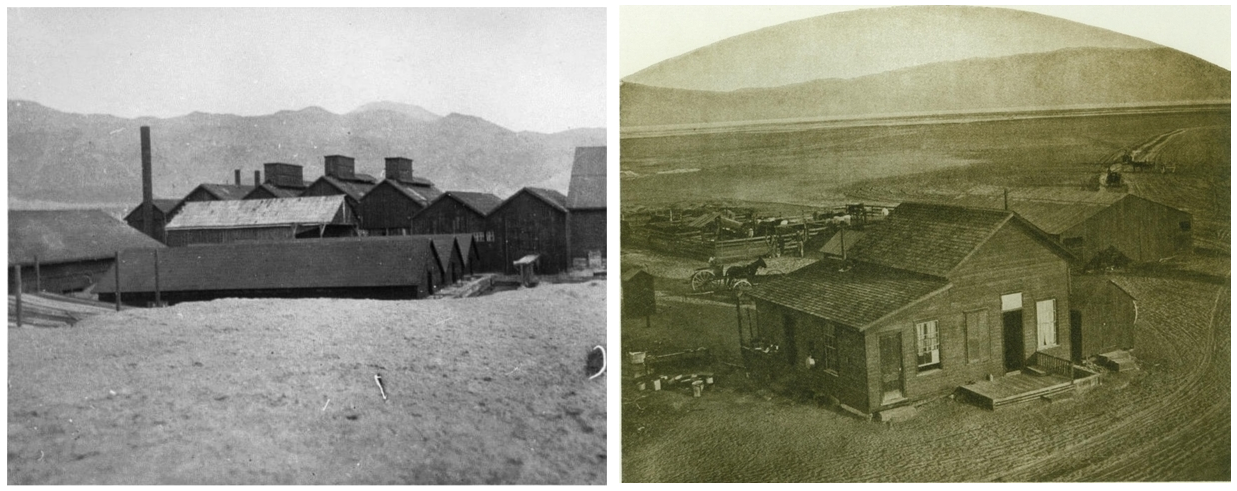
(Left) John Searles’ Borax Plant, Searles Lake, c. 1900
(Right) Searles Dwelling at Borax Works, Searles Lake, 1880
California Historical Society
May 28, 1890—The works for manufacturing the Borax are at the North Western end of the lake. There is somewhere near 30 buildings forming in itself a small town in the heart of the desert.
John Searles was the first to recognize the lake’s potential, but he certainly was not the last. In time, the lake’s saline mineral beds provided a continuing supply of minerals, including borax, sodium sulfate, and soda ash. In 1912, potash—a nutrient form of potassium—was discovered in the lake brine. Among its many uses, the Sausalito News noted, was “the making of glass, soap, bleaches, dyes, photographic chemicals, medicine, explosives, fertilizer,” and in “gold mining and many other industrial processes.” (5)  By 1979, the value of the lake’s mineral deposits was regarded as worth “billions of dollars.” (6)

Collecting from Searles Lake
Courtesy Searles Valley Historical Society
May 30, 1890—Now the regular routine of vacation has commenced, which I get very tired of within a month or so. It is get up in time for breakfast at half past five and then for the rest of the day there is plenty to do but one misses the company somewhat of young me as very near all the men are near onto 60.
Like the eponymous lake, Dennis Searles developed his potential over time. In 1895 he graduated with the first class of Stanford University (along with future president Herbert Hoover), majoring in engineering. He “made a brilliant record,” the San Francisco Call observed. “He had the reputation of being one of the ablest students there. He was probably the wealthiest . . . . Mr. Searles’ friends look to see him make a record in the days to come.” (7)  

His friends would not be disappointed. In addition to playing an active role as a Stanford alumni, Dennis Searles pursued a mining career, serving as vice president of Frank M. Smith’s (“the Borax King”) Pacific Coast Borax Company from 1909 to 1914 (8). He was Smith’s personal assistant in his numerous enterprises and director of the United Properties Company, which, when it was incorporated in 1911, was recognized as the “West’s Biggest Corporation” and “the most powerful corporation ever organized for the development of California, excepting that of the Southern Pacific Company.” (9)

Caroline Stetson Ayres and Dennis Searles, 1903
“Betrothal of Three Young Prominent Society Couples,” San Francisco Call, Sept. 23, 1903
“The engagement of Miss Ayres and Mr. Searles is without doubt one of the cleverest summer coups of Cupid,” wrote the San Francisco Call.
In 1904, Searles married Caroline Stetson Ayres (10). The couple, whose activities filled the society pages of the local newspapers, lived in Piedmont. On November 25, 1916, Dennis Searles, the “Oakland financier, real estate broker and clubman, and former secretary for F. M. Smith” died in an automobile accident when his car skidded off a road and over a 75-foot precipice near Saratoga, California (11).  

Nearly a year later, on September 21, 1917, Caroline Ayres Searles wrote a letter to her daughter, Mary, which she added to the last page of her husband’s journal from that summer of 1890: “Dear Little Mary, Mother is putting this safely away for you, hoping that someday, when you are old enough, you will read it and appreciate what a very fine little boy your dear Daddy was.”

On that “someday,” Mary would ignore her father’s “Hands off! Private” warning and open the cover of his journal. Inside she would learn what the Mojave Desert and borax mining were like in 1890. She would read about shooting coyotes, taking care of animals, sawing borax sacks and other chores, even a description of how to make healing ointment from horn-toads drowned in whiskey—all the features of desert life that filled young Dennis Searles’ days and nights at Borax Lake.

(Left) Dennis Searles with a Chinese worker; (right) Title page
Journal of Dennis Searles, 1890
California Historical Society, MSP 1933
May 25, 1890—As we are walking along I see a coyote standing looking at us about eighty yards away. I jump out of the wagon to get a shot at him but he disappears amongst the brush. He has been shot at before and knows what a man with a gun is.
Shelly Kale
Publications and Strategic Projects Manager
NOTES
  1. All quotes are from the Journal of Dennis Searles, May 21–July 4, 1890, MS 1933, California Historical Society.
  2.  James L. Fairchild, Russell L. Kaldenberg, Searles Valley Historical Society, Around Trona and Searles Valley (Charleston, SC: Arcadia Publishing, 2015), 63. A caption in “20-Mule Team Era Recalled,” San Bernardino County Sun, Dec. 2, 1962, reads “Time for Lunch: Dennis Searles is shown having a noon meal on the desert while he rests his horses. Such was desert travel in his day.”
  3.  James Fairchild and Russell Kaldenberg, Lecture on the History of Trona and Searles Valley, Maturango Museum, https://www.youtube.com/watch?v=PPIOu7wIIX8); Fairchild and Kaldenberg, Around Trona and Searles Valley, 9, 23, 24. In the early 1860s the Slate Range Stage Company brought prospectors and business people on a weekly basis from Los Angeles to this region originally inhabited by the Panamint Shoshone. In 1862 John, his brother (also named Dennis), and two other miners etched their initials on rocks in the Slate Range, a soda-salt marsh where they were mining gold and silver. The next year, having earlier suspected that there was borax in the soda, John attempted to test the mineral’s content in samples he brought to San Francisco. However, tests of the mineral’s existence in the samples were negative. Discouraged, the brothers returned to hard-rock mining, eventually moving to Los Angeles. In 1873, however, they were shown a borax crystal from the Slate Range area and renewed their interest. Claiming land on the salt marsh, they began extracting the mineral from the surface mud along the lake’s western edge.
  4.  George I. Smith, “Subsurface Stratigraphy and Geochemistry of Late Quaternary Evaporites, Searles Lake, California,” Geological Survey Professional Paper 1043 (Washington, DC: Government Printing Office, 1979), 4.
  5. “Concerning San Bernardino Potash Discovery,” San Francisco Call, Apr. 9, 1912; “Extensive Use of Postash,” Sausalito News, January 6, 1912. In March that year President William Howard Taft urged Congress to enact a law protecting the region from private exploitation and five years later, in 1917, with America’s entry into World War I, President Woodrow Wilson signed a bill reserving the Searles Lake district for potash production and use. As the Los Angeles Herald explained the year before, “A famine in potash fertilizer is threatened by the European war.” “Taft Would Protect Potash,” Sacramento Union, Mar. 27, 1912; “Wilson Signs Potash Bill,” Red Bluff Daily News, Oct. 3, 1917; “Experts to Work Calif. Kelp Beds,” Los Angeles Herald, Jan. 4, 1916
  6. Smith, “Subsurface Stratigraphy and Geochemistry,”4
  7. “California Bachelors Are Interesting: Who They Are, How They Live and What They Do,” San Francisco Call, Oct. 15, 1899
  8. “Borax in Death Valley,” Los Angeles Herald, January 20, 1901. Smith’s company, founded in 1890, had absorbed the San Bernardino Borax Co. in 1895, five years after Dennis Searles’ visit, and shortly discontinued its operations; W. D. Hamman, “Potash Solutions in the Searles Lake Region—II,” Mining Science (May 2, 1912), 391.
  9. “Great Enterprises in Merger: West’s Biggest Corporation,” San Francisco Call, Jan. 1, 1911; “Gigantic Financial Concern Plans Big Things: United Properties Company Will Expend Millions in Oakland and Vicinity,” in Evarts Blake, Greater Oakland (Oakland: Pacific Publishing Co., 1911), 50–51
  10. “Betrothal of Three Young Prominent Society Couples,” San Francisco Call, Sept. 23, 1903
  11. “Dennis Searles: Funeral of Dennis Searles to Be Tomorrow,” Oakland Tribune, Nov. 27, 1916
This article originally appeared as the Spotlight feature in the California History journal (Vol. 93, #3), published by the University of California Press in association with the California Historical Society. California History, Vol. 93, Number 3, pp. 101–103, ISSN 0162-2897, electronic ISSN 2327-1485. © 2016 by the Regents of the University of California. All rights reserved.

Wednesday, July 27, 2016

Photographing Yosemite: Rondal Partridge's Pave It and Paint It Green

Rondal Partridge, Pave It and Paint It Greensigned gelatin silver printc. 1965 
Gift of Rondal Partridge / California Historical Society
Beginning in his early twenties, Rondal Partridge operated the renowned photographer Ansel Adams’ darkroom in Yosemite Valley. From 1937 to 1939 he helped produce prints of Adams’ idealistic Yosemite photographs for tourists. Thirty years laterduring an era of political, social, and environmental awareness and upheaval—he captured tourism’s impact on the park with his best-known photograph, Pave It and Paint It Green. Today it is a reminder of the fragility of our National Parks and the imperative that we always preserve them. 

As a tribute to Rondal Partridge, we offer an essay by Shelly Kale—published in the California History journal by the University of California Press in association with CHS—about a man and the image that captured not only his spirit but that of a generation.

Pave It and Paint It Green

I don’t have any preconception of what is valuable as a photographic subject. A view, a snake—I never know what will catch my eye. I shoot it, print it, and wait for fashion to catch up with my eyes.
—Rondal Partridge, 2002 (1)


When Rondal Partridge (1917—2015) took this photograph of a congested parking lot in Yosemite National Park, it was the impact of tourism that caught his eye. “I went to Yosemite with a producer from KQED to make a film,” Partridge recalled in 2002. “All he saw was falling water, tall cliffs, and happy people…I saw congestion, destruction, erosion.” (2)

Partridge was the son of the renowned photographer Imogen Cunningham (1883—1976) and in his younger years assisted the celebrated photographers Dorothea Lange (1895—1965) and Ansel Adams (1902—1984). As photographs curator Jennifer A. Watts noted, in the 1960s and 1970s Partridge was one of “a new generation of up-and-coming photographers” who were “redefining photography’s function in Yosemite…This new school of photographers discovered and depicted a Yosemite unimagined by Adams. They framed their shots on the valley floor rather than the craggy vistas favored by Adams.” (3)

Unlike Adams’s emphasis on Yosemite’s purity, Partridge saw the interrelationship between the park’s human imprint and its natural beauty. In his photograph, the sprawl of cars across the foreground and the majestic Half Dome framed by trees seem to have equal billing. Partridge, art historian Sally Stein observed, “resisted compartmentalizing nature as a thing revered for its very apartness. Rather, in his view, we are part of nature and, for better and worse, it is yoked to us.” (4)

As “photography’s ‘grand laboratory,’” Yosemite has inspired photographers since Charles Leadner Weed (1824—1903) entered Yosemite Valley in 1855. The 1861 images of Carleton E. Watkins (1829—1916) had far reaching effects: they provided the visual evidence for Yosemite’s preservation that led to passage of the 1864 Yosemite Grant Act. That piece of legislation set aside the Yosemite Balley and the Mariposa Grove of Giant Sequoias for protection by the State of California “inalienable for all time,” paving the way for our national park system. (5)

Following Watkins’s lead, generations of landscape and tourist photographers alike focused their lenses on Yosemite’s geological wonders and inspirational splendor. But like the painter Chuira Obata (1885—1975), whose artworks of Yosemite in the late 1920s brought a fresh perspective to the park’s visual record, Partridge broke with this traditional approach. And like Eadweard Muybridge (1830—1904), whose daring feats over the landscape to reach the best viewpoints produced astonishing photographs of Yosemite, Partridge was intrepid. At the Camp Curry parking lot, “I got up on the top of the car and took the shot and was blasted by a bullhorn from a ranger. He demanded I get off the car. He wanted to arrest me, and I said I refused to be arrested. I convinced his supervisor that I had obtained permission to photograph, and that I could shoot from wherever I wanted.” (6)

By the mid-1960s, when Partridge trained his camera on Half Dome, the automobile’s destructiveness was apparent. As National Park Service historian David Louter recounted, one critic observed that the automobile “had brought more downgrading changes to Yosemite Valley than the previous five thousand years of erosion. Each day it was cramming a medium-sized city into a valley meant for a hamlet.” (7)

As the decade ended, the motto “Parks Are for People” was a rallying cry to address the problem. In 1980, automobiles were recognized in the National Park Service’s General Management Plan as “the single greatest threat to enjoyment of the natural and scenic qualities of Yosemite.” (8) Each year, the plan noted, approximately thirty miles of roadway accommodated a million trucks, cars, and buses. Decades later Partridge would state, “Automobiles are a main concern of mine. They’ll cover the world ten feet deep in the next fifty years. I have dozens of photographs of parking lots.” (9)

Today—as we mark the hundredth anniversary of the National Park Service and evaluate the success of its conflicting mandates, use and preservation—automobiles are still at home in the Camp Curry parking lot. (10) As Yosemite photographer Howard Weamer described, “The lot is slightly more organized now, with parking in rows perpendicular to the camera, and always full.” (11).

Would Partridge have found the accommodation worthy of his camera’s eye?

NOTES

1. Elizabeth Partridge and Sally Stein, Quizzical Eye: The Photography of Rondal Partridge (San Francisco: California Historical Society Press, 2003), 134.
2. Ibid., 136.
3. Jennifer A. Watts, “Photography’s Workshop: Yosemite in the Modern Era,” in Yosemite: Art of an American Icon, ed. Amy Scott (Berkeley: University of California Press in Association with the Autry National Center, 2006), 129–130.
4. Sally Stein, “‘Everything but the Grand Gesture’: Tradition and Irreverence in the Photography of Rondal Partridge,” in Partridge and Stein, Quizzical Eye, 24–25.
5. Watts, “Photography’s Workshop,” 115; Thirty‐Eighth Congress of the United States of America, An Act Authorizing a Grant to the State of California of the “Yo‐Semite Valley,” and of the Land Embracing the “Mariposa Big Tree Grove,” June 30, 1864, http://www.outpost-of-freedom.com/library/Yosemite_Park_June_30_1864.pdf.
6. Partridge and Stein, Quizzical Eye, 136.
7. David Louter, Windshield Wilderness: Cars, Roads, and Nature in Washington’s National Parks (Seattle: University of Washington Press), 21.
8. U.S. Department of the Interior, Yosemite National Park: General Management Plan, Visitor Use/Park Operations/Development (Washington, DC: U.S. Government Printing Office, 1980), 3.
9. Bob O’Brien, “A Vision Sustained,” National Parks 76, no. 5–6 (July/August 2002), 44; David T. Page, Yosemite and the Southern Sierra Nevada: An Explorer’s Guide (Woodstock, VT: The Countryman Press), 67; Louter, Windshield Wilderness, 176; Partridge and Stein, Quizzical Eye, 137.
10. With the 1916 Organic Act, Congress authorized the National Park Service “to conserve the scenery and the natural and historic objects and the wildlife therein and to provide for the enjoyment of the same in such manner and by such means as will leave them unimpaired for the enjoyment of future generations.” See “Robin Winks on the Evolution and Meaning of the Organic Act,” The George Wright Forum 24, no. 3 (2007), http://www.georgewright.org/243winks.pdf.
11. Howard Weamer, e-mail message to the author, October 16, 2015.

Shelly Kale is Publications and Strategic Projects Manager at the California Historical Society. Formerly Managing Editor of California History, she has held editorial and administrative positions in academic, museum, educational, electronic, and trade and mass-market publishing.
__________________________________________________________________________
This article originally appeared in Spotlight, a feature of the California History journal (Vol. 93, #2), published by the University of California Press in association with the California Historical Society. Conceived by former journal editor and historian Janet Fireman as a last-page photographic feature that itself would evoke a lasting image for journal’s readers, Spotlight draws from CHS’s vast and diverse collection of California photography and photographic history.
California History, Vol. 93, Number 2, pp. 64–66, ISSN 0162-2897, electronic ISSN 2327-1485. ©2016 by the Regents of the University of California. All rights reserved.