Redirect to CHS blog

Tuesday, August 6, 2013

California Art Gallery and Museum Ephemera Collection

Check out the California Historical Society's newest addition to their California ephemera collections - the California Art Gallery and Museum Ephemera Collection!


John Bolles Gallery, San Francisco, The Visitors show, 1961


This collection consists of a variety of ephemera pertaining to California art galleries, art museums and college art museums. The collection comprises advertisements, announcements, brochures, exhibition catalogs, invitations and posters promoting gallery and museum shows primarily in San Francisco, the Bay Area and Los Angeles.
Types of art represented include painting, photography, sculpture, ceramic and glass art, textiles and mixed media.

Batman Gallery, San Francisco, Works by Bruce Conner, [1964]


Many 1960s-era contemporary art galleries are represented such as Arleigh Gallery (San Francisco), Batman Gallery (San Francisco), Dilexi Gallery (San Francisco), Dwan Gallery (Los Angeles), Ferus Gallery (Los Angeles), John Bolles Gallery (San Francisco) and Maxwell Galleries (San Francisco) as are the exhibition catalogs of major California museums such as the Oakland Museum and the Palm Springs Desert Museum.


Everett Ellin Gallery, Los Angeles, Clayton Pinkerton show, 1961


View the finding aid to the collection at the Online Archive of California or search the California Historical Society's catalog

Jaime Henderson
Archivist

Friday, August 2, 2013

A Tube Across the Golden Gate


The history of a city can be imagined in many ways: as an upward trajectory of successful collective endeavor, as a simmering cauldron of bitter class conflict, or as a landfill piled high with abandoned projects, doomed utopias, and broken dreams. Tossed into the dustbin of history (and sometimes deposited in the CHS archives), the record of these failures tells the story of a different city, the city that might have been. Some of these “unbuilt” landscapes are poignant, others are disturbing, still others are simply bizarre, but they all remind us that history—and the view from our window—could have been something very different.

Architect M.G. Bugbee’s 1921 notebook, A tube across the Golden Gate, tells one of these stories, in graceful sketches accompanied by handwritten technical notes. As the need for a transportation link between San Francisco and Marin County became more obvious, Bugbee proposed the construction of an underwater concrete tube reinforced by steel cables, as pictured below:


 A tube across the Golden Gate, 1921, by M.G. Bugbee, MS 251, California Historical Society, MS 251.002.


When we think Golden Gate, the brilliant image of our internationally beloved bridge sweeps into view, emerging from and dominating the natural landscape. It’s hard to imagine the city detached from its man-made, fog-swept icon. Technical questions aside, Bugbee’s plan might suggest an alternate vision of urban planning for the Bay Area, one that is more modest, less triumphalist, and, perhaps, for better or for worse, more twenty-first century.

Marie Silva, Archivist & Manuscripts Librarian

Thursday, August 1, 2013

Salad Days

Experiencing a deluge of tomatoes? Need to find some variety in your lettuce salads? Ever wonder what exactly is a “suspicion of garlic” – is it more or less than a ¼ teaspoon, finely grated?

Enjoy reading (if not actually trying) some recipes of years past from the second edition (1911) of Two Hundred Recipes for Making Salads with Thirty Recipes for Dressings and Sauces by Olive M. Hulse, printed at The Hopewell Press on Jackson St., San Francisco.


Recently reprinted by several publishers in 2009 to 2012, none of the available editions have such lovely covers as the one in our Kemble Collections on Western Printing and Publishing.  


Mayonnaise dressing, anyone?


Friday, July 19, 2013

Calling All Lovers of California History


A virtual postcard from Executive Director, Anthea Hartig:


Show your love for the California Historical Society and all we do to keep California’s rich and vibrant history a relevant part of our future.

Please consider making a tax-deductible gift today.


Keep the love for history flowing.


Thursday, July 11, 2013

William A. Leidesdorff Collection

These 1847 account books for Hawaiian and Indian sailors form a fascinating part of the California Historical Society’s William A. Leidesdorff Collection (MS 1277). Given to the Society in 1955 by Mr. and Mrs. K. K. Bechtel, they remind us of the ethnic and cultural diversity of early San Francisco, and the city’s historical interconnectedness with other Pacific Rim markets, even in the Mexican Period. (Leidesdorff himself was of mixed-race Dutch and West Indian ancestry.)

The accounts also provide a glimpse into the sailor’s life in pre-Gold Rush San Francisco, recording individual sailors’ names, dates shipped, wages advanced and earned, and goods used. Below are Leidesdorff’s accounts with the Indian sailor Simon and the Hawaiian sailor “Harry Oahu” – note that charges for grog and other goods appear to have been deducted from the men’s wages.


A finding aid for the collection, including a short biographical sketch of Leidesdorff, is available on the Online Archive of California: http://www.oac.cdlib.org/findaid/ark:/13030/c80k29kg/.


Marie Silva, Archivist & Manuscripts Librarian

Wednesday, July 10, 2013

Exaggeration Cards


Minnesota has Paul Bunyan and Babe, the Blue Ox. Florida has its gators, the world’s largest reptiles. And, of course, they say that everything is larger than life in Texas. But in California, home of the world’s tallest trees and an agricultural wonderland, it’s the plant life—cultivated or wild—that grows really, really big.

Image manipulations began long before the digital magic of Photoshop made it possible for everyone to become visual fantabulists and tellers of tall tales. A prime example can be seen in the exaggeration (tall tale) postcards that first appeared in Fresno in 1905. The appeal of outsized produce and livestock struck a chord throughout the West, where many printers began publishing “Bunyonesque cards utilizing props and darkroom legerdemain,” as Lewis Baer of the San Francisco Post Card Club has described the cards.

CHS’s exaggeration cards are pristine, never-scribbled-on, and never-mailed examples of the maker’s craft. They are mostly the productions of the San Francisco printer Edward H. Mitchell. Part of CHS’s Kemble Collections on WesternPrinting and Publishing, these and more postcards are accessible to researchers in the North Baker Research Library at our headquarters in San Francisco.


Type Specimens

This July the California Historical Society will welcome the Southern California Chapter of the American Printing History Association, meeting in San Francisco to coincide with the 2013 J. Ben Lieberman Lecture at the San Francisco Public Library featuring “Reproductive Arts in America: Lithography Challenges Letterpress; an illustrated talk with David Pankow.”


To celebrate we are sharing wonderful examples of type specimens from the Kemble Collections on Western Printing and Publishing. 


This bright and colorful sample comes from Wm. H. Page & Co.’s Specimens of Wood Type, published in 1868. The use of more than three colors, along with the addition of the gold color, makes this a particularly outstanding sample – and very fitting for Fourth of July celebrations!


Although the Kemble Collection has a special emphasis on printing and publishing in California and the West, the collection encompasses materials from all over the Western Hemisphere. Here is a type specimen from London’s Reed and Fox (late R. Besley & Co.) showing some of their more bold type fonts.


This delightful specimen from Marder, Luse & Co. of the Chicago Type Foundry demonstrates Grotesque and Old Style Ornamental fonts. These 19th century fonts were primarily used for decorative purposes and not typically used in text. Not only do these fonts display a stylistic flair but the text reads like fragments of poetry and is not without a bit of commentary!


This sample from the American Type Founders shows colorful sectional initial formers that incorporate animals, floral and vegetable motifs. The American Type Founders Company was a merger of 23 type foundries across the United States. Their California locations included Los Angeles and San Francisco. 
 Although the San Francisco branch was destroyed in the 1906 earthquake and fire, it was replaced by a new five-story building at 820-822 Mission Street in 1907. 


The Continental Typefounders Association’s type specimen, published in 1930, shows a stylish type created by M. Cassandre. Cassandre operated a Parisian advertising agency, Alliance Graphique, and was known for his posters advertising travel and wine. He was also a typeface designer, creating the font Bifur in 1929.


To view any of these type specimens in the California Historical Society’s North Baker Library please ask for the following:
American Type Founders Company. Supplement to the American line type book. Boston, 1909.
Chicago Type Foundry. Specimen book of printing types, borders, brass rule, etc. furnished by Marder, Luse & Co. Chicago, 1874.
Continental Typefounders Association, Inc. Specimen book of continental types. New York, 1930.
Reed and Fox, Late Robert Besley & Co. Fann street letter foundry specimen book. London, 1873.
Wm. H. Page & Co.’s. Specimens of wood type. Greeneville, CT, 1868.

Jaime Henderson
Archivist

Friday, June 28, 2013

The Arts of Beauty; or, Secrets of a Lady’s Toilet, by Madame Lola Montez


Cataloged under the subject heading “Beauty, Personal” is this gem of nineteenth-century cosmetology: Madame Lola Montez’s The Arts of Beauty; or, Secrets of a Lady’s Toilet, published by Dick & Fitzgerald of New York in 1858.

The Irish entertainer’s advice ranges from the impractical to the outrageous, begging the question: did this famous beauty really intend to divulge the secrets of her charms, or does this book have another, hidden purpose? Is The Arts of Beauty an ironic feminist treatise, or did Madame Montez simply wish to poison the competition?

For those of us who suffer from premature graying, Madame Montez recommends an intoxicating blend of oxide of bismuth, spermaceti, and pure hog’s lard: “The lard and spermaceti should be melted together and when they begin to cool stir in the bismuth. It may be perfumed to your liking.”


Another chapter is devoted to “A Beautiful Bosom.” The subject is delicate, yes, but “why should not a woman be suitably instructed in the right management of such extraordinary charms?” Various preparations are recommended to promote the desired growth or reduction of the area; ladies are discouraged, however, from the dangerous practice of self-medicating with internal doses of iodine!

And, lest the woman so spackled with layers of animal grease, ambergris, and ammonia be accused of vanity, Madame Montez asks us to consider: “Preach to the contrary as you may, there still stands the eternal fact, that the world has yet allowed no higher ‘mission’ to woman, than to be beautiful.” The quotation marks round “mission” say all.

Marie Silva
Archivist & Manuscripts Librarian


Friday, June 21, 2013

Traveling in Style

These colorful vacation guides inspired 1940’s travelers to explore California in style. Use them to inspire your own California summer plans!


There is plenty more travel ephemera to inspire you – visit the California Historical Society’s North Baker Research Library to view ephemera from our California Ephemera Collection.

To view the travel guides ask for:

Robert Spiers Benjamin, The Vacation Guide. New York: Whittlesey House, 1940.
Blair Tavenner, Seeing California. Boston: Little, Brown and Company, 1948.

Jaime Henderson
Archivist


Tuesday, June 11, 2013

National Dairy Month

June celebrates National Dairy Month! Originally started in 1937 as National Milk Month the tradition grew to celebrate all the contributions of the dairy industry including butter, cheese, yogurt, and ice cream in addition to milk.


Early dairying in California was rare. Cattle were prevalent but mostly used for beef, leather and tallow. Mission Indian women did make a soft cheese and butter that sustained missionaries in times of need but primarily the diets of the Dominican and Franciscan missionaries and the native population did not have the same great taste for milk, butter or cheese that came with the arrival of early pioneers from the Eastern states. Many families arriving in California from their overland journeys from the East brought along their family cow. In their new California home they continued the tradition of supplementing meals with milk, butter and cheese provided by their favored bovine.

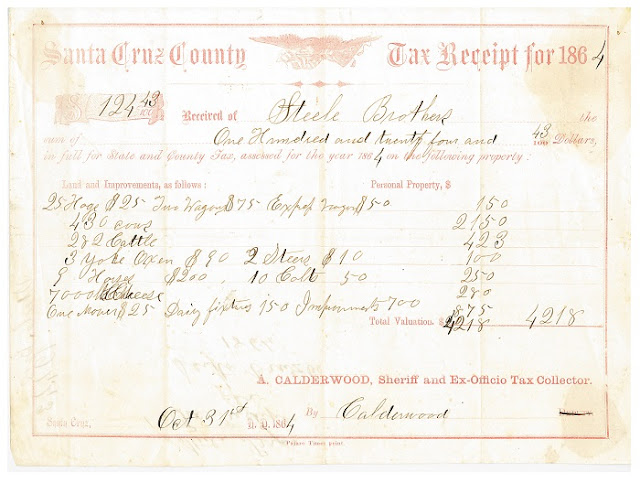
In the 1850s Clara Steele settled with her family near San Francisco. She missed the delicious cheddar cheese she enjoyed back in Ohio made from a family recipe, so she hired an Indian man to help her wrangle the cattle grazing near her home. With the milk from these cattle she replicated the cheddar cheese she so loved. The results were so delicious that when she introduced the cheese to the San Francisco market it was an immediate hit! Clara, her husband Rensselaer and cousins Isaac, Edgar and George begin making and selling high quality cheese and butter and start one of the first commercial dairies in the United States, known as Steele Brothers. By 1857 the Steele Brothers were so successful they relocated to a 6,000 acre farm in Point Reyes to expand their dairy operation. In 1861 they purchased 15,000 acres in Santa Cruz County. Here is a tax receipt for the Steele Brothers Santa Cruz County property. Note the 7000 lbs. of cheese at a value of $280.00.


Throughout the 1880s and 1890s dairying becomes less of a rustic enterprise and begins to rely on modernization to allow the booming industry to supply its customers with safe, quality products. Improved farming techniques such as extensive planting and irrigation of alfalfa nourished cows and improved production to meet the needs of the market. In the rapidly growing cities, dairy products could be delivered straight to the customers home or business.


 Modern dairying equipment such as cream separators, refrigerators, milking machines and even butter wrapping machines industrialized the dairying industry.


From the dairy industry’s early beginnings, in which a pioneer woman had to wrestle wild cattle just to get a good piece of cheddar, to California’s current status as the nation’s leading dairy producer, dairying has made a significant impact on the economy, landscape and tastes of Californians.

References:
California Milk Advisory Board. Two Centuries of Prominence and Personalities. (Available: http://www.californiadairypressroom.com/Press_Kit/History_of_Dairy_ndustry, accessed June 2011).
California State Parks. Guide to the California Dairy Industry History Collection. (Available: http://www.parks.ca.gov/pages/1080/files/fa_456_001.pdf, accessed June 2011).

Jaime Henderson, Archivist
California Historical Society