Redirect to CHS blog

Showing posts with label History. Show all posts

Wednesday, June 29, 2016

This Day in San Francisco History: The Founding of Mission Dolores (Mission San Francisco de Asís)

William Alexander Coulter (b. Ireland, 1849-1936)
Mission San Francisco de Asis, 1910
Oil on canvas, 11 -1/2 x 17 -1/2 inches
California Historical Society, acquired through purchase and exchange
Acc. 62-88-1-2
On June 29, 1776, Mission San Francisco de Asís, named after St. Francis of Assisi but commonly known as Mission Dolores, was founded by Lieutenant José Joaquin Moraga and Francisco Palóu. It was officially dedicated on October 9, 1776. Today it is the oldest surviving structure in San Francisco and is in active use by the local Parish. On the 240th anniversary of the founding of Mission Delores, we look back on the importance of this institution in shaping California and its history.

Called “Mission Dolores” because of the nearby creek named “Arroyo de Nuestra Señora de los Dolores” (meaning “our lady of sorrows”), Mission Dolores was built on the site of the Ohlone Indians of the Chutchui village. The Ohlone Indians comprised one of 40 tribes in a large Native American population —numbering 10,000—that predated the arrival of the first Europeans to the Bay Area. For thousands of years they occupied the area in settlements of 200 to 500 persons and sustained themselves with a “hunter-gatherer” lifestyle: they did not cultivate crops or herd domestic animals but instead hunted native game as needed and utilized naturally available foods

Under the leadership of Father Junípero Serra, a Majorcan and superior of the Franciscan Fathers, the first mission was dedicated Mission San Diego de Alcalà on July 16, 1769. It was the first of nine missions Father Serra would personally found and the beginning of a series of twenty-one missions that formed the framework of what is now the modern state. Some of these sites evolved into cities we recognize today: San Diego, Santa Barbara, San Jose, and San Francisco. The Spanish used the missions as frontier outposts to colonize and convert Native Americans thus the missions provide a window to California and our nation's past. Few regions of the world have such a physical, visual timeline of a nation's growth and development.

Padre Fray Junipero Serra
Courtesy, California Historical Society, FN-23572
Jeu des habitans de Californie, 1822, Choris
Courtesy, California Historical Society
Vault 910.4 C45_004
Mission Dolores was the sixth mission established by Father Serra. Father Serra remains unchallenged as a pivotal force in California’s early history, though his canonization on September 23, 2015 was met with controversy and protest from many indigenous groups who criticized his treatment of the Native Americans. For more than twenty-five generations prior to the Missions, Native Americans lived in their own places and under the terms of their own culture;  however, the social forces, diseases and violence they encountered soon brought them to the brink of extinction. The missions enslaved Native Americans and used them for labor. Those who ran away were captured by soldiers, brought back, and whipped severely. The conditions allowed disease to spread like wildfire, ravaging the native population.

In 2004 artist Ben Wood and archeologist Eric Blind investigated a centuries-old mural
concealed behind the wooden altar of Mission Dolores. It was painted in ochre, white, red, yellow, black, and blue/gray directly onto plaster by Native Americans, though the names of the artists are unknown. A reredos covered up the 22 feet by 20 feet mural in 1796.  Whether the mural was a gesture of Christian piety on the part of the natives or if it reflects a native aesthetic or symbolism remains unclear. Wood and Blind photographed the mural over two weeks, shooting one foot at a time. The images were then manipulated into a single composite.


Photo of the recreated mural on Bartlett at 22nd Street.
Photographer: LisaRuth Elliot
San Francisco, CA
On April 14, 2011 a public painting of the mural was unveiled on Bartlett at 22nd Street in San Francisco. It was the result of a collaboration between the Mission Community Market and Jeremy Shaw and recreated by Ben Wood and local muralists Jet Martinez, Bonnie Reiss, and Ezra Eismont. The mural and Wood’s work with Mission Dolores has provided the public a glimpse of a very important piece of San Francisco history.

Mission Dolores and the Parish
Photographer: Kathleen Yago
San Francisco, CA
Mission Dolores. Dolores & 16th (Sixteenth) St., CA (1906)
Courtesy of the California Historical Society

The Mission Dolores chapel was finished in 1791 and built with adobe walls that were four feet thick. This may have been one of the reasons that the chapel was one of the buildings left standing after the 1906 San Francisco earthquake and fire. In 1916 the buildings were reinforced with steel and survived subsequent earthquake Loma Prieta in 1989. Today the Mission continues to play a central role in the religious, civic, and cultural life of San Francisco.


Sarah Lee
Intern
California Historical Society


Sources

· Ben Wood, "The Hidden Mural At Mission Dolores", Foundsf.org.

· Guire Cleary, "Encyclopedia Of San Francisco", Sfhistoryencyclopedia.com.
http://www.sfhistoryencyclopedia.com/articles/m/missionDolores2.htm

· "Junipero Serra", Biography.com.
http://www.biography.com/people/junipero-serra-9479243#synopsis

· Kevin Starr, California. (New York: Modern Library, 2005)

· "Native Groups Protest Pope Francis' Canonization Of Junípero Serra Over Role In California Genocide", Democracy Now!
http://www.democracynow.org/2015/9/23/native_groups_protest_pope_francis_canonization

· Rickie Lazzarini, "The History Of California", Kindredtrails.com.
http://www.kindredtrails.com/California-History-2.html

· "San Francisco De Asís | California Missions Resource Center", Missionscalifornia.com.
http://www.missionscalifornia.com/keyfacts/san-francisco.html

· Tricia Weber, "Mission San Francisco De Asis (Mission Delores)", Californias Missions.
http://www.californias-missions.org/individual/mission_san_francisco_de_asis.htm

· University of Santa Clara, "Historical Information - Mission Santa Clara De Asís", Scu.edu.
https://www.scu.edu/missionchurch/historical-information/


Wednesday, January 9, 2013

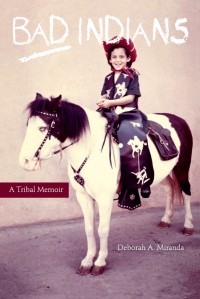
An Evening with Deborah Miranda, author of Bad Indians

Thursday, January 17, 2013, 6:00pm

Reservations are required
Free event at the California Historical Society
678 Mission Street
San Francisco


Join us for an evening with author Deborah Miranda. Her book,Bad Indians, part tribal history, part lyric and intimate memoir. Deborah A. Miranda tells stories of her Ohlone Costanoan Esselen family as well as the experience of California Indians as a whole through oral histories, newspaper clippings, anthropological recordings, personal reflections, and poems. The result is a work of literary art that is wise, angry, and playful all at once, a compilation that will break your heart and teach you to see the world anew. Deborah A. Miranda is an enrolled member of the Ohlone Costanoan Esselen Nation of California, and is also of Chumash and Jewish ancestry. The author of two poetry collections—Indian Cartography, which won the Diane Decorah Award for First Book from the Native Writer’s Circle of the Americas, and The Zen of La Llorona, nominated for the Lambda Literary Award—she also has a collection of essays, The Hidden Stories of Isabel Meadows and Other California Indian Lacunae, forthcoming from the University of Nebraska Press. Miranda is an associate professor of English at Washington and Lee University and says reading lists for her students include as many books by “bad Indians” as possible.

RSVP at mirandaatchs.eventbrite.com and we'll see you there! 

Wednesday, October 24, 2012

An evening with Matt Garcia, author of From the Jaws of Victory


Tuesday, November 13, 2012, 6:00 PM at the California Historical Society, 678 Mission Street, San Francisco


RSVP at http://jawsofvictory.eventbrite.com/.


Join us for an evening with author Matt Garcia. His book, From the Jaws of Victory: The Triumph and Tragedy of Cesar Chavez and the Farm Worker Movement is the most comprehensive history ever written on the meteoric rise and precipitous decline of the United Farm Workers, the most successful farm labor union in United States history. Based on little-known sources and one-of-a-kind oral histories with many veterans of the farm worker movement, this book revises much of what we know about the UFW. Matt Garcia’s gripping account of the expansion of the union’s grape boycott reveals how the boycott, which UFW leader Cesar Chavez initially resisted, became the defining feature of the movement and drove the growers to sign labor contracts in 1970. Garcia vividly relates how, as the union expanded and the boycott spread across the United States, Canada, and Europe, Chavez found it more difficult to organize workers and fend off rival unions. Ultimately, the union was a victim of its own success and Chavez’s growing instability.

From the Jaws of Victory delves deeply into Chavez’s attitudes and beliefs, and how they changed over time. Garcia also presents in-depth studies of other leaders in the UFW, including Gilbert Padilla, Marshall Ganz, Dolores Huerta, and Jerry Cohen. He introduces figures such as the co-coordinator of the boycott, Jerry Brown; the undisputed leader of the international boycott, Elaine Elinson; and Harry Kubo, the Japanese American farmer who led a successful campaign against the UFW in the mid-1970s. Copies of From the Jaws of Victory will be available for purchase at the event. 

Tuesday, September 4, 2012

African American Out Movements of San Francisco


Thursday, September 13, 2012, 5:00 pm

African American Out Movements of San Francisco

Panel Discussion at the California Historical Society
Free event at the California Historical Society, 678 Mission Street, San Francisco

RSVP at zacchochs.eventbrite.com.

From September 13-16, 2012, Zaccho Dance Theatre will perform Sailing Away: San Francisco’s 1858 Black Exodus. Sailing Away is a site-specific performance inspired by San Francisco’s early African American settlers. Created by Choreographer and Director Joanna Haigood, Sailing Away features eight prominent African Americans who lived and worked near Market Street during the mid-nineteenth century and evokes their participation in the mass exodus of African Americans from California in 1858.  Free performances occur at 12pm, 1:30pm, and 3pm traveling along Market Street beginning at the Market & Powell Street Cable Car station.

On opening day, a panel discussion and reception will be held in conjunction with scholars, historians, and local community leaders who will discuss San Francisco’s African American out migration then and now at 5pm at the California Historical Society. This panel discussion is co-presented by Zaccho Dance Theatre, the Museum of African Diaspora and the California Historical Society.


Panelist Biographies
As Co-Founder (1980) and Artistic Director of Zaccho Dance Theatre, Joanna Haigood's creative work focuses on making dances that use natural, architectural and cultural environments as points of departure for movement exploration and narrative. From harnessing the menacing energy of a 10-ton crane tofocusing on the delicacy of a butterfly’s nesting ground, her dances become extensions of their surroundings with choreography that interprets the site’s physical, cultural, and historical identities. Recent projects include The Shifting Cornerstone (2008) commissioned by Dancers’ Group and performed on the 3rd & Mission in collaboration with Yerba Buena Center; performance installation The Monkey and The Devil (2008) in collaboration with visual artist Charles Trapolin; Departure and Arrival (2007), commissioned by the SF International Arts Festival and performed at the SF International Airport; a remounting of Invisible Wings (first premiered in 1998 at SF’s Fort Point and based on the Underground Railroad) presented as the culminating event of the 75th anniversary season at Jacob’s Pillow; Breaking Ground (2005) a dance charette conceived and curated by Haigood, presented by Dancing in the Streets NYC; Ghost Architecture (2004) a meditative reflection on the controversial history of SF’s downtown redevelopment project at Yerba Buena Center for the Arts; A View From Here (2002) inspired by the paintings of Marc Chagall and presented at SF’s Theater Art and Picture conceived to be produced in three urban settings in celebration of communities,that while perceived as troubled, reveal unexpected and hopeful signs of renewal, Picture Powderhorn presented by the Walker Art Center in Minneapolis 2000 and Picture Redhook presented by Dancing in the Streets Brooklyn, NY 2002.
Joanna Haigood's work has been commissioned by leading arts presenters both nationally and internationally. Among them are the National Black Arts Festival, Festival d'Avignon and Festival d'Arles in France, the Exploratorium, Capp Street Project, Dancing in the Streets, the Walker Art Center, Jacob's Pillow, the San Francisco Art Commission, Kaatsbaan International Dance Center, and the McColl Center for Visual Art. Her choreography has also been commissioned by Alonzo King's Lines Contemporary Ballet, Robert Moses' KIN, and Axis Dance Company and is in the repertory of the Joffrey Ballet of Chicago. Ms. Haigood was honored in 2007 as recipient of the United States Artists Fellowship to further her work.
Gregory Hodge (panel moderator) is a youth development policy advocate and member of the Oakland Unified School District Board of Education from 2000-2008. Gregory Hodge also serves as an organizational development and community building consultant. He works with a range of groups from small nonprofitsand foundations to public agencies, particularly school districts. He was previously the Chief Executive Officer for California Tomorrow, an Oakland-based organization dedicated to building a strong multiracial and multicultural society. He also previously served as the Executive Director of Safe Passages, the Oakland Child Health and Safety Initiative. Prior to Safe Passages, Mr. Hodge was the Executive Director of the Urban Strategies Council, where he served as the director of the youth development initiative, managed the Freedom Schools program, and worked as the regional representative of the Black Community Crusade for Children, an effort coordinated nationally by the Children's Defense Fund.
Greg volunteered as the Master of Ceremonies of Bay Area Youth Arts’ annual Kwanzaa and Harvest Celebration for many years. His longtime support of Oakland’s esteemed Malonga Casquelourd Centerfor the Arts and of cultural arts, in general, as integral to positive community development is widely appreciated. Mr. Hodge continues to work as an attorney in private practice handling a variety of civillitigation matters. His involvements include member of the national Annenberg School District Reform Task Force. He holds a bachelor of arts degree from Northwestern University and a law degree from Golden Gate University, San Francisco, California. He is the father of four children.
Jan Batiste Adkins (panelist), an educator and lecturer, spent the last five years researching and documenting the history of San Francisco’s African American pioneers. Her master’s thesis from San Jose State University documented the history of the African American community as reflected in black newspapers of the 1850s through the 1890s. Her new book (January 2012) African Americans in San Francisco is an expansion of that project, for which she has consulted area archives, museums, and libraries, including the California Historical Society, the San Francisco African American Historical Society, the African American Museum and Library at Oakland, San Francisco Public Library History Center, California State Public Library, church and organization archives, and family albums. She has traveled to Canada and retraced the lives and destinations of many of San Francisco’s 1858 Canada-bound voyagers. In her book, she managed to weave a photographic tapestry of the amazing stories and history that began during the early years of the Gold Rush and continue into the present era.
Beginning in the 1840s, her book chronicles black men and women who heard the call to go west, migrating to California in search of gold, independence, freedom, and land to call their own. By the mid-1850s, a lively African American community had taken root in San Francisco. Churches and businesses were established, schools were built, newspapers were published, and aid societies were formed. For the next century, the history of San Francisco’s African American community mirrored the nation’s slow progress toward integration with triumphs and setbacks depicted in images of schools, churches, protest movements, business successes, and political struggles. Ms. Adkins book has been adopted by Bayview Superintendent Zone K-12 schools through San Francisco Unified School District.
Performer/presenter Cheryl Susheel Bibbs (panelist), Ph.D. who recently retired after 25 years teachingat UC Berkeley, is also a former EMMY-award winning WGBH-TV executive producer. Ms. Bibbs’ dramatic one-woman shows (chautauquas) on Mary Ellen Pleasant (depicted in Sailing Away) are part of the National Park Service Underground Railroad Network-to-Freedom Program that is acclaimed in the US and Canada. Susheel's dramatic one-woman chautauquas on Pleasant, which are part of the National Park Service Underground Railroad Network-to-Freedom Program, have been acclaimed in the US and Canada. Theresearch collection on which these works are based has been certified by the California Council for the Humanities.

Dr. Bibbs' award-winning book on Pleasant and Marie LaVeaux (Heritage of Power) and her documentary films on Pleasant -- The Legacy of Mary Pleasant and Meet Mary Pleasant, have won 6 broadcast and film-festival awards: The shorts -- Best Documentary Peace Reel Medallion at the Berkeley Film Festival and a Silver Telly (Northern Calfornia's premiere TV broadcast) Award, and the PBS documentary -- Best Historical Documentary and Best Director of a Documentary (for Bibbs) from the New York International Independent Film Festival and, most recently, The Gold Kahuna Award for Filmmaking Excellence from the Honolulu Film Festival. Dr. Bibbs' three-DVD archive on Pleasant, which demonstrates the research background forher chautauquas, is housed at the African American Museum and Library at Oakland, CA and at the San Francisco Public Library; her films on DVD are available there, at the Bancroft Library at UC Berkeley, on www.mepleasant.com and on Amazon.com.

Monday, September 3, 2012

White Wash


Sunday, September 16, 2012, 2:00 PM.

White Wash 

Film Screening and Discussion

Free Event at the Santa Monica Public Library Main Branch’s Martin Luther King, Jr. Auditorium, 601 Santa Monica Blvd. Santa Monica, CA

Seating is limited for this special screening. Guests should arrive in a timely manner, as seating will be offered on first come, first serve basis.

White Wash explores the history of African Americans and water culture, from slavery and civil rights wade-ins to surfing in contemporary times. This 2011 documentary includes archival footage and interviews with professional surfers, and features the historic beach site known as the “Ink Well.” A discussion with director Ted Woods, historian Alison Rose Jefferson and blacksurfing.com founder, Rick Blocker follows the screening. The California Historical Society is proud to join Heal the Bay, The Santa Monica Conservancy and the NAACP to sponsor the White Wash documentary screening event.

Sunday, September 2, 2012

California and the Civil War


Friday, September 21, 2012 at 6:00 PM

California and the Civil War

A Panel Discussion featuring Al Camarillo, Michael Magliari, Glenna Matthews, Ruthanne Lum McCunn, James Tejani, and Michael Green, moderated by Robert Cherny

RSVP at civilwarcalifornia.eventbrite.com/

For many, the words California and the Civil War seem to have nothing to do with each other. However, California played a significant role in the Civil War. Join us at the California Historical Society for a panel discussion of this fascinating topic. Historians and scholars will discuss many aspects including the Californio community, Indian slavery in California and what changed--or didn't--during the war, Chinese participation in the war, the impact of the war on the infrastructure of southern California and the twin sesquicentennials of the Preliminary Emancipation Proclamation and the launching of the huge fund-raising for the Sanitary Commission that week in San Francisco. This program is presented in collaboration with the Presidio Historical Association.

Tuesday, June 26, 2012

Civil Liberties in San Francisco with Stan Yogi and Elaine Elinson

Wednesday, July 11, 2012, 6:00 p.m.

Civil Liberties in San Francisco with Stan Yogi and Elaine Elinson

Join Stan Yogi and Elaine Elinson, co-authors of Wherever There's a Fight : How Runaway Slaves, Suffragists, Immigrants, Strikers and Poets Shaped Civil Liberties in California, 2010 Gold Medal winner in the California Book Awards.

Wherever There's a Fight captures the sweeping story of how freedom and equality have grown in California, from the gold rush right up to the precarious post-9/11 era.  It connects the experiences of early Chinese immigrants subjected to discriminatory laws and expulsion to those of African Americans who challenged the color bar on San Francisco Streetcars and workers who fought for union contracts on the docks and in the fields.

With vivid, illustrated stories, the authors will take you on a tour of key civil liberties sites in San Francisco – places you may have passed every day without realizing the hidden history they hold.  They will also share some treasures they found in the archives of the California Historical Society.

RSVP at civlibsf.eventbrite.com or 415.357.1848, ext. 233.

Sunday, June 3, 2012

Leo L. Stanley Scrapbooks and Papers


Leo L. Stanley Scrapbooks and Papers, 1849-1974 (bulk 1928-1965), MS 2061


For those drawn to the more colorful figures in California history, the recently re-processed and cataloged Leo L. Stanley collection might be of interest.

Dr. Stanley received a fair amount of notoriety in the press when it was revealed in 1928 that he was performing medical experiments on prisoners while acting as Chief Medical Officer at San Quentin State Prison. Less known, however, is that he was an enthusiastic pen-pal with some of San Quentin’s more infamous prisoners, including J.P. “Bluebeard” Watson, who was convicted for the murder of fifteen women.

This letter, from Watson to Stanley, is representative of the intimate tone found in much of the correspondence between Stanley and the convicts he cared for (regardless of the severity of their crimes).   


While Stanley’s personal and professional anecdotes are fascinating in their own right, his scrapbooks and papers also illuminate broader themes, including the history of San Quentin, the California prison system, convict labor, and human experimentation in medicine.

The new guide to the collection can be found on the Online Archive of California at http://www.oac.cdlib.org/findaid/ark:/13030/c80863rn

Megan Hickey Nespeco, Library Volunteer

Monday, May 28, 2012

Spanning Space and Time: The Golden Gate Bridge and the Transformation of the Bay Area


Thursday, May 31, 2012, 6:00pm

$8 admission for California Historical Society, San Francisco Architectural Heritage, or National Trust members

$12 admission for the general public

San Francisco Architectural Heritage, in partnership with the California Historical Society and the National Trust for Historic Preservation, Western Office, will hold a symposium to commemorate the 75th anniversary of the opening of the Golden Gate Bridge. Panelists Gray Brechin, Catherine Powell, and Dick Walker will explore themes such as art, commerce, labor, and demographics that are typically overlooked in standard accounts of the Golden Gate Bridge, which have traditionally focused on the bridge’s importance as an engineering feat (one of the modern “Wonders of the World”). The symposium will be moderated by John King, urban design critic for the San Francisco Chronicle. A Q&A will follow the program and light refreshments and wine will be served. Click here to but tickets for Spanning Space and Time.

About the panelists:

Gray Brechin
Dr. Gray Brechin became an environmentalist when he first read Rachel Carson’s Silent Spring on its publication in 1962. Prior to receiving his Ph.D. from the UC Berkeley Department of Geography in 1998, he covered environmental and urban issues as a columnist and television producer in San Francisco. His published dissertation, Imperial San Francisco: Urban Power, Earthly Ruin, spent 16 weeks on the San Francisco Chronicle’s best-seller list and is considered a classic of urban studies. He is the founder of the Living New Deal project and a Visiting Scholar at the UCB Department of Geography where the Living New Deal is based.

John King
John King is the San Francisco Chronicle’s Urban Design Critic, a post he created in 2001, and the author of “Cityscapes: San Francisco and Its Buildings,” published in May 2011 by Heyday. His work also has appeared in Dwell, Metropolis, and The American Scholar. He is an honorary member of the American Society of Landscape Architects and recipient of awards from the California Preservation Foundation and the state chapters of the American Planning Association and the American Institute of Architects.

Catherine Powell
Catherine Powell is the Director of the Labor Archives and Research Center at San Francisco State University.  She currently serves on the executive board of the California Faculty Association and is a delegate the San Francisco Labor Council and chair of its Law and Legislative Committee. She is also coordinator of the Bay Area Labor History Workshop and a board member of the Fund for Labor Culture and History. Catherine is co-editor of The San Francisco Labor Landmarks Guide Book: A Register of Sites and Walking Tours.

Richard Walker
Richard Walker is professor of geography at the University of California, Berkeley, where he has taught for 35 years. Walker has written on a diverse range of topics in economic, urban, and environmental geography, with scores of published articles to his credit. He is co-author of The Capitalist Imperative (1989) and The New Social Economy(1992) and has written extensively on California, including The Conquest of Bread(2004) and The Country in the City (2007).   He is also PI of the Living New Deal Project to inventory all New Deal public works sites in the United States.

Saturday, May 26, 2012

A Wild Flight of the Imagination: The Story of the Golden Gate Bridge eBook

As hundreds of thousands of admirers of the Golden Gate Bridge begin to converge on the San Francisco Bay area to celebrate the 75th Anniversary of the world-renowned icon, the California Historical Society has released its first multi-media eBook for iPads that captures the rich history and amazing story of the Bridge through a selection of rarely seen artwork, photographs, video, memorabilia, stories, images and much more.

The free iPad eBook, A Wild Flight of the Imagination: The Story of the Golden Gate Bridge, can be downloaded through the California Historical Society’s new, dynamic and image-rich website at www.californiahistoricalsociety.org.  The app is also available on Apple's iTunes App Store as a free download under the name “GG Bridge.” 

Published by the California Historical Society and produced by Sol Editions and Wild Blue Studios, the eBook was funded through a grant provided by United Healthcare.

“The story of the Golden Gate Bridge is a remarkable one, captivating millions of people around the world with its themes of promise, innovation, perseverance, and artistic inspiration,” said Dr. Anthea Hartig, Executive Director of the California Historical Society. “This eBook will help share that story and bring the amazing history of this California icon to life in an interactive way.”

The eBook’s title is drawn from the exhibition of the same name currently on view at the California Historical Society galleries. The phrase is borrowed from a 1921 promotional prospectus for the Golden Gate Bridge in which the authors, chief engineer for the bridge Joseph Strauss and San Francisco city engineer M.M. O’Shaughnessy, used inspirational language to set a tone for the enormously ambitious engineering feat.

The interactive multimedia app extends the reach of the California Historical Society’s exhibition and makes over 350 historic objects, including dozens of photographs, letters, journals, reports and other ephemera from its own holdings and 19 other collections available to readers of all ages.
Highlights include photographs by Ansel Adams and Dorothea Lange, paintings by Maynard Dixon, Ray Strong, and Chesley Bonestell, and architectural drawings by Irving F. Morrow and John Eberson, the two architects who worked on the bridge design. Audio highlights include the heroic and poignant voices of men who built the bridge and an opening music selection from composer Rob Kapilow’s “Chrysopylae,” A Golden Gate Opus, written with contributions from sound designer Fred Newman.
Readers of all ages can also watch a short film of Chief Engineer Strauss speaking to a reporter on the bridge during construction, examine the family scrapbook of Fred Dummatzen, one of the workers who tragically lost his life when a scaffold collapsed, and even view some of the proposed bridge color schemes that were ultimately rejected.
“This exciting new format allows us to bring the richness of our historic collections to a much larger audience, including teachers and students, and will allow many more people around the world to share in the Golden Gate’s 75th Anniversary, even if they cannot be here in person,” Hartig said.

Wednesday, April 25, 2012

Geil J. Norris Family Papers, Vault MS 156


Geil J. Norris Family Papers, Vault MS 156


            These New Year cards—printed in Mexico City in 1881 for Sam Brannan and Manual Castro, with the Mexican coat of arms and, yes, real feathers affixed in the shape of birds—are part of the recently cataloged Geil J. Norris Family Papers. Though small, the collection contains many notable and exquisite examples of Californiana documenting the Pico, Castro, and Sanchez families, from which Mr. Norris was descended, throughout the nineteenth century. Highlights of the collection include: an 1844 broadside announcing Thomas O. Larkin’s appointment as United States consul; letters by Zamorano, Pío Pico, Thomas O. Larkin, and Manuel Castro; documents pertaining to the Mexican War, including an 1846 bando and a letter of protest written by the minister of the missions at Santa Clara and San José; and the pictured greeting cards. 

            The cards (and a letter in the collection) tell an interesting story in their own right, suggesting that Mormon pioneer Sam Brannan and Mexican War general Manual Castro were business associates in Mexico in the early 1880s, when Brannan was involved in land speculation schemes in Sonora. The collection as a whole reminds us of the complex and historic interconnections—political, economic, and familial—between Mexico and California.

            A detailed guide to the collection is available on the Online Archive of California: http://www.oac.cdlib.org/findaid/ark:/13030/c8k072ns

Marie Silva
Archivist & Manuscripts Librarian 

Monday, April 16, 2012

George Cruikshank, Charles Dickens’ illustrator & temperance advocate

George Cruikshank, Dickens’ illustrator & temperance advocate

In belated celebration of Charles Dickens’ 200th birthday, we present a letter from the CHS Collection, written by George Cruikshank, the Victorian caricaturist most famous perhaps for his illustrations of Oliver Twist:


In this 1848 letter, Cruikshank presents his nephew W. Percy Cruikshank to a C. M. Evans of Birmingham. Cruikshank (the nephew) delivered lectures “in the provinces” on The Bottle, his uncle’s popular illustrations on the evils of alcoholism. (On the temperance issue, Dickens and Cruikshank parted ways.)

Despite some preliminary investigation, the provenance of this letter remains a mystery. Did C. M. Evans eventually leave Birmingham for the golden shore of California?
                                                                       
Marie Silva, Archivist & Manuscripts Librarian