Redirect to CHS blog

Showing posts with label Conference. Show all posts

Monday, March 25, 2019

Teaching California at California Council for the Social Studies conference 2019

On March 15th, California Historical Society Reference Librarian (and super colleague) Frances Kaplan and I traveled to the annual California Council for the Social Studies (CCSS) conference to promote CHS’s new curriculum project, Teaching California. Each year, the CCSS conference aims to deliver professional development for educators focused on new scholarship, research-based strategies, and networking -- all designed to improve the teaching and learning of history/social studies across the state. Held in San Jose this year, CCSS 2019 was filled to the brim with presentations, workshops, and exhibitors, and was well-attended by educators from across the state.
Shelley Brooks, California History-Social Science Project (CHSSP) Program Coordinator, previewing student and teacher resources found in Teaching California’s instructional materials focused on the California Missions (taught in 4th grade).
Frances and I presented at two separate sessions (one aimed at the elementary school-level and one at the high school-level), each together with members of our Teaching California curriculum partners at the California History-Social Science Project. In these sessions, titled “Teaching CA: Bringing Archives into the Classroom,” we introduced teachers and administrators to our project, a joint collaboration between archivists, librarians, educators, and subject specialists.

Our goal is to empower teachers to engage in inquiry instruction that is aligned to California’s new History-Social Science Framework, improves student literacy, and supports civic learning and engagement. In both sessions, teachers practiced the historical investigation process and, excitingly, previewed some of the inquiry-based lessons (and primary sources!) that we are creating for the project. Here are more scenes from our sessions:
Tuyen Tran, Assistant Director of CHSSP, going over the basics of California’s new History-Social Science Framework. Teaching California will create Framework-aligned materials that will aid in school and classroom implementation.


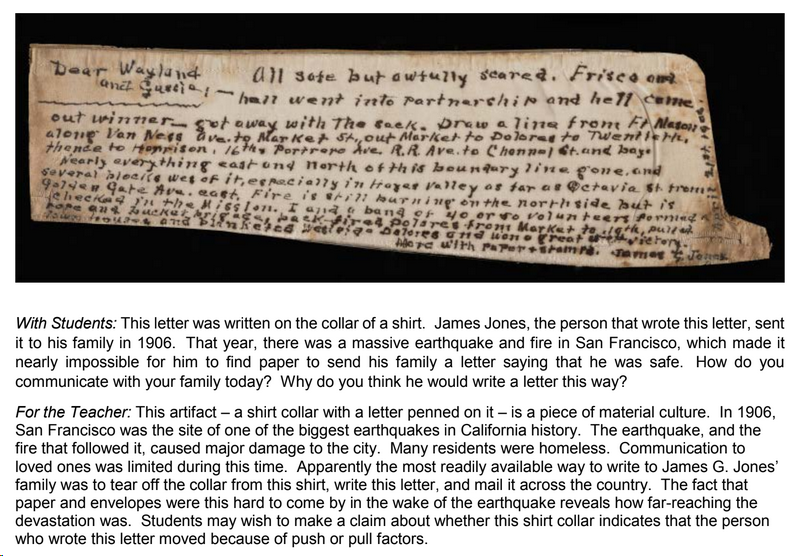
A closer look at a draft of one of our Teaching California lessons, called “inquiry sets,” for the second grade, which includes both primary sources and contextual information aimed at both students and teachers. This set includes a handwritten note on a collar produced during the 1906 earthquake and fire, from CHS's collections of California history.
Elementary school teachers review drafts of Teaching California’s second-grade instructional materials, which includes never-before-seen objects and photographs from CHS’s collections.


To view the slides for one of our CCSS sessions on Teaching California, visit this link.
 ---
This post comes from Kerri Young, Teaching California Project Manager. You can reach out to her at kyoung@calhist.org

Friday, June 1, 2018

Event recap: Rolling out California's new History and Social Science Framework in Sonoma


CHSSP's Statewide office team and Teaching California Project Manager Kerri in front of the day's schedule, May 22nd, 2018. Left to right: Tuyen Tran (CHSSP), Nancy McTygue (CHSSP), Kerri Young (CHS), Beth Slutsky (CHSSP).


On May 22nd, our friends and partners at the California History and Social Science Project (CHSSP) invited us to attend a local conference at Sonoma State University, part of series they are doing to promote California's new History and Social Science Framework. The CHSSP served as the primary writers of the new Framework, adopted by the State Board of Education in 2016, which outlines an instructional approach that promotes student-centered inquiry and encourages students to develop clear and persuasive arguments based on their own interpretations of the past, using relevant evidence. While the history and social science standards for California provide the “what” of an instructional program (unchanged), the Framework helps flesh out the “how (new!)”

CHSSP Director Nancy giving the day's opening address. She was joined onstage by Michelle Herczog of the Los Angeles County Office of Education (far left), and Kristin Cruz Allen of the California Department of Education.

As we continue to work with CHSSP to create and implement Teaching California, this was an opportunity to dig into the important instructional shifts that inform the content development work we are doing. With its emphasis on content, inquiry, literacy, and citizenship, the Framework, and by extension our project, will offer students the opportunity to learn about the world and their place in it, think critically, read, write, and communicate clearly, all through a uniquely California lens.

Our Reference Librarian, Frances Kaplan, and I attended multiple sessions, learning about as many sections of the Framework as we could. From the new FAIR Education Act's role in the new Framework rollout, to the ways Ethnic Studies, Literacy, and US History content are articulated, there was a lot to learn!

CHS Reference Librarian Frances Kaplan (right), with Molly Snider from Mendocino's California Office of Education. Molly hosted a session we attended focusing on K-5 Inquiry, and the importance of introducing students to primary sources at an early age.

As Teaching California's Project Manager, it was fantastic to get a closer look at the monumental effort that was the writing and adopting of the Framework, as well as having the opportunity to speak with local K-12 teachers and administrators. We were very inspired learning about the ways they are already helping students learn inquiry, literacy, and citizenship in the classroom, and how the new Framework will help better guide and build upon the work that they are already championing in their schools. Further, all were excited at the prospect of incorporating these skills into the history and social science curriculum as early as Kindergarten, a shift in approach that builds capacity even before students enter middle school.

In a session about how Ethnic Studies is articulated in the Framework, participants were asked to consider California's ethnic makeup and how that compares with the rest of the country. We discussed how the Framework can help teachers, according to CHSSP Site Director Rachel Reinhard, bring their students' "full cultural self to the classroom space."

But for many teachers, Framework implementation does not come without its fair share of challenges, including in many cases the lack of up-to-date textbooks, or starting out as the sole champion of the Framework at his or her school and faced with the task of building capacity in a strategic and resourceful way. Hearing these comments, it was heartening to know that Teaching California will be able to fill a crucial need by providing free and online resources for teachers to more easily implement the Framework in their local areas.


Handouts from the day. 

A lovely day at Sonoma State's Student Center. 

For more information about California's new History and Social Science Framework, visit CHSSP's website at http://chssp.ucdavis.edu/framework and the California Department of Education’s Framework page at https://www.cde.ca.gov/ci/hs/cf/.

Stay tuned for more on Teaching California here soon!

The California Historical Society is working in partnership with the California History-Social Science Project (CHSSP) at UC Davis to establish and implement Teaching California: a free and expansive online set of instructional materials to support the State’s new K-12 History-Social Science Framework. Comprised of curated primary source material from California's premier archives, libraries, and museums, Teaching California presents a research-based approach to improving student reading, writing, and critical thinking. This post comes from Kerri Young, Teaching California Project Manager. You can reach out to her at kyoung@calhist.org 

Saturday, February 23, 2013

Scanning the Horizon


The Society of California Archivists will hold its 2013 Annual General
Meeting on April 11-13, in Berkeley, California.

Complete schedule, registration, and hotel information is available at

This year's conference theme, "Scanning the Horizon," invites you not
only to gaze at the Golden Gate views afforded by our bay front hotel
location, but also to look ahead at the world of archives and historical
research in the 21st century. The program includes sessions that take
stock of the impact of digital technology, online primary resources, and
trends in digital humanities. There will be even more offerings
addressing traditional processing, reference, public outreach, grant
management, and audiovisual preservation, among other engaging topics.

Photo by Ansel Adams. Courtesy of the Bancroft Library

In addition to two days of sessions, the SCA AGM offers two
pre-conference workshops, an opening reception at the Berkeley Hillside
Club, and numerous opportunities to network and mingle at repository
tours, vendor exhibits, and a new member happy hour!

The venue will be the DoubleTree Hotel at the Berkeley Marina.

Follow SCA on Facebook and Twitter for additional updates:
@calarchivists  (use the hashtag #sca13 to follow all AGM-related
tweets)