 |
| Pacific Mail Steamship Co's Steamer Sonora bill of fare, circa 1858, Kemble MS OV 1, California Historical Society |

Monday, February 23, 2015
Manuscript Monday—Bill of Fare for the Steamer Sonora
This week we present another gem from the Society's Kemble Collection, a bill of fare for the Pacific Mail Steamship Company's Steamer Sonora, dated circa 1858. The carnivorous traveler could choose from a variety of boiled, fried, stewed, and roasted meats—including beef, pork, chicken, ham, mutton, tongue, kidneys, and pigs' heads. The menu was printed by the Excelsior Steam Presses in San Francisco.
Tuesday, February 17, 2015
Type Tuesday - More Nelson C. Hawks and the Pacific States Type Foundry

Specimens initialed by "NCH" had been set by Hawks, although I believe his sense of humor might have also made its way into the bill heads and newspaper masts featured below.


Jaime Henderson,
Archivist
Monday, February 16, 2015
Manuscript Monday—Nelson C. Hawks diaries
At the 48th California International Antiquarian Book Fair, held last weekend in downtown Oakland, CHS exhibited a few volumes from the diaries of the great San Francisco printer Nelson C. Hawks. Born in Milwaukee in 1840, Hawks came to San Francisco in 1874 as an agent of the Chicago firm Marder, Luse & Co. and was put in charge of the newly established Pacific Type Foundry. Hawks is most famous for inventing the American point system for standardizing types. (The French type founder Simon-Pierre Fournier actually originated the point system in 1734, but this system had not been implemented in the United States.) He also wrote very funny texts for type specimen books, as described by Alastair Johnston in his Type Tuesday post of September 10, 2013: http://californiahistoricalsociety.blogspot.com/2013/09/type-tuesday-nelson-c-hawks.html
Hawks’ diaries form part of the Kemble Collections on
Western Printing and Publishing. The opening salvo of his first extant journal,
written in 1855 when Hawks was still a teenager, is extraordinary. Is it an
early specimen of Midwestern deadpan or dead serious?
 |
| Nelson C. Hawks diary, v. 1, 1855, Nelson C. Hawks diaries, Kemble MS 3, California Historical Society |
I, Nelson Crocker
Hawks, was born in the city of Milwaukee, on the 21st day of August,
A.D., 1840. My early life was full of suffering. When I was a year old I had “dropsy
of the brain,” in consequence of which, my head grew out of shape. When I was
four year old, I had the “inflammation in the eyes,” and was perfectly blind. I
continued so two years and then was afflicted with the “rheumatism.” I could
not walk around much until I was eight years old. I then went to school.
Marie Silva
Archivist & Manuscripts Librarian
Tuesday, February 10, 2015
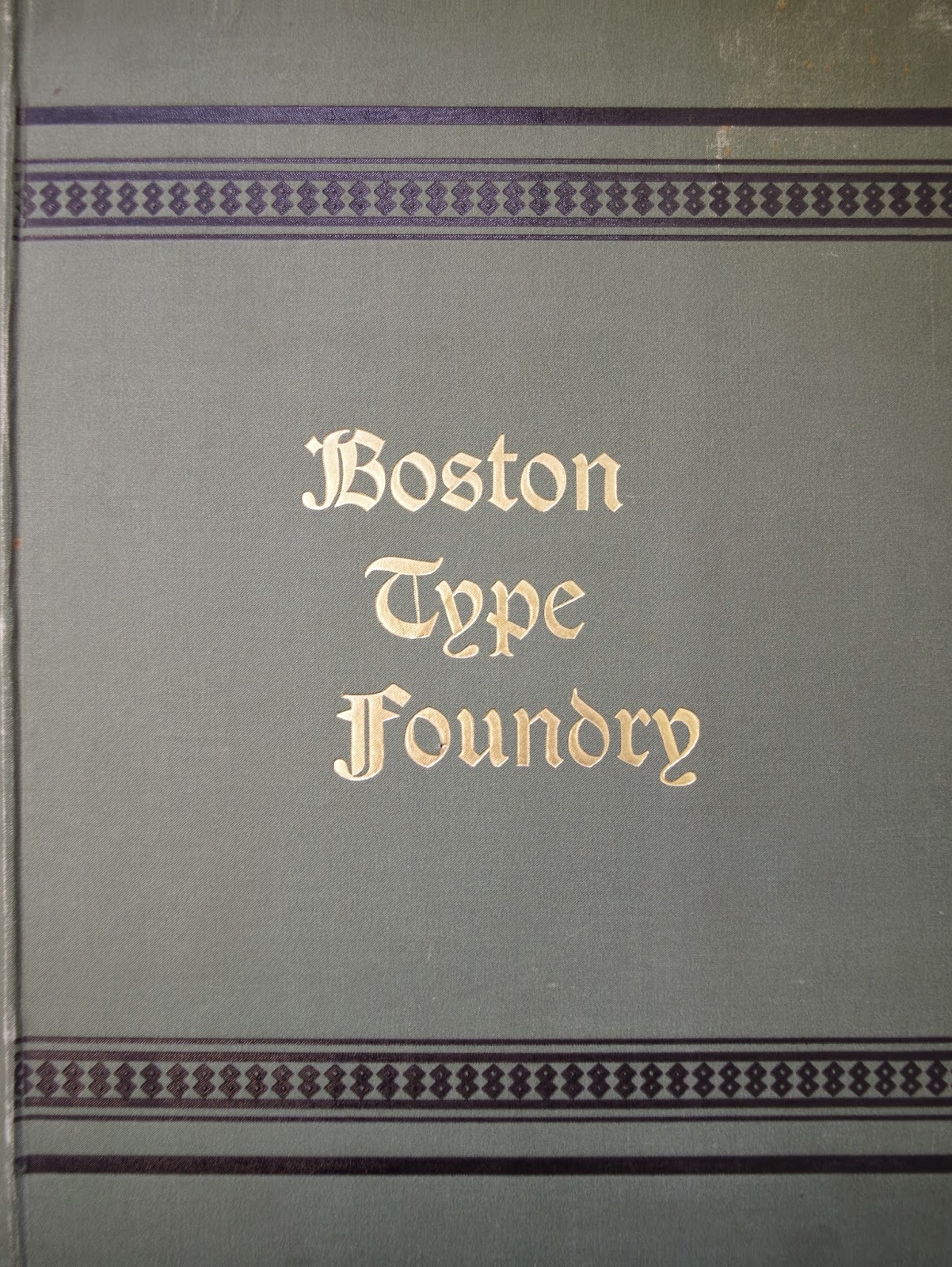
Type Tuesday - Boston Type Foundry
These outstanding types were spotted in the recently catalogued 1892 type specimen of the Boston Type Foundry.
These specimens of letter combinations are crying out for colorful tiles to bring out the best in their appearances!


Jaime Henderson
Archivist
These specimens of letter combinations are crying out for colorful tiles to bring out the best in their appearances!
Jaime Henderson
Archivist
Tuesday, February 3, 2015
Type Tuesday - Boston Type Foundry
Today we feature specimens from the oldest type foundry in New England, the Boston Type Foundry, established in 1817.

Boston Type Foundry agent John K. Rogers writes in the preface to the 1883 type specimen:
The Boston Type Foundry is not only the FIRST Letter Foundry
in New England, having been established in 1817, but takes precedence also in
the number and variety of its Faces, the quality of its Metal, the accuracy of
its Bodies, and the general perfection of its manufacturers.
The Type-Casting Machine now in use all over the world, was
developed and perfected at this Foundry in 1843, under the direction of Mr.
David Bruce, the inventor.


Jaime Henderson,
Archivist
Monday, February 2, 2015
Manuscript Monday—Sir Dynamite!
I was delighted to discover this anarchist broadside, with mysterious manuscript notations, in the California Historical Society's Kemble Collection on Western Printing and Publishing. Described by Gary F. Kurutz as the "jewel in the crown of the Society's Research Library," the Kemble Collection comprises an extraordinary diversity of materials related to printing and publishing history, including books, periodicals, type specimens, labels, and manuscript collections. Our local Type Tuesday correspondent presents gorgeous typographic specimens from the Collection each week.

Dated from the 1880s, this broadside was published by Patrick Joseph Healy's Antiquarian Book Store and Song Factory at 104 O'Farrell Street. Healy, to whom an entire chapter is dedicated in Robert Cowan's Booksellers of Early San Francisco, is one of the most fascinating (and endearing) characters in the colorful book history of San Francisco. An Irish immigrant and labor activist, he earned the animus of his comrades by vigorously defending the rights of the Chinese during the sandlot riots. He opened his first bookshop in 1883 at the address above. His shop (later known as "the Tunnel" because of its narrow dimensions) became a sort of informal, democratic salon for political discussion and debate.
The song reproduced here is laden with Messianic expectation, as is typical of the radical discourse of the period:
The weary slave in mill or mine,
The peasant and toiling herd,
Through the ages awaited the "coming sign,"
And died from "hope deferred."
"How long, oh, Lord!" they cried, "how long,"
Must we toil, and weep, and slave?"
But an answering cry for their cruel wrong
At length the heavens gave,
In a new Messiah, to loose the bands
That chained down the sons of earth;
Send joyous tidings o er sea and lands
To cheer the poor toilers' hearth.
Let all proclaim his glorious name,
Who comes, man's wrong to right,
A terror he brings to the heart of Kings—
Puissant Sir Dynamite!
In 1905, Healy and Ng Poon Chew, the editor of a Chinese daily newspaper, co-authored A Statement for Non-Exclusion, an impassioned polemic in defense of Chinese rights. This work can also be found in the Society's collection.
Marie Silva
Archivist & Manuscripts Librarian
msilva@calhist.org
Dated from the 1880s, this broadside was published by Patrick Joseph Healy's Antiquarian Book Store and Song Factory at 104 O'Farrell Street. Healy, to whom an entire chapter is dedicated in Robert Cowan's Booksellers of Early San Francisco, is one of the most fascinating (and endearing) characters in the colorful book history of San Francisco. An Irish immigrant and labor activist, he earned the animus of his comrades by vigorously defending the rights of the Chinese during the sandlot riots. He opened his first bookshop in 1883 at the address above. His shop (later known as "the Tunnel" because of its narrow dimensions) became a sort of informal, democratic salon for political discussion and debate.
The song reproduced here is laden with Messianic expectation, as is typical of the radical discourse of the period:
The weary slave in mill or mine,
The peasant and toiling herd,
Through the ages awaited the "coming sign,"
And died from "hope deferred."
"How long, oh, Lord!" they cried, "how long,"
Must we toil, and weep, and slave?"
But an answering cry for their cruel wrong
At length the heavens gave,
In a new Messiah, to loose the bands
That chained down the sons of earth;
Send joyous tidings o er sea and lands
To cheer the poor toilers' hearth.
Let all proclaim his glorious name,
Who comes, man's wrong to right,
A terror he brings to the heart of Kings—
Puissant Sir Dynamite!
In 1905, Healy and Ng Poon Chew, the editor of a Chinese daily newspaper, co-authored A Statement for Non-Exclusion, an impassioned polemic in defense of Chinese rights. This work can also be found in the Society's collection.
Marie Silva
Archivist & Manuscripts Librarian
msilva@calhist.org
Tuesday, January 27, 2015
Type Tuesday - Typothetæ and Platemaker
Today we feature another selection from the Kemble Collection's outstanding holdings of periodicals on printing and typography.

Typothetæ and Platemaker was a journal “devoted to Printers, Engravers and Electrotypers” and featured beautifully illustrated, brightly colored covers.


The California Historical Society's Kemble Collection holds the full run of Typothetæ and Platemaker, from January of 1898 to December of 1900. January of 1901 marked a name change for the journal to The Progressive Printer, which the California Historical Society also houses.

The California Historical Society's Kemble Collection holds the full run of Typothetæ and Platemaker, from January of 1898 to December of 1900. January of 1901 marked a name change for the journal to The Progressive Printer, which the California Historical Society also houses.
Visit the California Historical Society's North Baker Research Library to view these (and many other) gorgeous journals available in our Kemble Collection on Western Printing and Publishing.
Jaime Henderson
Archivist
Monday, January 26, 2015
Manuscript Monday—Guyana Emergency Relief Committee

 |
| Guyana Emergency Relief Committee press release, 1979 January 18, Donneter Lane papers relating to the Guyana Emergency Relief Committee, MS 3792, California Historical Society |
Among these collections is a small but significant body of
records maintained by Donneter Lane of the Guyana Emergency Relief Committee.
The Guyana Emergency Relief Committee (GERC) was formed on November 28, 1978,
by members of the San Francisco religious community in response to the deaths
of over 900 people at Jonestown, Guyana, on November 18, 1978. Composed of
representatives of the San Francisco Council of Churches, the Archdiocese of
San Francisco, and the Board of Rabbis of Northern California, the Committee
had a two-fold purpose: to assist with the expeditious return of over 500
bodies from Dover Air Base, Delaware, to California for proper burial; and to
provide counseling, pastoral services, and material assistance to grieving
families.
In order to obtain funds for the interment of unidentified
or unclaimed bodies from Peoples Temple assets, the Committee participated in
proceedings held in the Superior Court of California for the winding up and
dissolution of Peoples Temple (Peoples
Temple of the Disciples of Christ v. The Attorney General of the State of California)
as an Amicus Curiae ("friend of
the court"). The Superior Court ordered that a portion of Peoples Temple
assets be set aside to pay for burial expenses, and approved the Committee's
plan for the removal, transportation, and burial of the bodies.
Cooperating closely with the State Department, the Committee
communicated with family members (representing over 547 Jonestown victims) by
telephone and letter. On a case by case basis, the Committee ascertained the
wishes of family members regarding the burial of loved ones, arranged for the
shipment and interment of remains, and helped family members obtain
reimbursement for burial expenses. On May 10, 1979, the first 50 unidentified
bodies were buried at Evergreen Cemetery in Oakland, California.
The collection at CHS documents the Committee’s early and
diligent efforts to ensure dignified burials for Jonestown victims. In an
interview for the book The Need for a
Second Look at Jonestown (edited by Rebecca Moore and Fielding M. McGehee
III), Rabbi Malcolm Sparer, one of the principal organizers of the Committee,
recalled that only fifty members of the community attended a memorial service
for the Jonestown victims organized by San Francisco Council of Churches and
held the Sunday night before the assassination of Mayor Moscone. Despite the
winds of fear and violence that swept over San Francisco in the terrible final
months of 1978, the members of the Guyana Emergency Relief Committee resolved
to pursue a course of pastoral care, cooperation, and healing.
Marie Silva
Archivist & Manuscripts Librarian
msilva@calhist.org
Tuesday, January 20, 2015
Type Tuesday - The Merrymount Press
Today we feature type specimens from the Merrymount Press.


The press was founded by Daniel
Berkeley Updike in Boston, Massachusetts and remained active from 1893-1941.
The Merrymount Press is considered to have printed books that best represent the Arts and Crafts
movement in American book arts.
The press' archives are housed at the Boston Athenaeum.
Jaime Henderson,
Archivist
Friday, January 16, 2015
Mojo Navigator Rock & Roll News

The wild going-ons of San Francisco’s psych rock scene were
recorded in the West Coast’s first rock & roll magazine Mojo Navigator R&R News. Its premier
issue, published by teenagers David Harris and Greg Shaw on August 8, 1966,
includes a colophon stating the Mojo Publishing Company, at 2707 McAllister
Street, San Francisco, would publish weekly. The mimeographed, stapled zine did
not stick too closely to this arduous weekly schedule - presumably its young
editors were busy attending the many musical performances, light shows, be-ins
and happenings that Mojo Navigator
covered in its gossip and events columns. Instead, only fourteen issues were
published beginning in August of 1966 and ceasing sometime in 1967. But these fourteen issues
included interviews with bands that would come to be known as seminal rock
& roll artists, and the short-lived zine would be considered a major
influence for the creation and publication of Rolling Stone magazine.
Harris and Shaw attended high school together in a Bay Area
suburb. Harris had been a rock & roll fan, listening to Berkeley’s KPFA Midnight
Special radio show, which featured local artists such as The Grateful Dead
and Janis Joplin playing live music and attending shows at the Longshoreman’s
Hall, the Avalon Ballroom and the Fillmore Auditorium. Shaw was more interested
in print – writing and publishing two fanzines. The first, Entmoot, was devoted to the writings of J.R.R. Tolkien, and the
second, a sci-fi fanzine called Freemwlort.
What Shaw might have lacked in knowledge of the San Francisco rock & roll
scene, he more than made up for with his zine making skills, including a keen talent for stenciling and being particularly handy with the mimeograph machine.

Courtesy
rockandrollreport.com/book-review-bomp-saving-the-world-one-record-at-a-time/
Just out of high school, Harris, Shaw, and Geoff Evans, Mojo Navigator’s art director, moved to
McAllister Street, nearby Golden Gate Park’s Panhandle, where the Diggers
distributed free food to any person who was hungry and held rallies and
happenings for the hippies that proliferated in the Haight neighborhood. From
their apartment, Harris and Shaw began work on the first issue of Mojo Navigator R&R News. Published
Tuesday, August 8, 1966, the typed, four-paged zine contained gossip and news
about Bay Area artists such as Jefferson Airplane, Big Brother and the Holding
Company and R&B artists such as Howlin’ Wolf and Bo Diddley; Shaw’s record
reviews of The Peter, Paul and Mary Album (“Don’t
expect much from this record if you do buy it”) and the Byrds Fifth Dimension (“every song is flavored strongly
with originality and performed flawlessly”); and a special report on radio DJ
Wolf Man Jack, based out of Chula Vista, California, who could be heard in
the Bay Area on XERB 1090 from 9 pm to 3 am. One hundred copies of the inaugural
issue were printed and made available in local stores, such as Cosmo’s Grocery
Store, the Psychedelic Shop and City Lights Bookstore.
As Mojo Navigator’s
popularity grew so too did its print runs and distribution. The burgeoning San Francisco
rock & roll scene created a fan base that yearned for a smart, hip and
in-the-know music magazine that featured news and criticisms about the bands
they were listening to. The teen magazines such as Teenbeat and 16 wouldn’t touch the long-haired, drugged out, heavy guitar bands, instead still focusing
on teenybopper pop and American Bandstand
hit makers. Music journalist Mick Farren noted: “A new and serious breed of
rock fan required a publication that could be trusted to clue them in on all
that was happening as original music – from A to Z, from The Animals to Frank
Zappa – poured from every creative orifice.... An embryonic
rock magazine would need to have the grit of the street and a delinquent
iconoclasm.”
Short on the heels of the publication of East Coast writer
Paul Williams’ Crawdaddy - the
earliest rock & roll fanzine - Mojo
Navigator R&R News provided its San Francisco Bay Area readers
with reviews, gossip, and interviews with bands producing the acid-infused,
psychedelic sounds of the local scene, while also keeping its hip readers in
the loop about happenings such as the San Francisco Calliope Company’s dance
parties and the Diggers' Love Pageant Rally, where participants gathered
together to ingest LSD on October 6, 1966. Farren notes that Mojo Navigator’s writing was “smart, and yet still manage[d] to
retain the disturbed and disturbing subversion of the street.”

During Mojo Navigator’s just-over-one-year, fourteen issue run, Harris and Shaw managed to interview the
heavyweights of rock & roll,
publishing possibly the first interview with the Grateful Dead in August and
September of 1966 (before the release of their self-titled first album in
1967); and interviews with Big Brother and the Holding Co., Country Joe and the Fish, and the
Doors. The magazine ceased publication in 1967, not before providing a major
influence to fellow San Franciscan Jann Wenner, who began publication of Rolling Stone magazine in November of
1967.
In 1970 Greg Shaw introduced Who Put the Bomp in response to the "mainstream" music press. The magazine published the early writings of rock music journalists Lester Bangs, Greil Marcus and Richard Meltzer, and grew into an independent record label, BOMP!, with the 1974 release of the San Francisco-based band Flamin' Groovies' single "You Tore Me Down." BOMP! Records has released innumerable influential artists in the garage, punk and power pop genres. The label continues today under the guidance of Suzy Shaw, ex-wife and life-long friend and partner to Greg, after his death in 2004.
In 1970 Greg Shaw introduced Who Put the Bomp in response to the "mainstream" music press. The magazine published the early writings of rock music journalists Lester Bangs, Greil Marcus and Richard Meltzer, and grew into an independent record label, BOMP!, with the 1974 release of the San Francisco-based band Flamin' Groovies' single "You Tore Me Down." BOMP! Records has released innumerable influential artists in the garage, punk and power pop genres. The label continues today under the guidance of Suzy Shaw, ex-wife and life-long friend and partner to Greg, after his death in 2004.
The California Historical Society holds four of the fourteen
issues of Mojo Navigator R&R News, including the rare first issue, and the issues featuring the two part
interview with the Grateful Dead. We will be featuring our holdings of Mojo Navigator R&R News,
along with other rock & roll ephemera and posters from the CHS vaults in an
open house as part of our program Creating
a Lasting Cultural Community: The 50th Anniversary of the Grateful
Dead, featuring author Dennis McNally, Grateful Dead archivist Nicholas
Meriweather and Peter Richardson, author of No
Simple Highway: A Cultural History of the Grateful Dead, on Thursday,
January 22, from 5:30 to 8:00 pm. Vault materials will be available for viewing
in our library from 5:30 to 6:00, so be sure to get there early to check them
out! Grab your ticket for the event here!
Works cited:
Shaw, Suzy and Mick Farren. BOMP! Saving the World One Record at a Time. American Modern Books, 2007.
Jaime Henderson
Archivist
Subscribe to:
Posts (Atom)