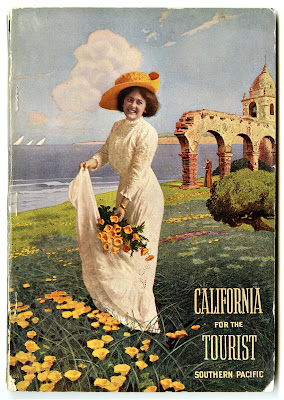
A pivotal moment for the era and a monumental industrial infrastructure achievement in the history of the United States, the transcontinental railroad completion in 1869 had a profound effect on American life which changed the nation forever. It was a revolution which reduced travel time from the east to west coasts from months to about a week, and at less cost than previous overland and by sea options, that open economic and cultural opportunities for the possibilities of the movement of people and goods. It opened California, other parts of the U.S., and the Pacific World to more travelers, tourists, emigrants, and settlers.
A settler colonialist and imperialist project, corporate and military organization hosted imported (mostly from China) laborers who were paid low wages to plow across and lay the tracks through indigenous people’s sovereign nation lands to connect the distant colony of California to become a vital part of the U.S. continental empire. The railroad companies produced pamphlets and magazines to recruit whites from the U.S. and Europe to settle in California and the West, and those who wanted to explore the Western landscape from the comfort of the modern railway car. Although not thought of as part of the audience for this promotion, African Americans would also learn and benefit from what the transcontinental railroad could offer.
Before, during and after the transcontinental line’s construction, in southern states, thousands of enslaved and then freedmen worked on the railroads grading lines, building bridges, and blasting tunnels. They working as firemen shoveling coal into the boiler riding alongside the engineer, and as brakemen and yard switchmen. They loaded baggage and freight, and sometimes drove the train. Even with racist resistance to blacks as they migrated to northern states that rose after the Civil War, the new freedmen joined their northern brothers in the few jobs like these mentioned which were open to them.
The post-Civil War years into the early decades of the twentieth century, black men gained employment on the transcontinental railroad, most often as Pullman Company’s Palace Car porters and waiters, helping to define American travel during the railroad transportation era. These Pullman porters, as they were called, made “porter” synonymous with “Negro,” and provided glorified servant work as valet, bellhop, maid, and janitor for luxury sleeper cars used for overnight travel. Pullman cars were like or better than the best of America’s hostelries of the era, only on wheels.
Paid low wages, Pullman porters had to make money in tips from the public to survive and thrive, which they unquestionably accomplished. These men worked long hours and faced routine racial discrimination, abuse and indignities. The exploitative working conditions were imposed by management supposedly to incentivize black employees to provide the best service, compliancy in following orders and resistance to unionization, and to intimidate them to be grateful for their jobs. Scholarly studies showed in the 1920s, the Pullman company hired the most African Americans in the U.S. and the porters were one of the worst exploited workers in the country. But even under these conditions the job did have life changing benefits.
Pullman porter jobs offered stable blue collar employment, the adventure, glamour and education of travel to many places, and escape from hard physical labor on the farm or in the factory. Interaction with more intelligent classes in the travelers who Pullman porters meet and served, and the information gained from these people and the publications they left behind on the trains, informed them about what was going on in the broader world. Porters passed this knowledge and publications on to their families and the black communities they passed through in their travels around the country.
Between 1867 and 1969, thousands of African American men changed history as they rode the nation’s railroads as Pullman porters. They were an example of upward mobility for black males during the nation’s railroad transportation era. They spread the word of higher wages and improved circumstances which helped energize the Great Migration of nearly 500,000 southern African Americans who moved to the North between 1915 and 1919, and those who followed in later decades during the twentieth century to western, as well as northern cities. They created the first labor union for African Americans, the Brotherhood of Sleeping Car Porters (which also included the maids) in 1927, and helped build the 1950s–1960s phase of the civil rights movement.
California had its share of African American men who worked as Pullman porters and in other railroad jobs who migrated from southern states to its railroad hub cities during the late nineteenth and early twentieth centuries. They, like many African Americans, would have been attracted by California’s admittance to the Union as a free state in 1850, and the freedoms and opportunities this extended over the years. A history of less racially motivated violence and harassment directed towards African Americans was also an encouragement for migration to Los Angeles and other western cities. The opportunity for their children to attend public schools and the state’s 1893 anti-discrimination law were other factors which made California an enticing destination for new life opportunities.
John Wesley Coleman (1865–1930) worked as a Pullman porter for 12 years, after migrating with his family from Austin, Texas to Los Angeles at the time of an economic boom in 1887. An entrepreneurial clan, he and his relatives bought land and settled in Boyle Heights, a newly subdivided area just east of Los Angeles’ downtown and the river. They were some of the earliest African American settlers in Boyle Heights.
Before and sometimes while Coleman worked as a railroad porter, he used his skill set and resources to take advantage of several employment and business development opportunities in his years of becoming an established Los Angeles citizen. By 1907, after ending his traveling around the country serving and meeting all types and classes of people as a Pullman porter, Coleman began one of his most enduring business endeavors. He opened an employment agency in downtown Los Angeles where he helped many African American newcomers find jobs.
Enormously successful in getting people employment up and down the Pacific coast, some observers in the African American media called Coleman the ”Employment King of Los Angeles.” Over the years, he also would accumulate and sell valuable regional real estate on his own and with relatives, and be a part of other business ventures such as the Hotel Coleman DeLuxe which provided services to primarily an African American clientele at Lake Elsinore, a resort town in Riverside County.
Among Coleman’s many significant civic leadership undertakings was in helping establish and support the Forum, founded in 1903. This organization encouraged collective action to advance and strengthen African Americans socially, intellectually, financially, and in Christian ethics. With a membership of all African American classes, the Forum fought against racial discrimination and engaged in philanthropic efforts. They supported black business development and patronage. They urged white-owned businesses and the government to employ African Americans in non-menial positions. Lasting until the 1940s, the Forum was one of the most important organizations in the history of African Americans in Los Angeles as it helped them develop a sense of community through providing a space for public discourse, civic organizing, political dialogue, and aided newcomers to network and assimilate into Los Angeles society.
While working as a Pullman porter, Arthur L. Reese (1883–1963) first traveled to Los Angeles and its environs. On a layover in 1902, he read in the newspaper about a new amusement pier and resort town construction by pioneering developer Abbot Kinney in an area to be called Venice of America on the Pacific Ocean’s Santa Monica Bay, just south of the city of the same name. Looking toward the future, Reese was interested to develop his own business and rode out on the streetcar to Venice to investigate what opportunities might be available for him with Abbot Kinney and his new venture. Soon after this, on his returned to Louisiana, Reese quit his railroad porter job and then moved to Los Angeles.
Reese eventually established successful service oriented businesses which supported the needs of the Santa Monica and Venice business and residential community. Alongside his own business endeavors, he would become head of maintenance and decorations for the Kinney facilities and be very actively involved in Venice civic affairs with local business and other groups. Reese’s business operations would eventually extended into Los Angeles, and Lake Elsinore in Riverside County where he was part of a business partner in the Lake Shore Beach grounds, a resort site for African Americans. Over the years, Reese supervised a work force of a few dozen people which included several of his relatives who he inspired to migrate to California from Louisiana. Reese, his family members and other African Americans who worked with his and, or Abbot Kinney’s enterprises made up the early African American community which live in Los Angeles’ Venice beach community.
Like thousands of other African Americans in college, law and medical school, and other academic programs, Eugene Curry Nelson (1883–1962) spent summers working as a steamboat and railroad car waiter in the northeast U.S. In this temporary work, he earned a salary and tips which helped pay tuition and expenses for medical school and later the needed equipment for his professional office as a physician and surgeon. Born and reared in Charleston, South Carolina, he earned his undergraduate degree from Prairie View A&M University near Houston, Texas. He obtained his medical training degree from Meharry Medical School, in Nashville, Tennessee.
In 1911, Nelson commenced his medical practice in Virginia, before migrating to Los Angeles in 1914, where he settled and built a practice that included patients who were African American, white, and from other racial and ethnic groups. In Los Angeles, even before the end of the Jim Crow era in the middle decades of the twentieth century, it was not uncommon for African American physicians to have patients from the varied ethnic communities of the city. This occurred even as these doctors and other African Americans were discriminated against in most other professional, employment and social settings.
By 1924, Nelson was called “one of California’s wealthiest Negroes” by Noah D. Thompson in an article which appeared in The Messenger, a nationally circulated African American monthly published by A. Philip Randolph and Chandler Owen in New York. In additional to practicing medicine, Nelson invested in several businesses in finance, real estate, manufacturing, oil, and amusement. He also held leadership roles in undertakings to promote and develop African American businesses and civic participation for individual and group benefit. In the 1920s, Nelson was part of a group of very ambitious African American businessmen who bought the white owned, Parkridge Country Club in Corona, a Riverside County community, to operate as an interracial space of recreation and for a new African American community development in Southern California’s Inland Empire.
Coleman, Reese, Nelson and others who worked as Pullman porters and waiters exemplified the “New Negro” determined to achieve fuller participation in American society in a hostile white world. Along the way, these men helped give birth to the African American professional classes. The transcontinental railroad line offered them new opportunities for employment, broader knowledge about the U.S. for their personal betterment and that of their community. It facilitated the ability of Coleman, Reese, Nelson and many other African American men and their relatives to migrate to Los Angeles to live their California Dream of new life opportunities in a mild climate and sublime landscape.
A settler colonialist and imperialist project, corporate and military organization hosted imported (mostly from China) laborers who were paid low wages to plow across and lay the tracks through indigenous people’s sovereign nation lands to connect the distant colony of California to become a vital part of the U.S. continental empire. The railroad companies produced pamphlets and magazines to recruit whites from the U.S. and Europe to settle in California and the West, and those who wanted to explore the Western landscape from the comfort of the modern railway car. Although not thought of as part of the audience for this promotion, African Americans would also learn and benefit from what the transcontinental railroad could offer.
Before, during and after the transcontinental line’s construction, in southern states, thousands of enslaved and then freedmen worked on the railroads grading lines, building bridges, and blasting tunnels. They working as firemen shoveling coal into the boiler riding alongside the engineer, and as brakemen and yard switchmen. They loaded baggage and freight, and sometimes drove the train. Even with racist resistance to blacks as they migrated to northern states that rose after the Civil War, the new freedmen joined their northern brothers in the few jobs like these mentioned which were open to them.
The post-Civil War years into the early decades of the twentieth century, black men gained employment on the transcontinental railroad, most often as Pullman Company’s Palace Car porters and waiters, helping to define American travel during the railroad transportation era. These Pullman porters, as they were called, made “porter” synonymous with “Negro,” and provided glorified servant work as valet, bellhop, maid, and janitor for luxury sleeper cars used for overnight travel. Pullman cars were like or better than the best of America’s hostelries of the era, only on wheels.
Paid low wages, Pullman porters had to make money in tips from the public to survive and thrive, which they unquestionably accomplished. These men worked long hours and faced routine racial discrimination, abuse and indignities. The exploitative working conditions were imposed by management supposedly to incentivize black employees to provide the best service, compliancy in following orders and resistance to unionization, and to intimidate them to be grateful for their jobs. Scholarly studies showed in the 1920s, the Pullman company hired the most African Americans in the U.S. and the porters were one of the worst exploited workers in the country. But even under these conditions the job did have life changing benefits.
Pullman porter jobs offered stable blue collar employment, the adventure, glamour and education of travel to many places, and escape from hard physical labor on the farm or in the factory. Interaction with more intelligent classes in the travelers who Pullman porters meet and served, and the information gained from these people and the publications they left behind on the trains, informed them about what was going on in the broader world. Porters passed this knowledge and publications on to their families and the black communities they passed through in their travels around the country.
Between 1867 and 1969, thousands of African American men changed history as they rode the nation’s railroads as Pullman porters. They were an example of upward mobility for black males during the nation’s railroad transportation era. They spread the word of higher wages and improved circumstances which helped energize the Great Migration of nearly 500,000 southern African Americans who moved to the North between 1915 and 1919, and those who followed in later decades during the twentieth century to western, as well as northern cities. They created the first labor union for African Americans, the Brotherhood of Sleeping Car Porters (which also included the maids) in 1927, and helped build the 1950s–1960s phase of the civil rights movement.
California had its share of African American men who worked as Pullman porters and in other railroad jobs who migrated from southern states to its railroad hub cities during the late nineteenth and early twentieth centuries. They, like many African Americans, would have been attracted by California’s admittance to the Union as a free state in 1850, and the freedoms and opportunities this extended over the years. A history of less racially motivated violence and harassment directed towards African Americans was also an encouragement for migration to Los Angeles and other western cities. The opportunity for their children to attend public schools and the state’s 1893 anti-discrimination law were other factors which made California an enticing destination for new life opportunities.
John Wesley Coleman (1865–1930) worked as a Pullman porter for 12 years, after migrating with his family from Austin, Texas to Los Angeles at the time of an economic boom in 1887. An entrepreneurial clan, he and his relatives bought land and settled in Boyle Heights, a newly subdivided area just east of Los Angeles’ downtown and the river. They were some of the earliest African American settlers in Boyle Heights.
 |
| John Wesley Coleman and his family arrived in Los Angeles in 1887 from Austin, Texas and settled in the Boyle Heights District east of downtown. One of his early jobs in Los Angeles was working as a Pullman Porter, before he became a successful real estate investor, employment agent, and important civic leader. Photograph from The Negro Trail Blazers of California by Delilah Beasley, 1918. |
Enormously successful in getting people employment up and down the Pacific coast, some observers in the African American media called Coleman the ”Employment King of Los Angeles.” Over the years, he also would accumulate and sell valuable regional real estate on his own and with relatives, and be a part of other business ventures such as the Hotel Coleman DeLuxe which provided services to primarily an African American clientele at Lake Elsinore, a resort town in Riverside County.
Among Coleman’s many significant civic leadership undertakings was in helping establish and support the Forum, founded in 1903. This organization encouraged collective action to advance and strengthen African Americans socially, intellectually, financially, and in Christian ethics. With a membership of all African American classes, the Forum fought against racial discrimination and engaged in philanthropic efforts. They supported black business development and patronage. They urged white-owned businesses and the government to employ African Americans in non-menial positions. Lasting until the 1940s, the Forum was one of the most important organizations in the history of African Americans in Los Angeles as it helped them develop a sense of community through providing a space for public discourse, civic organizing, political dialogue, and aided newcomers to network and assimilate into Los Angeles society.
While working as a Pullman porter, Arthur L. Reese (1883–1963) first traveled to Los Angeles and its environs. On a layover in 1902, he read in the newspaper about a new amusement pier and resort town construction by pioneering developer Abbot Kinney in an area to be called Venice of America on the Pacific Ocean’s Santa Monica Bay, just south of the city of the same name. Looking toward the future, Reese was interested to develop his own business and rode out on the streetcar to Venice to investigate what opportunities might be available for him with Abbot Kinney and his new venture. Soon after this, on his returned to Louisiana, Reese quit his railroad porter job and then moved to Los Angeles.
 |
Arthur L. Reese discovered Los Angeles and Venice,
California were he eventually moved, while on a layover from his Pullman Porter
job in 1902. After moving to the region in 1904, Reese eventually became
recognized as the “Wizard of Venice” due to the inventive decorations he
designed for the Venice-of-America amusement center.(Photograph collage from
the Arthur L. Lewis Family Archives)
|
Like thousands of other African Americans in college, law and medical school, and other academic programs, Eugene Curry Nelson (1883–1962) spent summers working as a steamboat and railroad car waiter in the northeast U.S. In this temporary work, he earned a salary and tips which helped pay tuition and expenses for medical school and later the needed equipment for his professional office as a physician and surgeon. Born and reared in Charleston, South Carolina, he earned his undergraduate degree from Prairie View A&M University near Houston, Texas. He obtained his medical training degree from Meharry Medical School, in Nashville, Tennessee.
 |
Dr. Eugene Curry Nelson, like so many young African American
men and a few women when in college, law and medical school, and
other academic programs, spent summers working on steamboats and
railroad cars as waiters, porters and maids in the northeast U.S. to earn money
to pay for tuition and other education. expenses. He moved to Los Angeles
in 1914.
|
By 1924, Nelson was called “one of California’s wealthiest Negroes” by Noah D. Thompson in an article which appeared in The Messenger, a nationally circulated African American monthly published by A. Philip Randolph and Chandler Owen in New York. In additional to practicing medicine, Nelson invested in several businesses in finance, real estate, manufacturing, oil, and amusement. He also held leadership roles in undertakings to promote and develop African American businesses and civic participation for individual and group benefit. In the 1920s, Nelson was part of a group of very ambitious African American businessmen who bought the white owned, Parkridge Country Club in Corona, a Riverside County community, to operate as an interracial space of recreation and for a new African American community development in Southern California’s Inland Empire.
Coleman, Reese, Nelson and others who worked as Pullman porters and waiters exemplified the “New Negro” determined to achieve fuller participation in American society in a hostile white world. Along the way, these men helped give birth to the African American professional classes. The transcontinental railroad line offered them new opportunities for employment, broader knowledge about the U.S. for their personal betterment and that of their community. It facilitated the ability of Coleman, Reese, Nelson and many other African American men and their relatives to migrate to Los Angeles to live their California Dream of new life opportunities in a mild climate and sublime landscape.
Bibliography
Jefferson, Alison Rose. Living
the California Dream, African American Leisure Sites during the Jim Crow Era.
Lincoln: University of Nebraska Press, in press.
Tye, Larry. Rising
from the Rails, Pullman Porters ad the Making of the Black Middle Class.
New York: Owl Books/Henry Holt and Company, 2004.
--
Written by Alison Rose Jefferson, MHC, PhD.