
 |
Delilah
L. Beasley, “Miss Virginia Stephens:
Sponsor for the Name Jewel City for the
Panama Pacific International Exposition,”
In The
Negro Trail Blazers of California (Los Angeles: Time Mirror, 1919)
California Historical Society, VAULT 979.403N B385
|
Delilah Leontium Beasley’s book The Negro Trail-Blazers of California (1919) is a classic in the field of California black history. In it she featured notable achievements of the black men and women of California, from the 1840s to the late nineteenth century.
Beasley (1871–1934) combed the California Archives in the Bancroft Library at the University of California, Berkeley, to compile her book. The nine years she spent writing it soon paid off: she became California’s first black woman to write regularly for a newspaper. She reported for the Oakland Tribune and the Oakland Sunshine, the state’s leading black newspaper.
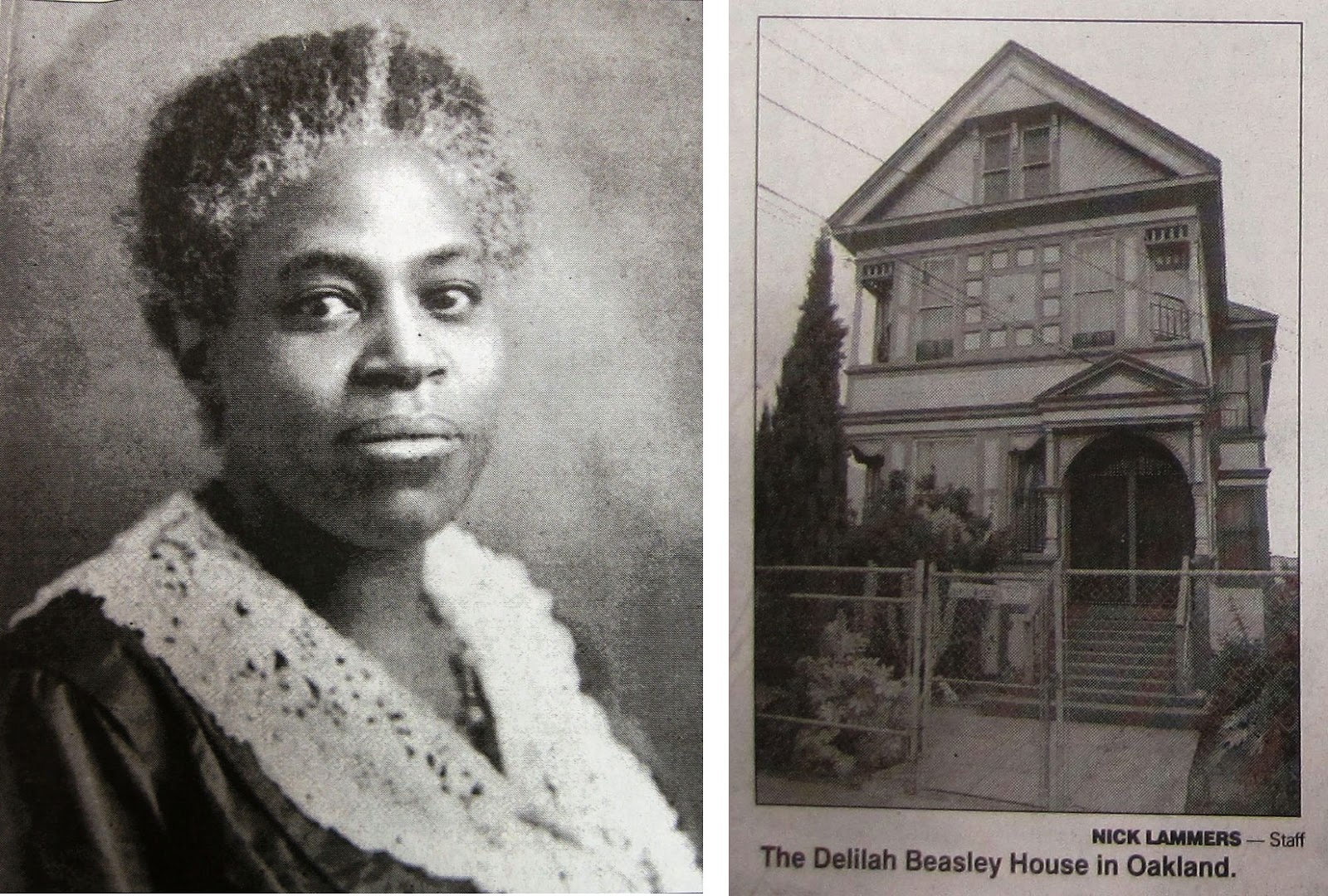 |
Delilah L. Beasley (1866–1934) and Her House in Oakland
Courtesy of the African American
Museum and Library of Oakland
|
Beasley was a so-called “race women.” She and other black women sought to “lift as they climbed." Decades before the mid-twentieth-century civil rights movement, these women organized against and tried to change the prevailing racial climate in which black Americans lived.
San Francisco’s 1915 World Fair
In 1915, Beasley was working to counteract the negative stereotypes presented in the highly controversial and overtly racist film The Birth of a Nation, which was screening in Bay Area theaters. The same year, as one of the state’s most influential black reporters, she covered the Panama-Pacific International Exposition (PPIE), San Francisco’s world fair. She interpreted for African Americans what the fair could mean for them in an era of racism and discrimination.
San Francisco’s 1915 World Fair
In 1915, Beasley was working to counteract the negative stereotypes presented in the highly controversial and overtly racist film The Birth of a Nation, which was screening in Bay Area theaters. The same year, as one of the state’s most influential black reporters, she covered the Panama-Pacific International Exposition (PPIE), San Francisco’s world fair. She interpreted for African Americans what the fair could mean for them in an era of racism and discrimination.
 |
Racial
Stereotyping in “Der’ll be Wahm Coons a Prancin,’” 1903
Sheet Music Collection, California Historical Society
Thomas Dixon, Jr., The Clansman: An Historical Romance of the
Ku Klux Klan
(New
York: Grosset & Dunlop, 1915)
|
The African American community wanted to claim a space at the fair where they could represent themselves. There was debate about having a “Negro Day,” but it never materialized. Instead the Oakland Sunshine challenged readers to turn out for “Alameda County Day” to “show to our visitors that this is our Fair and our State.”
 |
African
Americans at the San Francisco World’s Fair, 1915
Courtesy of The Bancroft Library,
|
The community rallied, throwing themselves into planning the day and showing up in droves. The Day kicked off with a parade down Market Street and onto the main fairgrounds. Among the numerous floats were several filled with black children and decorated with cherry blossoms. Beasley wrote: “The mere fact that colored children marched through the streets of San Francisco, carrying the Stars and Stripes, showed a decided advance and change of feeling toward the colored race in these parts.” For Beasely and others, this display of beautiful, healthy black children had to have in some way countered the negative stereotypes prevalent during the era and at the fair.
Virginia Stephens and San Francisco’s World Fair
In her book, Beasley emphasized the role of black women in the state’s history. Among them was twelve-year-old Virginia Stephens (1903–1986). The Oakland schoolgirl won a contest sponsored by the San Francisco Call Newspaper to nickname the fair. Her winning submission, one of 1,300 entries, was The Jewel City—a reference to the skyscraping, jewel-encrusted tower at the center of the fairgrounds.
Virginia Stephens and San Francisco’s World Fair
In her book, Beasley emphasized the role of black women in the state’s history. Among them was twelve-year-old Virginia Stephens (1903–1986). The Oakland schoolgirl won a contest sponsored by the San Francisco Call Newspaper to nickname the fair. Her winning submission, one of 1,300 entries, was The Jewel City—a reference to the skyscraping, jewel-encrusted tower at the center of the fairgrounds.
 |
Virginia Stephens (detail), photographed in
the NAACP’s The Crisis, vol. 11, no.
1 (November 1915)
Laura Ackley Collection
The Jewel City: Souvenir Views of the Panama-Pacific
International Exposition, 1915
Laura Ackley Collection |
Few people knew that Stephens was African American. As reported in The Crisis, published by the National Association for the Advancement of Colored People (NAACP), despite recognition in some local newspapers, “We regret to say that when it was discovered that Miss Stephens had colored blood there was a sudden silence on the part of the press and the only recognition ever given her was a season ticket to the grounds.”
 |
California
State Federation of Colored Women’s Clubs, 1915
Courtesy African American Museum and Library at Oakland
(AAMLO)
|
Stephens might have remained anonymous but for the efforts of the black women’s club members who worked to influence prevailing attitudes of racial discrimination and inequality. At the fair’s Alameda County Day on June 10, 1915, they arranged for her to be crowned queen and to ride with fifty other African American children on a parade float described by the Oakland Sunshine as “a credit to the race.” Virginia Stephens went on to attend the University of California, Berkeley as an undergraduate and then BOALT law school. She was the first African American woman admitted to the bar in California and had a long career in the State Office of Legislative Counsel in Sacramento.
 |
| Rho Chapter, Alpha Kappa Alpha, University of California, Berkeley, 1921 Courtesy AKA Far Western Region Virginia Stephens (far left) and the founding members of the Rho Chapter (University of California, Berkeley) of the national Alpha Kappa Alpha Sorority. Seated in front is the renowned education pioneer Ida Louise Jackson, who formed the idea of establishing the chapter and served as its first president. |
Shelly Kale
Publications and Strategic Projects Manager
California Historical Society
Erin Garcia
Managing Curator of Exhibitions
California Historical Society
egarcia@calhist.org
Sources
Managing Curator of Exhibitions
California Historical Society
egarcia@calhist.org
Sources
- AKA Far Western Region, http://www.akafarwest.com/region.html
- Alameda County Day, Oakland Sunshine, June 12, 1915
- “Branches and Locals,” The Crisis 11, no. 1 (November 1915)
- Lynn M. Hudson, “‘This Is Our Fair and Our State,’ African Americans and the Panama-Pacific International Exposition,” California History 87, no. 3 (2010)

Portions of this blog are adapted from Erin Garcia and Shelly Kale, “Bravely Useful Part”: Five Women and San Francisco’s 1915 World’s Fair, posted on December 1, 2015 on www.PPIE100.org, sponsored by the California Historical Society.


