Redirect to CHS blog

Thursday, August 23, 2018

California's Enduring Diversity

After years of researching California history, I am still struck by the state’s long-standing population diversity and cultural vibrancy. To come across an image such as this one reminds me that the state’s cultural richness is sometimes on parade, but is more often simply - and meaningfully - woven into all we see around us and in images from the past.


Mexican American caballero with the horse 'Puente,' La Fiesta, Los Angeles; General Subjects Photography collection; PC-GS; California Historical Society. 

In the fourth grade, students begin the year by studying California’s native peoples from the Pre-Columbian to the Mexican Rancho period, and learn that their lives varied considerably from one geographic region to the next, and that there were approximately 100 distinct dialects in use. The curriculum continues with an examination of the different European explorers arriving in California from the sixteenth century onward. Fourth graders also study the gold rush, when a truly global population descended upon the U.S. territory. Following these investigations of California’s rich diversity, the new History-Social Science Framework adopted by the CA State Board of Education poses a question to accompany the next content standard: “What was life like for California’s diverse population at the turn of the century?”

For the Teaching California curriculum project, the California Historical Society (CHS) and the California History-Social Science Project (CHSSP) are working together to identify and contextualize primary sources that illuminate California, U.S., and world history, and to align these with the new Framework. For this particular Framework question on California’s diverse population at the turn of the twentieth century, we are drawing from the CHS’s rich collection of images and documents that provide insight into the opportunities many newcomers enjoyed, as well as the hardships that some experienced on account of their racial or ethnic backgrounds.

I was particularly struck by the record of a speech given by Rep. Cowdery in 1874 about the importance of integrating African-American - “Negro” - students in public schools. I learned that African-Americans in California organized as early as the 1870s to point out the difference between the rights recently afforded them in the 14th Amendment, and their children’s treatment in California’s segregated school system.

“Last fall there assembled at Sacramento a body of colored citizens, demanding all the rights their citizenship entitled them to.”

“Under…our political code the children of negroes must attend separate schools. This would not be objectionable, provided the State has furnished separate schools equal to those for white children…It is clear the State has not performed her duty in this respect.”

Students reading these words (with the historical context and literacy support provided) will learn that segregation in schools was common in these years, and that it was a group of parents who demanded better for their children. Teachers may choose to link this to the long struggle for civil rights in public schools, both in California and throughout the nation.

While students learn that these civil rights were not always realized quickly or fully (and in the case of the 1882 Chinese Exclusion Act, for instance, new barriers were erected), they also learn that people in California from many different backgrounds created numerous opportunities for themselves. This image of a Chinese float during the 1902 “La Fiesta” parade in Los Angeles, helps students see the long history of people honoring their cultures and sharing them with others through festivals like these that brought together California’s diverse peoples. 


Chinese Dragon. La Fiesta Parade, Los Angeles, Cal., 1902 May 2; General Subjects Photography collection; PC-GS; California Historical Society 

We find evidence of California’s turn-of-the-century population diversity in much more than these brief celebrations. In an era when newspapers were one of the only ways to communicate with a broad number of people, ethnic communities used this print media to stay connected and establish themselves within broader society. 


Various newspapers, 1879; Henry D. Cogswell Time Capsule Collection, MS 559; California Historical Society. 

Today’s students will no doubt identify with this language diversity. The California Department of Education identifies 65 different language groups spoken among the state’s public school students. Through the Teaching California project, we are striving to provide classroom materials that represent California’s historic population diversity. We believe that students will be more engaged in learning about the past when they can see themselves represented in California’s story. 

--------------------------------------------------------------------------------------------------------------------------


This post comes from Shelley Alden Brooks, a scholar of California and environmental history. She holds a doctorate from the University of California, Davis, and together with the California History Social Science Project is developing history-social science curriculum for Teaching California. Comprised of curated primary source material from California's premier archives, libraries, and museums, Teaching California presents a research-based approach to improving student reading, writing, and critical thinking.


Thursday, August 16, 2018

5 Summer Destinations Full of California History

California is a land brimming with stunning natural landscapes, diverse cultures, and deep histories. As a tribute to summer freedom and exploration, we’ve come up with a short list of destinations across the state that provide an opportunity for adventurers of all ages to engage with their surrounding while learning about the people and events that came before them. Each photo included below comes from our permanent collection and will be featured in Teaching California, a set of new classroom-ready history curriculum resources set to become available next Summer. The images provide a glimpse into the past, framing each destination as it once was and prompting consideration of how time, change, and human experience shape the places around us.

[Crystal Cave, Sequoia National Park, undated]; [California Counties photograph collection]; California Historical Society, CHS2016_2135.
The natural wonder of the Sierra Nevada cannot be overstated with geologic masterpieces shaped by millions of years of interaction between glaciers and rocks resulting in canyons, jagged peaks, domes, rivers, vast waterfalls, and the highest mountain peak in the contiguous U.S., Mount Whitney. 

The area that is now Sequoia National Park was first inhabited for thousands of years by Native American groups, each with a unique culture and language including: the Western Mono (Monache), the Foothills Yokuts, and the Tubatulablal. In the early 1800s, fur trappers arrived followed by gold seekers and eventually loggers, all hoping to make a claim to the area’s rich natural resources.

One of the most prized of these resources was the Giant Sequoia tree. Giant Sequoias can live to be 3,000 years old while growing to be more than 300 feet tall and 100 feet in circumference, making them one of earth’s largest living organisms. These epic proportions made the trees extremely attractive to fortune seekers who descended upon the Sierra Nevada during the 19th century and whole groves of ancient forest were leveled during this period.

Sequoia National Park was formed in 1890 as the nation’s second national park to put an end to deforestation and to protect the massive trees. The park is home to three of the top 5 largest sequoia trees on earth. 

What to do:

  • Tour Crystal Cave. Beneath the shade of massive trees lies more than 250 underground marble caves. Crystal Cave is the only one open to the public and is filled will walls of marble, stalactites, and stalagmites.
  •  Visit the Giant Forest Museum. The museum is the starting point for visits to the Giant Forest sequoia grove and provides visitors with an opportunity to learn about local ecosystems. The Giant Forest includes the famous General Sherman tree, currently the largest living organism on the planet, by volume.
  •  Visit Buck Rock Lookout. Built in 1923, Buck Rock is one of the oldest fire lookout buildings still in use in the area and is the place where rangers once sat to scan for smoke signifying forest fires.

     2.  San Francisco’s Chinatown
[Street scene, Chinatown, San Francisco, circa 1910]; [San Francisco Subjects photograph collection, box 9, folder 16]; California Historical Society.
San Francisco’s Chinatown is the oldest Chinatown in North America as well as the largest Chinatown outside of Asia. In 1848 the first Chinese immigrants arrived on the shores of the San Francisco Bay. The discovery of gold as well as the building of the transcontinental railroad resulted in a large increase in the Chinese population within the city and a large portion settled in a community in the center of the city known as Chinatown.  The entire neighborhood was destroyed in the massive fire that followed the 1906 earthquake and was eventually rebuilt with tourism in mind.

What to do:
  • Walk through Portsmouth Square. The city’s oldest public square was established in the early 1800s in the community of Yerba Buena, which later became San Francisco. The San Francisco Bay’s shoreline was only about a block away. The park is now a bustling Chinatown community fixture where locals gather to catch up with friends, play mahjong, or practice tai chi.

[Children participating in a religious ceremony on Olvera Street, Los Angeles, undated]; [California Historical Society collection, 1860-1960]; University of Southern California Libraries and the California Historical Society, CHS-36243.
Los Angeles was founded by Spanish settlers in 1781 on a site close to what is now El Pueblo de Los Angeles. Mexican independence in 1821 welcomed the establishment of the first streets and adobe structures in that same area, a place that we now associate with the heart of LA’s original Mexican community. As Los Angeles rapidly expanded throughout the late 1800s and beyond, the original settlement fell into disrepair. In the 1920s, Christine Sterling launched a revitalization campaign to restore the historic pueblos and create a modern marketplace and tourist destination which celebrated Mexican history and culture.

What to do:
  • Take in Olvera street. Explore the colorful Mexican marketplace, shop for handcrafted items and folk art, fill up on tacos at outdoor cafés, and listen to strolling mariachi music. Olvera Street, originally named Vine Street after the vineyards that spread across the area, is full of well-preserved historic buildings.
  • Tour Avila Adobe. Built in 1818, the Avila Adobe is the oldest existing residence in LA and was the home of wealthy cattle rancher and Mexican native, Francisco Avila. A tour of the home will give you an idea of how the first settlers in the area lived under Spanish rule and the structure itself is built from local resources including clay from the LA River and tar from the La Brea Tar Pits. 
  • See the Siqueiros mural. “América Tropical” was painted on the side of the old Italian Hall in 1932 by Mexican muralist David Alfaro Siqueiros, a contemporary of Diego Rivera and José Clemente Orozco. The mural was controversial due to its imperialist subject matter and was whitewashed soon after its creation. The mural was rediscovered in the 1960s and recent efforts have restored it. It can be seen from a viewing platform on Olvera Street. 

4.  Sonoma County 
[Three children in a Sonoma County chicken ranch, undated]; [California Historical Society collection, 1860-1960]; University of Southern California Libraries and the California Historical Society, CHS-45631. 
Sonoma is a diverse region known for its wine, cheese, redwood forests, rolling pastoral hills, and dramatic coastline. Pomo, Coast Miwok, and Kashaya peoples were the earliest human inhabitants and the land was later utilized by Europeans looking for fur, timber, and fertile farmland.  After California became a state in 1850, Sonoma was increasingly settled by the local logging, cattle ranching, poultry farming, fruit processing, and winemaking industries.

What to do:
  • Explore Fort Ross. Fort Ross Historic Park was once a Kashaya Native settlement and later became  a Russian settlement and fur trading post before becoming a hub for agriculture and logging. The area is now a state park which showcases the Russian-era fort.
  • Go on a Sonoma County farm tour. Take part in one of the many farm tours offered throughout the area’s verdant hills and farmland. Take your pick from offerings by local farms and ranches including cheese making classes, sustainable farming demonstrations, and goat cuddling. Buy fresh eggs or be the first in line for organic peaches. Many farms are family-run and focused on sustainability.
  •  Explore Mission San Francisco Solano. The mission is the 21st and last mission founded in California in 1823 and the only mission founded after Mexico’s independence from Spain. The mission is part of Sonoma State Historic Park which also includes Sonoma military barracks built by General Vallejo and is where the first bear flag was raised over California declaring it a republic, independent from Mexico.

   4. Mojave Desert
[Two Mojave Indian girls standing in front of a small dwelling with a thatched roof, 1900]; [Title Insurance and Trust, and C.C. Pierce Photography Collection, 1860-1960]; University of Southern California Libraries and the California Historical Society, CHS-1241. 
We don’t necessarily suggest a trip to the Mojave during the middle of the summer – but this trip can be saved for a bit later into the fall when temperatures have dropped a tad.

The Mojave is an arid desert full of Joshua trees and one of the driest places in North America. Located between the Great Basin Desert in the north and the Sonoran to the south, this desert plays host to the Mojave National Preserve as well as parts of Death Valley and Joshua Tree National Parks. The Chemehuevi and Mojave peoples were nomadic residents of the region for thousands of years living off of prickly pear, mesquite, agave, deer and bighorn sheep. Europeans arrived in 1776 and throughout the 1800’s settlers came to the area searching for gold, copper, iron, and silver.

What to do: 
  • Visit Mojave National Preserve. This 1.6-million-acre park is full of sand dunes, Joshua trees, wildflowers, volcanic cinder cones, canyons, mountains, limestone caves, petroglyphs, abandoned mines and military outposts. Hike, camp, and explore, making a stop at the Kelso Depot a Spanish Mission Revival style railroad stop opened in 1924.
Of course, the destinations listed above are only a glimpse into the myriad of experiences available to explore the colorful stories of California. As summer draws to a close, we encourage you to harness what time you have available and get out to explore the history of the state.

---

by Katie Peeler, California Historical Society

Monday, August 13, 2018

Engaging Local Youth Through Exquisite Mural Project


During the Chicana/o Movement of the 1960s and 1970s, public murals became an essential form of artist response and public voice. They were a means of challenging the status quo and expressing both pride and frustration during a time when other channels of communication were limited for the Mexican American community. Because they threatened established authority, Chicana/o murals were often censored, neglected, whitewashed, or destroyed

As part of the current exhibition ¡Murales Rebeldes!—L.A. Chicana/o Murals under Siege, the California Historical Society created a program to engage youth, many of Latino heritage, who live and go to school in the Mission District of San Francisco, an area renowned for its murals. We named the program Exquisite Mural after the old parlor game “exquisite corpse,” in which a collection of words or images is collectively assembled.

Over the course of the program, roughly 200 students from Jamestown Community Center and Mission Community Beacon joined us in our gallery to take part in the project.

Before the children participated in the Exquisite Mural Project, I lead them on a tour of the gallery and discussed three of the mural artists featured in the exhibition. The kids have shown an incredible amount of empathy for the artists, asking multiple times “Why did they have to paint over the mural? Why did they have to destroy the mural?” The children are also very keen on knowing if the muralists were still alive and were fascinated when told that I had met a few of them. Some of the kids were able to meet muralist Ernesto de la Loza, who led a personal tour of his section of the exhibition and stayed to participate in the mural making activity.

Resurrection of the Green Planet by Ernesto de la Loza

In our version of the game, a mini mural is created collaboratively as a triptych, which basically means a three-part picture. A child would complete the first panel of the picture, then, two mural artists, one from Los Angeles and one from San Francisco, each drew on one of the remaining two panels. The person drawing did not know what the person before them had created due to the paper being folded, rendering the other images hidden. I explained to the kids that they might treat the Exquisite Mural as a concept drawing that they could use to build on if they were to paint a full-scale mural.

Using stories as a backdrop, the youth explored themes raised by the exhibition and its featured mural artists such as displacement, activism, immigration, cultural heritage, racism, memory, feminism, and censorship. The art created by the kids embodied similar ideas with many of the kids expressing pride towards their heritage by painting the flags of countries from where they or their families are from. Much of the art included imagery of peace, unity, and friendship.


The most fulfilling thing about this project was seeing the kids who were initially adamant about “not being able to draw” or saw themselves as “not artists” come up with really creative pieces of art inspired by iconography that they saw in the gallery. Some spoke with me about how they were used to seeing the Virgen de Guadalupe at home. Mermaids and dinosaurs were other popular subjects that resonated with the group. These conversations were a great opportunity to help the kids understand that anybody can be an artist and that each muralist they had learned about were once kids themselves.

The Exquisite Mural art will be showcased in the CHS galleries beginning August 25th. We plan to celebrate the hanging of the murals with the youth participants and their family during an afternoon reception, poetry reading, and discussion with artists of all ages.

by Erik Zuniga, Guest Concierge and Exquisite Mural project group leader

Tuesday, July 24, 2018

A Night of Tar, Feathers, and Terror: Anti-labor Vigilantism in Sonoma


Each July since 1994, San Francisco has played host to LaborFest, an event established to institutionalize the history and culture of working people in an annual labor cultural, film, and arts festival. As part of this year’s LaborFest, CHS hosted an evening gallery talk entitled A Night of Tar, Feathers, and Terror: Anti-labor Vigilantism in Sonoma.


In the evening of August 21, 1935 a band of vigilantes abducted Sol Nitzberg—a Jewish Sonoma County chicken farmer—along with three other labor organizers. Nitzberg and Silva Green (another organizer) were tarred and feathered and forced by the mob to parade through Santa Rosa. For our event, Barry Nitzberg—grandson of Sol Nitzberg— and historian Ken Kann were present at the CHS galleries to unpack the history of labor organizing in and vigilante terror in Sonoma County, including the 1935 Sebastopol Apple Pickers Strike, the assault on Nitzberg and Green, and the role of ACLU in the subsequent trial.

CHS member Oliver Pollak wrote the following response and event recap in the evening in the San Diego Jewish World:

"Imagine, 1974 was 39 years after the event, and 2018 was 44 years after the book. Who would still be interested 83 years after the event? Well, an over-flow crowd of one hundred fifty people attended, some were sitting on the staircase. These children, grandchildren, great-grandchildren, and friends of Zionists, Communists, Socialists, the old left, anarchists and some red diaper babies listened intently and then asked questions, some of which recalled the tension between the Rechters (right wing) and Linkers (left wing), echoes of the McCarthy anti-communist inquisition, Israel socialism and Zionism in Israel."

Read more here.


Monday, July 2, 2018

Designing for our audiences in Teaching California

The California Historical Society (CHS) and its partners at The California History and Social Science Project (CHSSP) have the unique opportunity, thanks to a substantial grant from the state’s Department of Education, to develop Teaching California, a free K-12 online curriculum that puts California’s archives at the center of student investigation into the past. Crucial to this initiative will be taking a co-designing approach with the audiences we want to engage, so that what is created is as discoverable and widely-used by those audiences as possible.

Brainstorming Teaching California audiences in an internal session at CHS in early April. Questions explored included: Who are the people or groups reached directly by Teaching California? Which are more peripherally relevant but still stand to benefit from what we create?

When embarking on a user-centered design approach, the first step is to identify and gain empathy for your users. For our project team, this meant making our implicit primary audiences explicit and discussing the range of periphery audiences who stand to benefit from what we create.

On April 25th, CHS and CHSSP teammates met for a session to do just that and to determine what success for those audiences might look like as we plan for website development. CHSSP, based out of the University of California at Davis, are teacher professional development experts and the primary authors of the state’s recently adopted History and Social Science Framework, which provides the foundation for our content work on Teaching California.


The CHS and CHSSP teams reviewing Teaching California primary, secondary, and tertiary audiences and what signifies success for those audiences at an all-hands-on-deck session on April 25th, 2018.

While teachers unsurprisingly emerged as a core primary audience, the California County Offices of Education also emerged as primary audiences for what will be a crucial role in project dissemination to local teachers. And we could not forget that Teaching California will be important to the growth and development of both the CHSSP and CHS organizations, who will also serve as important primary audiences. This was a fun and productive session and our group cycled through many self-adhesive flipcharts!

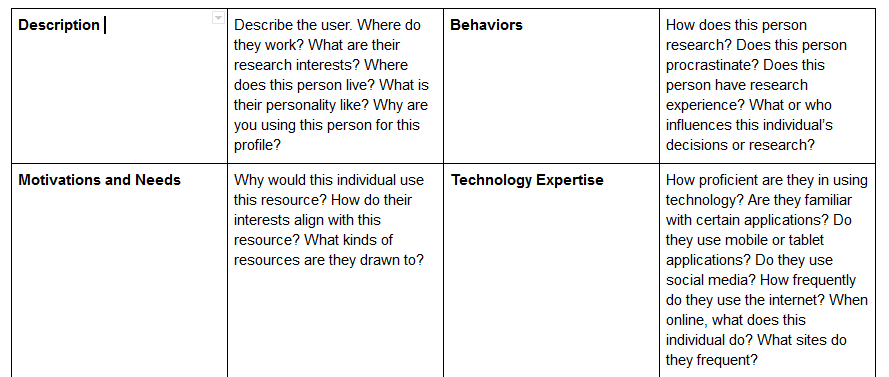
Following this session, we worked with CHSSP to develop basic user profiles for the primary audiences we identified. User profiles acts as a cursory audience examination, allowing a project team to think more holistically about a project and to start to tie ‘why’ a project is being developed together with ‘whom’ it is being developed for. While we will have the opportunity to continue a more in-depth audience analysis in the coming months, this exercise allowed us to scope out the basic needs and motivations of those we will be designing for.


An excerpt of the questions we explored to form our user profiles.

As we aim for statewide reach for Teaching California, which we hope will help spur Framework adoption across all corners of the state, identifying our audiences has helped our CHS website design team address some important challenges including: How can we create an online resource for the diverse California school communities teachers serve, and how can we co-design with them throughout the project to continue addressing needs? 

We are looking forward to continuing to develop out our process for co-designing for our audiences, so follow along with our progress here!

The California Historical Society is working in partnership with the California History-Social Science Project (CHSSP) at UC Davis to establish and implement Teaching California: a free and expansive online set of instructional materials to support the State’s new K-12 History-Social Science Framework. Comprised of curated primary source material from California's premier archives, libraries, and museums. Teaching California presents a research-based approach to improving student reading, writing, and critical thinking.  This post comes from Kerri Young, Teaching California Project Manager. You can reach out to her at kyoung@calhist.org

Friday, June 1, 2018

Event recap: Rolling out California's new History and Social Science Framework in Sonoma


CHSSP's Statewide office team and Teaching California Project Manager Kerri in front of the day's schedule, May 22nd, 2018. Left to right: Tuyen Tran (CHSSP), Nancy McTygue (CHSSP), Kerri Young (CHS), Beth Slutsky (CHSSP).


On May 22nd, our friends and partners at the California History and Social Science Project (CHSSP) invited us to attend a local conference at Sonoma State University, part of series they are doing to promote California's new History and Social Science Framework. The CHSSP served as the primary writers of the new Framework, adopted by the State Board of Education in 2016, which outlines an instructional approach that promotes student-centered inquiry and encourages students to develop clear and persuasive arguments based on their own interpretations of the past, using relevant evidence. While the history and social science standards for California provide the “what” of an instructional program (unchanged), the Framework helps flesh out the “how (new!)”

CHSSP Director Nancy giving the day's opening address. She was joined onstage by Michelle Herczog of the Los Angeles County Office of Education (far left), and Kristin Cruz Allen of the California Department of Education.

As we continue to work with CHSSP to create and implement Teaching California, this was an opportunity to dig into the important instructional shifts that inform the content development work we are doing. With its emphasis on content, inquiry, literacy, and citizenship, the Framework, and by extension our project, will offer students the opportunity to learn about the world and their place in it, think critically, read, write, and communicate clearly, all through a uniquely California lens.

Our Reference Librarian, Frances Kaplan, and I attended multiple sessions, learning about as many sections of the Framework as we could. From the new FAIR Education Act's role in the new Framework rollout, to the ways Ethnic Studies, Literacy, and US History content are articulated, there was a lot to learn!

CHS Reference Librarian Frances Kaplan (right), with Molly Snider from Mendocino's California Office of Education. Molly hosted a session we attended focusing on K-5 Inquiry, and the importance of introducing students to primary sources at an early age.

As Teaching California's Project Manager, it was fantastic to get a closer look at the monumental effort that was the writing and adopting of the Framework, as well as having the opportunity to speak with local K-12 teachers and administrators. We were very inspired learning about the ways they are already helping students learn inquiry, literacy, and citizenship in the classroom, and how the new Framework will help better guide and build upon the work that they are already championing in their schools. Further, all were excited at the prospect of incorporating these skills into the history and social science curriculum as early as Kindergarten, a shift in approach that builds capacity even before students enter middle school.

In a session about how Ethnic Studies is articulated in the Framework, participants were asked to consider California's ethnic makeup and how that compares with the rest of the country. We discussed how the Framework can help teachers, according to CHSSP Site Director Rachel Reinhard, bring their students' "full cultural self to the classroom space."

But for many teachers, Framework implementation does not come without its fair share of challenges, including in many cases the lack of up-to-date textbooks, or starting out as the sole champion of the Framework at his or her school and faced with the task of building capacity in a strategic and resourceful way. Hearing these comments, it was heartening to know that Teaching California will be able to fill a crucial need by providing free and online resources for teachers to more easily implement the Framework in their local areas.


Handouts from the day. 

A lovely day at Sonoma State's Student Center. 

For more information about California's new History and Social Science Framework, visit CHSSP's website at http://chssp.ucdavis.edu/framework and the California Department of Education’s Framework page at https://www.cde.ca.gov/ci/hs/cf/.

Stay tuned for more on Teaching California here soon!

The California Historical Society is working in partnership with the California History-Social Science Project (CHSSP) at UC Davis to establish and implement Teaching California: a free and expansive online set of instructional materials to support the State’s new K-12 History-Social Science Framework. Comprised of curated primary source material from California's premier archives, libraries, and museums, Teaching California presents a research-based approach to improving student reading, writing, and critical thinking. This post comes from Kerri Young, Teaching California Project Manager. You can reach out to her at kyoung@calhist.org 

Tuesday, April 10, 2018

Libraries Lead: Showcasing the North Baker Research Library’s collections

The role of the research library in a special collections archive often poses a problem: how do we support access to our collections when we are open limited days, and when, in order to protect and preserve our often fragile materials, collections cannot leave our reading room?

Here at the California Historical Society, we know that to succeed in our mission of making our State’s history part of the lives of contemporary Californians, we needed to make our collections accessible in ways that went beyond the traditional reference library. By including our unique materials in exhibitions and public programs, in publications and on social media, we are able to provide people far greater, and more varied, opportunities to interact with the wonderful photographs, manuscripts, maps, and rare books that make up our collections.

Here is a glimpse into some of the projects staff are working on currently:

Thursday, March 1, 2018

#onthisday 50 years ago, the East L.A. Walkouts Began


#Onthisday 50 years ago, the influential East L.A. School Walkouts (Blowouts) began, transforming the Chicano movement in Los Angeles. 

Over two weeks, tens of thousands of young Latino students took to the streets to protest conditions in their schools on the East Los Angeles. In many ways, the walkouts (primarily at Wilson, Roosevelt, Garfield, Belmont and Lincoln high schools) were the first public display of an urban Chicano rights movement that had begun among California farm workers in the previous several years. The walkouts were the first mass mobilization of Mexican-Americans in Southern California. 

The East L.A. Walkouts and their impact are being remembered through over the next couple of weeks in a range of ways, from conferences to news articles. See some of these efforts below

http://www.latimes.com/nation/la-na-1968-east-la-walkouts-20180301-htmlstory.html

http://laschoolreport.com/50-years-after-the-walkouts-los-angeles-latino-students-are-still-fighting-for-educational-equity/

https://www.scpr.org/news/2018/03/01/81235/fifty-years-ago-thousands-walked-out-of-east-la-sc/

https://la.curbed.com/maps/east-los-angeles-walkouts-history

http://www.latimes.com/opinion/op-ed/la-oe-arellano-blowouts-20180228-story.html 

https://www.kcet.org/shows/departures/east-la-blowouts-walking-out-for-justice-in-the-classrooms

http://www.boyleheightsbeat.com/cal-state-la-marks-50th-anniversary-of-east-l-a-walkouts-19432/

http://www.calstatela.edu/univ/ppa/publicat/walkin-2018

https://achieve.lausd.net/site/Default.aspx?PageID=14359


https://www.nbclosangeles.com/news/local/50th-Anniversary-of-East-LA-Walkouts-Highlights-Student-Activism-475609353.html

http://losangeles.cbslocal.com/2018/03/01/1968-walkouts-50th-anniversary/

https://www.huffingtonpost.com/entry/opinion-sanchez-east-la-walkouts_us_5a981ef2e4b07dffeb708bc5

http://www.latimes.com/local/education/la-me-edu-walkout-anniversary-garfield-20180228-story.html 

https://home.lausd.net/apps/news/article/829816

https://daily.jstor.org/the-activist-students-of-1960s-east-los-angeles/?

Thursday, February 8, 2018

Who Tells Your Story? California Historical Society Extends Exhibitions about Colonial Histories on the East and West Coasts

The California Historical Society (CHS) has announced that it will extend its current exhibitions--- bringing the complex story of Alexander Hamilton to San Francisco as part of an initiative showcasing two versions of the United States’ colonial history: English and Spanish---through March 18th!


The cornerstone of this historical presentation are two simultaneous exhibitions, Alexander Hamilton: Treasures from the New-York Historical Society, which examines the life and prolific career of now-popular American statesman Alexander Hamilton (c. 1755–1804) and his lasting influence on shaping the foundation of the modern United States, and Meanwhile Out West: Colonizing California, 1769–1821, which explores Spanish Colonial California during the period of Hamilton’s life. 


Together, these two exhibitions present, side-by-side, two versions of the United States’ colonial history, British and Spanish. Realigning the frame of American history beyond the revolutionary thirteen colonies, symbolized by the story of Alexander Hamilton, we include the complicated Spanish colonial and Native Californian world along the Pacific Coast. In doing so, the exhibitions implicitly ask the questions: Who tells the story of the United States? Who tells the story of California?


The exhibitions are on view through March 18, 2018 at the California Historical Society, 678 Mission Street, San Francisco, .