Redirect to CHS blog

Showing posts with label North Baker Research Library. Show all posts

Monday, June 10, 2019

Children's voices in the Archives : El Joaquin Newspaper

Children’s Voices in the Archives is a series of posts brought to you by CHS’s North Baker Research Library.

Reading through the historical newspaper issues of El Joaquin is a strange experience. El Joaquin was a newspaper published in the Stockton Assembly Center during Japanese incarceration. This was considered a ‘temporary detention center’--such centers or concentration camps as called by others were used from late March, 1942 until mid-October, 1942. The El Joaquin newspaper issues in CHS’s collections have a run from May 1942 to the Final Edition, September, 1942. It was published every Wednesday and Saturday by the El Joaquin Press, W.C.C.A. Assembly Center, Stockton, CA. Single copies were delivered to each ‘apartment’ free of charge.

The editors of the newspaper seem to take great pains to tread the line between boosting morale--in the face of a racist policy that used war as an excuse to force Japanese citizens and residents out of their households--and appeasing the people who were incarcerated, perhaps in the attempt to ensure their safety. In the first Volume (issue no. 1) one gets a sense of the appeasing tone the editors use to try to get everyone to cooperate: “However, our personal frustrations must be shelved temporarily for an undertaking which requires each individual to cooperate with his fullest and best effort” (p. 1). This appeal seems at once appeasing yet subversive. Why subversive? Let me explain.

The same Volume 1 (no. 4) introduces us to Pancho, the newspaper mascot. Pancho is a toothy El Joaquin staff character: “Little Pancho represents the spirit of the Center. He is Patient, Active and Neighborly, Courteous, slap-Happy and Orderly” (an acrostic for his name).

Pancho for President, June 10, 1942; El Joaquin, Vol. 1, No. 4; OV Vault 289, Stockton Assembly center; California Historical Society.
On closer study, little Pancho has an interesting backstory the reader may peruse in the El Joaquin Final Edition (page L3). When the newspaper staff discover little Pancho “perched pertly on the Art Editor’s desk” toting a huge sombrero with “patches of hair showing underneath” the staff writes that upon more close observation of this “mysterious object… we noticed that there was a face and even a body beneath the hat. ‘Hey,” we shouted, “What the ____.”

When they ask Pancho what he is doing there, Pancho replies, “Why… you know me. I helped develop the lands around here. I raised beets, celery, grapes, potatoes, and even carrots. I’ve been a doctor, lawyer, farmer, merchant, laborer and a scholar. You’ve seen me around -- everywhere. I came in when the evacuation order was issued, because I had to” (Final Edition, L3). The staff notes how their adopted mascot then leaps gracefully from the table to the right-hand corner of the front page with a cry of “Let it roll.” The story of Pancho within the pages of El Joaquin begins a subtle subversive thread of a character who is resilient and ready to take on the immense burden of captivity with an industrious spirit.

But the subversive hint doesn’t end here. Remember--the El Joaquin newspaper had to, by the nature of the people’s captivity, be tame since the captors and hired staff of administrators and center’s workers could read its contents. In the issues I reviewed, I didn’t find the significance of the name “El Joaquin.” I wondered if there was more to it than being emblematic of San Joaquin County, the center’s county location in Stockton. It turns out there may be more history there. Upon speaking with library staff at the San Joaquin County Historical Society and Museum, the special collections staff thought that at first glance the newspaper was just named after the county. However, when the staff spoke with the Education Director, he mentioned that according to local lore the name has historical significance for one of the following reasons:

The newspaper was named after Joaquin Murrieta, a symbol of resistance.
Cover page, September 28, 1942; El Joaquin Final Edition, 1942; OV Vault 289, Stockton Assembly center; California Historical Society.
Joaquin Murrieta was a “legendary bandit who became a hero of the Mexican-Americans in California” during a time when Yankee miners pressured the legislature in Sacramento in 1850 to pass the Greaser Act and the Foreign Miners Act with the intent to drive out Mexicans (Encyclopædia Britannica). According to lore, Murrieta or several “Murrietas” responded to the oppression by “leading bands of outlaws that raided up and down the San Joaquin and Sacramento valleys, robbing gold miners and holding up stages” (Encyclopædia Britannica). Murrieta reached a symbolic status as a freedom fighter that has “long resonated and provided a powerful symbol of resistance for Chicano activists” (Encyclopædia Britannica). Could this resonance be the motive for the re-branding of El Joaquin Newspaper by the editors? Remember there is power in naming. Is it a reach to say that the branding of El Joaquin Newspaper by the editors was a subtle act of resistance? A way of reminding us of the historical implications of racist laws meant to favor one group over another and undoing it by capturing the original spirit of a Mexican migrant who wanted to settle with his bride in California?

Researchers must read between the lines and sometimes history is completely hidden from records and/or passed on as oral history. It’s hard to discover the “truth.” Remember the echoing lines, “Why… you know me. I helped develop the lands around here. I raised beets ... even carrots. I’ve been a doctor, lawyer, farmer, merchant, laborer and a scholar. You’ve seen me around -- everywhere. I came in when the evacuation order was issued, because I had to.” If the Japanese community saw themselves as Americans, they saw themselves as the traditional ideal of what Americans aspire to be: a helping hand, a laborer, a farmer, an intellectual. Whatever circumstance they are forced into, that ideal rises to meet the massive ‘challenge’ (an understatement in this context). Words are well but don’t always convey their true meaning. So we keep reading between the lines and between bodies’ gestures and actions.

What terribly complicates this captivity and the extent to which the captive can object, resist, or openly rebel are, of course, the children. Imagine if you were a parent under captivity. Imagine what you would do if you were forced out of your home and told that you and your children had to stay in an assembly center until further notice not knowing what will happen. What would you do?


The people at the Stockton Assembly Center and the newspaper staff got to work immediately-- organizing a nursery school; training Boy Scouts “the value of serving their communities” (A8, Final Issue); informing the “centerites” mothers that infant care would be provided as the dreams of the people were crushed when they were told they were being relocated to another new facility dubbed the “Arkansas project” (Final El Joaquin issue).

Pancho with travel bags, Aug. 8, 1942; El Joaquin, Vol. 2, no. 9. OV Vault 289, Stockton Assembly center; California Historical Society.
From church activities (Buddhist and Christian), to playing chess, performing Nisei symphonies, writing bittersweet poetry and humorous drawings, and setting up school lessons by dedicated volunteers serving as teachers in the center, the people of the Stockton Assembly Center arose to a difficult situation by uniting and organizing to make things work and to protect the children.


Kids playing chess, July 29, 1942; El Joaquin, Vol. 2, No. 6; OV Vault 289, Stockton Assembly center; California Historical Society. 


“Night and a Mood” poem, September 28, 1942; El Joaquin Final Edition, 1942; OV Vault 289, Stockton Assembly center; California Historical Society.

When I say that reading El Joaquin is a strange experience I mean to reflect upon the strength of the human spirit--how we meet captivity by doing what we've always learned to do--laughing at ourselves; caring for the children, and ensuring that their minds and bodies keep active (I'm thinking of the Girls' All-Star Teams noted in the Final Edition); dancing with "shimmering hues of brightly colored kimonos" (Vo. II, No. 2); informing our community of the latest developments through print and word of mouth. This is what a resilient and resisting people do. One may ask the bold question: What else can you do when you hope that the lives of the children will continue and maybe even thrive despite the trauma of captivity.

History repeats itself but it need not. We can learn from our costly mistakes and those of our ancestors. We can grow wiser and be better humans. We can resist. We can protect each other if we unite and raise a cry of protest against injustice.

El Joaquin takes kids to center store, August 5, 1942; El Joaquin, Vol. II, No. 8; OV Vault 289, Stockton Assembly center; California Historical Society.

References

El Joaquin, 1942; OV Vault 289, Stockton Assembly center; California Historical Society.

Joaquin Murrieta. (2019, May 1).  Encyclopædia Britannica. Retrieved May 29, 2019 from


Nisei. (2017, September 11). Encyclopædia Britannica. Retrieved May 29, 2019 from

Stockton (detention facility). (2015, July 14). Densho Encyclopedia. Retrieved 15:31, May 29, 2019 from https://encyclopedia.densho.org/Stockton%20(detention%20facility)/

--
Written by Lynda Letona, Assistant Archivist & Reference Librarian at California Historical Society (CHS).

Photos digitized by Marissa Friedman, Imaging Technician and Cataloger at CHS.

Monday, May 20, 2019

Behind the Scenes with Research Librarian Frances Kaplan

Recently we sat down with California Historical Society’s Research Librarian, Frances Kaplan, to discuss the rich stock of resources available to the public through the North Baker Research Library.

The North Baker Research library is a “special collections library,” can you explain what that means?
A special collections library is different from a lending library which would cover a vast range of topics. Ours is a research library where people come to do more in-depth research on collections that we have in our archives. Our focus is only California, which is bigger than a lot of places but smaller in scale than what many other libraries may cover. We house diverse collections that people can view and study to help them draw their own perspectives of the history of California.

What’s the difference between CHS’s library and a regular public library?
At a public library you generally don’t have rare materials and it’s usually a lending library, meaning they let you take the books home with you. We don’t loan out our materials because they are rare and unique. We are similar to some universities which will have a library for student use but also have special collections that focus on one area, for example the labor archives at SF State.

What does the public have access to through the North Baker Research Library?
We have more than half a million photographs as well as 35,000 books and 4,000 manuscript collections, plus maps, ephemera, posters, broadsides, periodicals, newspapers, and the Kemble Collection on Western Printing and Publishing. The bulk of our collections date from the 1860’s through the 1970’s, but we do have some very early manuscript material from when California was still part of Mexico. The public has access to everything in our vaults if they come visit during the library’s open hours. Anyone can visit the library and request to see a collection, which we will then take out of the vault for you to explore. People can also access our collection through the digital library, where we are rapidly digitizing material, and we have an online catalog which lets you see what we have and what you might want to look at when you come for an in person visit.

Can you talk a little more about the work you and the rest of the library and collections staff are doing to make our collections accessible to people who might not be able to physically visit our space?
We realize that it’s getting harder to get to San Francisco and difficult to stay here a long time, especially if you are a researcher exploring a specific topic. We want to, and are in the process of, digitizing as much of our collection as possible. The library is an intermediary between someone wanting to find information and the vaults below us where the information might be and so we want to make accessing those amazing resources as easy as possible. We do have to uphold a very deliberate process though, because the moment that we digitize something it becomes its own object that needs to be preserved and cataloged. There are also sometimes copyright and third-party rights that need to be addressed before a digital image is displayed online. Also some things you just can’t digitize, they’re too fragile, they’re oversized, or they might be thousands of pages long. So what we try to do is prioritize our digitization needs. Things that are older or more fragile need to be digitized sooner rather than later so they are handled and worn less. One example of a collection we recently digitized is the Peoples Temple collection. In this instance we felt it was necessary to digitize the photographs in the collection first, allowing people access to them immediately for research and learning purposes. That became a priority over the manuscripts materials, of which there are over one hundred boxes. The entire Peoples Temple collection is, however, open to researchers who visit our library.

Who comes to the library?
We get researchers from all over the world, we get people who are interested in their family genealogy, we get people from SF and the Bay Area who are interested in their neighborhood or their building history. We also get a lot of people from out of state or country who have a research topic in mind. We recently had a researcher from South Africa and spend a few days in our library looking over plans, drawings, and manuscripts related to water projects by a Californian who worked for a period of time in South Africa. There was also a professor from New Zealand who flew here to go through records we hold by the American Civil Liberties Union-Northern California. We also see a number of students, predominantly at the college and graduate level, but we welcome elementary and high school students as well! CHS is the source of material for lots of research that turns into books. So many of the books on our library shelves are by authors who came to the library seeking material from our collections in order to write their book. We also see a lot of documentary film makers here, as well as architectural historians, and journalists who are usually covering some aspect of local history.

How do we get our collection material?
Our original collection came from C. Templeton Crocker who, in 1922, donated his collection of rare books, manuscripts, maps, newspapers, and periodicals emphasizing overland travel, California’s transition from a Mexican province to statehood, and the Gold Rush. CHS has continued collecting with a focus on the documenting the diverse history of California.

When we acquire material to be added to our collection, it goes through a very stringent process because we want to make sure that we can take care of it, preserve it, and that it fits into our collection scope and policy.  Unfortunately, we can’t take everything and that means we do have very specific criteria for accepting things.

What is your role at the library?
I see my role as one of public service. I am part of the public face of the library and the first person people come across if they have a question they need to find an answer to, whether in person or by phone or email. I am the person that they can talk about their project with and discuss what they are hoping to find. I am able to show them how to use our catalogs or let them know more about the items they are interested in, and if we don’t have anything that meets their needs, I can let them know about what other institutions and archives might be able to help them. So it is my job to connect people to the right institution and the best place in order to find what they are looking for – whether that be the history center at San Francisco Public Library, the archives at UCSF, or one of the many wonderful special collections held at the University of California libraries or the California State University libraries. For many people, they need to go to more than one place if they want a variety of information because much of it is scattered across different archives.

Can you highlight something interesting from our archives that you’ve been working with recently?
We are constantly digitizing and cataloging and finding items in our collection that we didn’t necessarily know were there. The goal is that everything that we keep here ultimately has a description that people can see through the catalog on our website. We have a rare book cataloger, we have a manuscripts archivist, someone who works exclusively with photographs, etc.

A few items recently came to me through our rare book and printed material cataloger. He stumbled upon this pamphlet of Camp Curry in Yosemite from 1912. This is so timely, because right now we have an exhibition up about the Transcontinental Railroad, which made Yosemite easier to get to and more accessible that it is now in many ways. In the pamphlet they have a bit about how you can go by rail and then by stagecoach - “people may obtain stopover privileges on their transcontinental tickets at Merced. Then they changed to Yosemite Valley Railway or take a Pullman Car directly from either San Francisco or L.A.” So that’s how they got there in the olden days which makes it a lot more accessible in some ways than it is now.


Other things we might have had in our collection for a long time but because we have so many items, I don’t know them all. Sometimes when a researcher requests something, it’s the first time I’ve seen it. This is occurred recently and I was surprised to discover the original drawings by Donald Graham Kelley of the official California Bear design for the CA state flag. These are the original illustrations from 1952. It’s so cool because it allows you to follow the design process. You see that Kelley was commissioned by the government to create this and then you see scientific feedback on the bear figure from Tracy Storer, professor of zoology at UC Davis, based on the initial sketches that were sent over. 


Every now and then we discover material within our vaults that we didn’t realize even existed because it was hidden inside another collection. Thus was the case with this one last item I am intrigued with – it is a photographic album of images of Clark’s Waterworks from 1890-1891. This company existed before all of the other waterworks systems in San Francisco. It was a private enterprise from really early on. Clark owned a bunch of Eureka Valley and Glen Park and started his own waterworks business, damning and pumping water from that area and supplying it to the people around him, before the city owned the water systems.


We invite you to visit us at the North Baker Research Library at 678 Mission Street in San Francisco, Wednesday through Friday, 1PM to 5PM. You can access our digital library here and our online catalog here. The University of Southern California has also digitized and maintains images from our collection which can be found here.


Monday, January 28, 2019

Alfred Stiles: A Boy’s Adventurous Journey to California

Children’s Voices in the Archives is a series of posts brought to you by CHS’s North Baker Research Library. Stay tuned for more charming examples of history through a child’s eyes in the coming months.

Alfred Stiles’ diary reads like a mini adventure novel written from the perspective of a 13-year-old boy traveling from Boylston, Massachusetts on a ship headed to the Golden State. His sharp prose and keen observations may surprise you, not to mention his recording of details that veer into the journalistic then make a sharp turn towards the poetic. You might not think there would be much to do or observe on a ship’s long journey from Boston to San Francisco by way of Cape Horn (Dec. 1849 - June 1850), but even within the first few pages of Alfred’s diary, an avid debate club springs to life--the Cheshire Debating Club--to which his parents belonged. Alfred’s parents debated questions such as “Should the U.S. acquire the state of California?” Alfred diligently recorded the yeas and nays--his father in affirmative with 2 others and “Mother in Negative + 2 others.” They debated whether the acquisition of California would be of any benefit to the U.S.

Cover page, 1847; Alfred L. Stiles diary and letter, 1849-1856; MS 4014; California Historical Society.

Passenger list, 1849-1850; Alfred L. Stiles diary and letter, 1849-1856; MS 4014; California Historical Society.  
Christmas and New Years did not go by without incident. Alfred notes some rowdy behavior on Christmas Day when “2 thirds of the passengers drunk besides Capt + mate + 1 or 2 hands the mate pulled Choate from port hand of the forecastle and struck him several blows on the head, when some of the passengers cried out ‘throw him overboard’” he left for his cabin. Amidst the blows and drink, Alfred reports they had 2 pigs for dinner and apple duff.

On New Years, “About 2 clock a man had 4 bucket served at his head and a few other things which created a great excitement.” One diary entry records Tuesday, January 1st 1850 as evincing a light breeze and people wishing each other a happy New Year, with some passengers wishing to have a Heigh ride at home while it is as warm as July. Next Alfred describes fresh pork and apple pie for dinner, as well as doughnuts for supper with the addition of black fish.

We also find moments of quiet admiration and reflection where whale watching upon the ship Cheshire reminds the reader of Moby Dick. Alfred writes in another entry, “Thursday dec [?] very sick passengers most all sick saw some whales about 3 miles off” then on the opposite page of the diary, the lone word Whale crowns the page of text like a chapter title.

Whale title heading, 1849-1850; Alfred L. Stiles diary and letter, 1849-1856; MS 4014; California Historical Society.  
On a separate entry, we find a lovely poem titled “A Life on the Ocean Wave,” where Alfred transforms into a caged eagle amidst scattered waters and a dull unchanging shore.  [See end of blog for poem transcription]

“A Life on the Ocean Wave” poem, 1850; Alfred L. Stiles diary and letter, 1849-1856; MS 4014; California Historical Society.
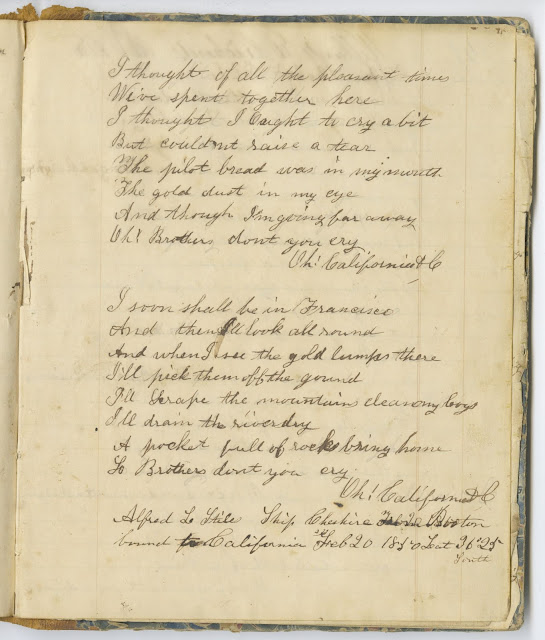
Some pages turn to odes yearning to find wealth in California, followed by a nostalgic homecoming. In the first stanzas Alfred reminisces upon pleasant times spent with loved ones, then the promise of “gold dust” in the eyes. This follows another line in which the writer waxes poetic about soon reaching San Francisco and fulfilling the fantasy of seeing “gold lumps there” on the streets ready for picking “off the ground,” as if the streets were lined with gold nuggets to fill one’s pockets full of riches to return home in glory.

Odes “Oh! California,” 1850; Alfred L. Stiles diary and letter, 1849-1850; MS 4014; California Historical Society.
Reading Alfred’s diary, whether you are an adult, teen, or child, will take you on an adventure from East to West Coast during a time when the promise of safe harbor in a new land might be your heart’s desire.

Poem Transcription for “A Life on the Ocean Wave”

A Life on the Ocean wave !!!!

A life on the Ocean Wave
A home on the rolling deep
Where the scattered waters save
And the Winds their [revels] keep
Like an Eagle caged I pine
On this dull unchanging shore
Oh! Give me the flashing Brine
The spray and the tempests roar
Once more on the deckd hand
Of my own swift gliding craft
Set sails farewell to the land
[May] the gale follow far aloft
We shoot through the sparkling foam
Like an Ocean Bird set free
Like an Ocean Bird our home
We find far out on the sea
The land is no longer in view
The clouds have begun to frown
But with a stout Vessel and Crew
We’ll say let the Storm come down
And the song of our hearts shall be
While the sounds and the waters save
A life on the heaving Sea
A Home on the bounding Wave !!!!!!

Alfred L. Stiles Ship Cheshire April 24, 1850
From Boston Bound to California


Transcription of Odes of yearning to California

I thought of all the pleasant times
We’ve spent together here
I thought I ought to cry a bit
But couldn’t raise a tear
The pilot bread was in my mouth
The gold dust in my eyes
And though I’m going far away
Oh! Brother don’t you cry

Oh! California

I soon shall be in San Francisco
And then look all around
And when I see the gold lumps there
I’ll pick them off the ground
I’ll scrape the mountains clearing logs
I’ll drain the river dry
A pocket full of rocks bring home
Lo Brothers don’t you cry

Oh! California


Alfred L. Stiles Ship Cheshire
From Boston Bound to California Feb. 20, 1850 Lat 36 25 South

--
Written by Lynda Letona, Assistant Archivist & Reference Librarian at California Historical Society (CHS).

Photos digitized by Marissa Friedman, Imaging Technician and Cataloger at CHS.

Reference:
Alfred L. Stiles diary and letter, 1849-1850; MS 4014; California Historical Society.