Redirect to CHS blog

Showing posts with label Children's Voices from the Archives. Show all posts

Monday, June 10, 2019

Children's voices in the Archives : El Joaquin Newspaper

Children’s Voices in the Archives is a series of posts brought to you by CHS’s North Baker Research Library.

Reading through the historical newspaper issues of El Joaquin is a strange experience. El Joaquin was a newspaper published in the Stockton Assembly Center during Japanese incarceration. This was considered a ‘temporary detention center’--such centers or concentration camps as called by others were used from late March, 1942 until mid-October, 1942. The El Joaquin newspaper issues in CHS’s collections have a run from May 1942 to the Final Edition, September, 1942. It was published every Wednesday and Saturday by the El Joaquin Press, W.C.C.A. Assembly Center, Stockton, CA. Single copies were delivered to each ‘apartment’ free of charge.

The editors of the newspaper seem to take great pains to tread the line between boosting morale--in the face of a racist policy that used war as an excuse to force Japanese citizens and residents out of their households--and appeasing the people who were incarcerated, perhaps in the attempt to ensure their safety. In the first Volume (issue no. 1) one gets a sense of the appeasing tone the editors use to try to get everyone to cooperate: “However, our personal frustrations must be shelved temporarily for an undertaking which requires each individual to cooperate with his fullest and best effort” (p. 1). This appeal seems at once appeasing yet subversive. Why subversive? Let me explain.

The same Volume 1 (no. 4) introduces us to Pancho, the newspaper mascot. Pancho is a toothy El Joaquin staff character: “Little Pancho represents the spirit of the Center. He is Patient, Active and Neighborly, Courteous, slap-Happy and Orderly” (an acrostic for his name).

Pancho for President, June 10, 1942; El Joaquin, Vol. 1, No. 4; OV Vault 289, Stockton Assembly center; California Historical Society.
On closer study, little Pancho has an interesting backstory the reader may peruse in the El Joaquin Final Edition (page L3). When the newspaper staff discover little Pancho “perched pertly on the Art Editor’s desk” toting a huge sombrero with “patches of hair showing underneath” the staff writes that upon more close observation of this “mysterious object… we noticed that there was a face and even a body beneath the hat. ‘Hey,” we shouted, “What the ____.”

When they ask Pancho what he is doing there, Pancho replies, “Why… you know me. I helped develop the lands around here. I raised beets, celery, grapes, potatoes, and even carrots. I’ve been a doctor, lawyer, farmer, merchant, laborer and a scholar. You’ve seen me around -- everywhere. I came in when the evacuation order was issued, because I had to” (Final Edition, L3). The staff notes how their adopted mascot then leaps gracefully from the table to the right-hand corner of the front page with a cry of “Let it roll.” The story of Pancho within the pages of El Joaquin begins a subtle subversive thread of a character who is resilient and ready to take on the immense burden of captivity with an industrious spirit.

But the subversive hint doesn’t end here. Remember--the El Joaquin newspaper had to, by the nature of the people’s captivity, be tame since the captors and hired staff of administrators and center’s workers could read its contents. In the issues I reviewed, I didn’t find the significance of the name “El Joaquin.” I wondered if there was more to it than being emblematic of San Joaquin County, the center’s county location in Stockton. It turns out there may be more history there. Upon speaking with library staff at the San Joaquin County Historical Society and Museum, the special collections staff thought that at first glance the newspaper was just named after the county. However, when the staff spoke with the Education Director, he mentioned that according to local lore the name has historical significance for one of the following reasons:

The newspaper was named after Joaquin Murrieta, a symbol of resistance.
Cover page, September 28, 1942; El Joaquin Final Edition, 1942; OV Vault 289, Stockton Assembly center; California Historical Society.
Joaquin Murrieta was a “legendary bandit who became a hero of the Mexican-Americans in California” during a time when Yankee miners pressured the legislature in Sacramento in 1850 to pass the Greaser Act and the Foreign Miners Act with the intent to drive out Mexicans (Encyclopædia Britannica). According to lore, Murrieta or several “Murrietas” responded to the oppression by “leading bands of outlaws that raided up and down the San Joaquin and Sacramento valleys, robbing gold miners and holding up stages” (Encyclopædia Britannica). Murrieta reached a symbolic status as a freedom fighter that has “long resonated and provided a powerful symbol of resistance for Chicano activists” (Encyclopædia Britannica). Could this resonance be the motive for the re-branding of El Joaquin Newspaper by the editors? Remember there is power in naming. Is it a reach to say that the branding of El Joaquin Newspaper by the editors was a subtle act of resistance? A way of reminding us of the historical implications of racist laws meant to favor one group over another and undoing it by capturing the original spirit of a Mexican migrant who wanted to settle with his bride in California?

Researchers must read between the lines and sometimes history is completely hidden from records and/or passed on as oral history. It’s hard to discover the “truth.” Remember the echoing lines, “Why… you know me. I helped develop the lands around here. I raised beets ... even carrots. I’ve been a doctor, lawyer, farmer, merchant, laborer and a scholar. You’ve seen me around -- everywhere. I came in when the evacuation order was issued, because I had to.” If the Japanese community saw themselves as Americans, they saw themselves as the traditional ideal of what Americans aspire to be: a helping hand, a laborer, a farmer, an intellectual. Whatever circumstance they are forced into, that ideal rises to meet the massive ‘challenge’ (an understatement in this context). Words are well but don’t always convey their true meaning. So we keep reading between the lines and between bodies’ gestures and actions.

What terribly complicates this captivity and the extent to which the captive can object, resist, or openly rebel are, of course, the children. Imagine if you were a parent under captivity. Imagine what you would do if you were forced out of your home and told that you and your children had to stay in an assembly center until further notice not knowing what will happen. What would you do?


The people at the Stockton Assembly Center and the newspaper staff got to work immediately-- organizing a nursery school; training Boy Scouts “the value of serving their communities” (A8, Final Issue); informing the “centerites” mothers that infant care would be provided as the dreams of the people were crushed when they were told they were being relocated to another new facility dubbed the “Arkansas project” (Final El Joaquin issue).

Pancho with travel bags, Aug. 8, 1942; El Joaquin, Vol. 2, no. 9. OV Vault 289, Stockton Assembly center; California Historical Society.
From church activities (Buddhist and Christian), to playing chess, performing Nisei symphonies, writing bittersweet poetry and humorous drawings, and setting up school lessons by dedicated volunteers serving as teachers in the center, the people of the Stockton Assembly Center arose to a difficult situation by uniting and organizing to make things work and to protect the children.


Kids playing chess, July 29, 1942; El Joaquin, Vol. 2, No. 6; OV Vault 289, Stockton Assembly center; California Historical Society. 


“Night and a Mood” poem, September 28, 1942; El Joaquin Final Edition, 1942; OV Vault 289, Stockton Assembly center; California Historical Society.

When I say that reading El Joaquin is a strange experience I mean to reflect upon the strength of the human spirit--how we meet captivity by doing what we've always learned to do--laughing at ourselves; caring for the children, and ensuring that their minds and bodies keep active (I'm thinking of the Girls' All-Star Teams noted in the Final Edition); dancing with "shimmering hues of brightly colored kimonos" (Vo. II, No. 2); informing our community of the latest developments through print and word of mouth. This is what a resilient and resisting people do. One may ask the bold question: What else can you do when you hope that the lives of the children will continue and maybe even thrive despite the trauma of captivity.

History repeats itself but it need not. We can learn from our costly mistakes and those of our ancestors. We can grow wiser and be better humans. We can resist. We can protect each other if we unite and raise a cry of protest against injustice.

El Joaquin takes kids to center store, August 5, 1942; El Joaquin, Vol. II, No. 8; OV Vault 289, Stockton Assembly center; California Historical Society.

References

El Joaquin, 1942; OV Vault 289, Stockton Assembly center; California Historical Society.

Joaquin Murrieta. (2019, May 1).  Encyclopædia Britannica. Retrieved May 29, 2019 from


Nisei. (2017, September 11). Encyclopædia Britannica. Retrieved May 29, 2019 from

Stockton (detention facility). (2015, July 14). Densho Encyclopedia. Retrieved 15:31, May 29, 2019 from https://encyclopedia.densho.org/Stockton%20(detention%20facility)/

--
Written by Lynda Letona, Assistant Archivist & Reference Librarian at California Historical Society (CHS).

Photos digitized by Marissa Friedman, Imaging Technician and Cataloger at CHS.

Wednesday, April 17, 2019

Children’s Voices from the Archives: Remembering the 1906 Earthquake and Fire

The 1906 earthquake and fire was a defining moment in San Francisco history. It was a disaster that changed the city’s social, economic, and cultural fabric, and to this day we often think of its history as divided into pre-earthquake and post-earthquake eras.

Photography, including the technology to produce outdoor shots, was gaining popularity by 1906, and CHS is fortunate to have a number of surviving images that document both the destruction and reconstruction of the city. Of equal importance are surviving personal diaries, journals, and letters that describe how residents coped with the aftermath of the disaster. One such document is the correspondence of Elsie Cross, a 12-year-old girl living in the Western Addition of San Francisco when, on April 18th 1906 at 5:12 a.m., an earthquake of massive force shook the city. Two letters to her friend Ruth, dated May 17-18 and May 28, give us a rarely explored child’s perspective of this event. The letters provide a firsthand account of the quake itself, the family’s escape from the house to the Sunset, and their eventual relocation to Oakland


Elsie’s description of the earthquake is notably poetic: “Things fell right & left, brick-a-brack flew around, furniture danced a jig,” and her strength and sense of humor shines through: “My brother could not stand so my brother had to hold him and, Ruth, I laughed when it knocked our beautiful Regina down and it played “Whistling Rufus” all the way through the earthquake.”

Through her words, however, the reader can also sense the fear and worry of Elsie’s parents as they flee, holding their children tight, wondering if the fire will reach them or if the earth will shake again:

“Wednesday afternoon with a few blankets, a canvas, and an eiderdown we went way out in the Sunset where the fire could never reach & slept part of the night on the front doorsteps. It was bright as day & you could have read a book in the house it was so light. About ten o’clock, the fire having died down, my brother & I both slept on one side of my mother. Both my mother & father did not sleep. The next day in the morning my mother & father & I packed in a steamer trunk old family laces, miniatures, & clothing. In the afternoon my father drove us in his buggy & we put the silver, jewelry, family pictures, & blankets in & went out into the Sunset…I felt very sorry to leave this and my piano, but as nothing else could be done I did not say anything.”


Elsie Cross’s letters and other earthquake material can be accessed at the North Baker Research Library at the California Historical Society during public hours, Wednesday through Friday from 1PM to 5PM. Full transcript below. Additional photos of the 1906 earthquake and fire can be viewed on CHS’s digital library.


---

Oakland, May 11, 1906


Dear Ruth,

As you will see by the heading I am no longer in Frisco. I received your parcel the week after that “gentle zepher” struck us. Ahem! Ahem!!!
Wednesday morning I was awakened by a slight shaking. Now as earthquakes are usually gentle and mild I waited for it to pass away. Instead of that it began to wrench & by that time I was in my door way. (That being considered the safest place). Then it began to go just up & down as a cat shakes a rat and I (thinking the world was coming to an end) said a prayer & waited for results. I saw my father in the front room try to get to my mother and also saw him thrown twice across the floor. I could see my mother & brother standing in their doorway. My brother could not stand so my mother had to hold him. And, Ruth, I laughed when it knocked our beautiful Regina down and it played “Whistling Rufus” all through the earthquake. Our chimney went through to the basement, my [ ] was thrown on my table and the drawers & their contents thrown on the floor. Things fell right & left, brick-a-brack flew around, and [ ]  danced a jig. As soon as it was over (& it only lasted (? ) 48 seconds…


[page 2]
…my father told us to dress as quick as we could and if another shake came to finish in the street.
Continued as I have to go downtown to get a Pineapple Smash & a library book. See “World [ ] Illustrations of Shock”

CONTINUED

May 18, ‘06

After we got out of the house my father said that the only trouble now, was fire. All that day there were shocks and the sun was a ball of purply red from the smoke. It was very hot. You could hear building after building being blasted. People passed in all kinds of wagons and some on foot with what possessions they could take. I forgot to tell you that a house across the street was moved over 9 ft. and the house next to that went down into the earth 10 ft. I will send you the pictures my father took of them and also some other places. Wednesday afternoon with a few blankets, * a canvas & a eiderdown we went way out in the Sunset where the fire could never reach and slept part of the night on the front doorsteps. It was as bright as day and you could have read a book in the house it was so light. About ten o’clock, the fire having

[page 3]

died down after & Ill my brother and I each slept on one side of my mother. Both my mother and father did not sleep. The next day in the morning my mother and I packed in a steamer trunk old family laces, miniatures, and clothing. In the afternoon my father drove up in his buggy and we put the silver, jewelry, family pictures, & blankets in & went out in to the Sunset. My room is all old fashioned furniture of mahogany and my wall, bedspread, and other trimming is old rose. I felt very sorry to leave this & my piano, but as nothing else could be done I did not say anything.  Where we went was out by the park, & the place was a grocery store & saloon. They had their own cow and chickens and also liquors & grocery provisions, the latter being stored in the house. There were 4 little children and a baby one month old. The first night we slept outdoors and they did not stop blasting when night came on but blasted all through the night.  In the morning I was awakened by a dreadfully loud blast and heard my mother say that she had watched the fire all night and it was now, she thought, under control.

---
Written and transcribed by Frances Kaplan, Reference Librarian at California Historical Society.
  

Citation:
Elsie H. Cross letters to Ruth, Oakland, California, May 17-28, 1906; MS 3469; California Historical Society


Monday, January 28, 2019

Alfred Stiles: A Boy’s Adventurous Journey to California

Children’s Voices in the Archives is a series of posts brought to you by CHS’s North Baker Research Library. Stay tuned for more charming examples of history through a child’s eyes in the coming months.

Alfred Stiles’ diary reads like a mini adventure novel written from the perspective of a 13-year-old boy traveling from Boylston, Massachusetts on a ship headed to the Golden State. His sharp prose and keen observations may surprise you, not to mention his recording of details that veer into the journalistic then make a sharp turn towards the poetic. You might not think there would be much to do or observe on a ship’s long journey from Boston to San Francisco by way of Cape Horn (Dec. 1849 - June 1850), but even within the first few pages of Alfred’s diary, an avid debate club springs to life--the Cheshire Debating Club--to which his parents belonged. Alfred’s parents debated questions such as “Should the U.S. acquire the state of California?” Alfred diligently recorded the yeas and nays--his father in affirmative with 2 others and “Mother in Negative + 2 others.” They debated whether the acquisition of California would be of any benefit to the U.S.

Cover page, 1847; Alfred L. Stiles diary and letter, 1849-1856; MS 4014; California Historical Society.

Passenger list, 1849-1850; Alfred L. Stiles diary and letter, 1849-1856; MS 4014; California Historical Society.  
Christmas and New Years did not go by without incident. Alfred notes some rowdy behavior on Christmas Day when “2 thirds of the passengers drunk besides Capt + mate + 1 or 2 hands the mate pulled Choate from port hand of the forecastle and struck him several blows on the head, when some of the passengers cried out ‘throw him overboard’” he left for his cabin. Amidst the blows and drink, Alfred reports they had 2 pigs for dinner and apple duff.

On New Years, “About 2 clock a man had 4 bucket served at his head and a few other things which created a great excitement.” One diary entry records Tuesday, January 1st 1850 as evincing a light breeze and people wishing each other a happy New Year, with some passengers wishing to have a Heigh ride at home while it is as warm as July. Next Alfred describes fresh pork and apple pie for dinner, as well as doughnuts for supper with the addition of black fish.

We also find moments of quiet admiration and reflection where whale watching upon the ship Cheshire reminds the reader of Moby Dick. Alfred writes in another entry, “Thursday dec [?] very sick passengers most all sick saw some whales about 3 miles off” then on the opposite page of the diary, the lone word Whale crowns the page of text like a chapter title.

Whale title heading, 1849-1850; Alfred L. Stiles diary and letter, 1849-1856; MS 4014; California Historical Society.  
On a separate entry, we find a lovely poem titled “A Life on the Ocean Wave,” where Alfred transforms into a caged eagle amidst scattered waters and a dull unchanging shore.  [See end of blog for poem transcription]

“A Life on the Ocean Wave” poem, 1850; Alfred L. Stiles diary and letter, 1849-1856; MS 4014; California Historical Society.
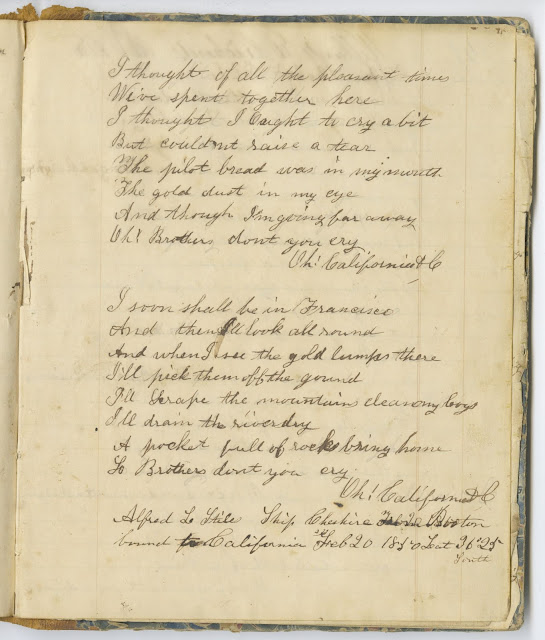
Some pages turn to odes yearning to find wealth in California, followed by a nostalgic homecoming. In the first stanzas Alfred reminisces upon pleasant times spent with loved ones, then the promise of “gold dust” in the eyes. This follows another line in which the writer waxes poetic about soon reaching San Francisco and fulfilling the fantasy of seeing “gold lumps there” on the streets ready for picking “off the ground,” as if the streets were lined with gold nuggets to fill one’s pockets full of riches to return home in glory.

Odes “Oh! California,” 1850; Alfred L. Stiles diary and letter, 1849-1850; MS 4014; California Historical Society.
Reading Alfred’s diary, whether you are an adult, teen, or child, will take you on an adventure from East to West Coast during a time when the promise of safe harbor in a new land might be your heart’s desire.

Poem Transcription for “A Life on the Ocean Wave”

A Life on the Ocean wave !!!!

A life on the Ocean Wave
A home on the rolling deep
Where the scattered waters save
And the Winds their [revels] keep
Like an Eagle caged I pine
On this dull unchanging shore
Oh! Give me the flashing Brine
The spray and the tempests roar
Once more on the deckd hand
Of my own swift gliding craft
Set sails farewell to the land
[May] the gale follow far aloft
We shoot through the sparkling foam
Like an Ocean Bird set free
Like an Ocean Bird our home
We find far out on the sea
The land is no longer in view
The clouds have begun to frown
But with a stout Vessel and Crew
We’ll say let the Storm come down
And the song of our hearts shall be
While the sounds and the waters save
A life on the heaving Sea
A Home on the bounding Wave !!!!!!

Alfred L. Stiles Ship Cheshire April 24, 1850
From Boston Bound to California


Transcription of Odes of yearning to California

I thought of all the pleasant times
We’ve spent together here
I thought I ought to cry a bit
But couldn’t raise a tear
The pilot bread was in my mouth
The gold dust in my eyes
And though I’m going far away
Oh! Brother don’t you cry

Oh! California

I soon shall be in San Francisco
And then look all around
And when I see the gold lumps there
I’ll pick them off the ground
I’ll scrape the mountains clearing logs
I’ll drain the river dry
A pocket full of rocks bring home
Lo Brothers don’t you cry

Oh! California


Alfred L. Stiles Ship Cheshire
From Boston Bound to California Feb. 20, 1850 Lat 36 25 South

--
Written by Lynda Letona, Assistant Archivist & Reference Librarian at California Historical Society (CHS).

Photos digitized by Marissa Friedman, Imaging Technician and Cataloger at CHS.

Reference:
Alfred L. Stiles diary and letter, 1849-1850; MS 4014; California Historical Society.