Redirect to CHS blog

Wednesday, April 12, 2017

National Library Week: "Tracking Immigrants, Then and Now"

Photograph album of Chinese men and women in Sierra County, Vault 184, California Historical Society

There's a photo from the California Historical Society's North Baker Research Library that has fascinated me for years. It's the page of an immigration officer's journal from 1894. Stationed in Downieville, California, D.D. Beatty took photographs of nearly every Chinese resident in the city and noted their name, age, "identifying marks," and other details as part of his work as an inspector for the U.S. Bureau of Immigration. The Geary Act of 1892 required all Chinese immigrants to register with the U.S. government (a long-forgotten precursor to the "Muslim registry," or National Security Entry-Exit Registration System put into place after 9/11), and Beatty apparently used this journal to keep track of the Chinese immigrants in his jurisdiction. The faces of three women and one man stare out from their passport-size mugshots. Beatty's careful cursive appears alongside. An older woman is identified as Ung Gook, or "China Susie." At the time of the entry, she was 55 years old and noted as as "housekeeper." Beatty found "no marks" on her face. An additional note was added in 1900: "Gone to China for good."

I've been fascinated by this digitized source, because it documents the intense government surveillance of Chinese immigrants and Chinese Americans during the exclusion era in a way that no other source does. As someone who has spent her career researching and writing about immigration history and whose family was divided by the Chinese exclusion laws, D.D. Beatty's journal has both research and personal significance. I've been using the digital version of this photograph for years in my public lectures and in my teaching. But I have never seen the journal in person. Until recently. Last month, I was able to visit the North Baker Research Library and held the journal for the first time. It was a powerful moment to turn through page after page of Beatty's photographs and notations and feel the pull of history. And at a time when new government policies are deporting and banning new immigrants, remembering the consequences of this dark chapter in our history is more important than ever.

Erika Lee
Rudolph J. Vecoli Chair in Immigration History and Director, Immigration History Research Center, University of Minnesota; author of The Making of Asian America: A History, Angel Island: Immigrant Gateway to America (with Judy Yung), and At America's Gates: Chinese Exclusion During the Exclusion Era, 1882-1943.

Tuesday, April 11, 2017

National Library Week: The American Civil Liberties Union of Northern California


Fred Korematsu letter: Salt Lake City, to Ernest Besig, American Civil Liberties of Northern California records, MS 3580, California Historical Society

As a historian based in New Zealand interested in the history of radicalism and repression in California, I have found the records of the American Civil Liberties Union held at the California Historical Society of immense value. Since San Francisco was a major site of confrontation in the mid- to late 20th century and the ACLU was heavily involved in defending minorities, labor unions, immigrants, and radicals being persecuted and prosecuted, the ACLU-NC collection gives important insights into efforts to resist the power of the state, major interest groups, and federal government.  It provides important evidence about the effects of repressive legislation including the state law against criminal syndicalism and federal legislation, such as the Alien Registration Act (Smith Act). It reveals the efforts to civil libertarians, including local lawyers based in San Francisco and Oakland,  to defend radicals, union officials, union organizers, and groups deemed to be subversive, which ultimately resulted in some important Supreme Court decisions such as Yates vs. the United States (1957).

The records are also extremely useful for revealing conflicts between the ACLU’s Board of Directors and the Northern California branch over such vexed questions as to whether members of the Communist Party could serve on the Board and deserved the protection of the Bill of Rights. It becomes possible to trace the ACLU’s internal upheaval  in 1940 and again in the early 1950s over these questions in which the ACLU of Northern California was a stronger supporter civil liberties than the national organization. Such insights make the ACLU collection at the California Historical Society of great significance for investigating the conflict between civil liberties and domestic security, an issue just as relevant in the current climate as it during important periods in the past.  

As a visitor from a New Zealand university, I was also impressed by the professionalism and the supportive environment provided by the archival staff at the California Historical Society. Communications prior to my visit were done extremely well and the records were ready for me when I arrived.  The positive attitude and expertise made the task of researching both enjoyable and productive. For someone who usually has too little time to spend during a research trip, the quality of the staff and their interest in helping the researcher was much appreciated.

Dolores Janiewski,
Associate Professor
School of History, Philosophy, Political Science & International Relations
Victoria University of Wellington, New Zealand

Monday, April 10, 2017

Celebrating National Library Week

In honor of National Library Week, California Historical Society (CHS) staff and researchers will contribute one blog post a day celebrating some of the Society's most beloved, inspiring, and unforgettable collections. The CHS Collection is vast, idiosyncratic, and wonderful, so full of treasures and delights that it's hard to pick favorites. For this inaugural post, I let my mind wander until the three items below emerged as especially precious.

Rosalía Vallejo de Leese, after 1847, Dag8H, California Historical Society   

I first discovered this daguerreotype of Rosalía Vallejo de Leese while conducting research for the exhibition Juana Briones y su California: Pionera, Fundadora, Curandera. The sister of Mariano Guadalupe Vallejo, Rosalía married early San Francisco trader Jacob Leese in 1837, making her one of Yerba Buena's earliest non-Native residents. I find Rosalía's youthful gravity extremely moving. According to photography historical Peter Palmquist, Rosalía's niece Epfiania "Fannie" de Guadalupe Vallejo may have been California's first photographer, acquiring a daguerreotype camera around 1847.


Representación del Colegio [Apostólico de Propaganda Fide de San Fernando] al Virrey, MS Vault 151, California Historical Society
I encountered this manuscript, a letter written to Viceroy Marquis de Croix from the Franciscan college in Mexico City, as I was working on a project to catalog CHS’s neglected Spanish-language manuscripts. The letter was penned around 1767, the year King Charles III expelled the Jesuits from Spain and Spanish America, radically changing the course of religious history in the New World. In the letter, the Franciscans thank the Viceroy for entrusting them with the missionization of California, but also emphasize the urgent need for more priests and warn that a single missionary living alone among the neophytes is an exceedingly dangerous thing (“una cosa sumamente peligrosa”). Manuscripts like these are powerful because they particularize, humanize, and bring into focus almost inconceivably momentous historical events and upheavals.


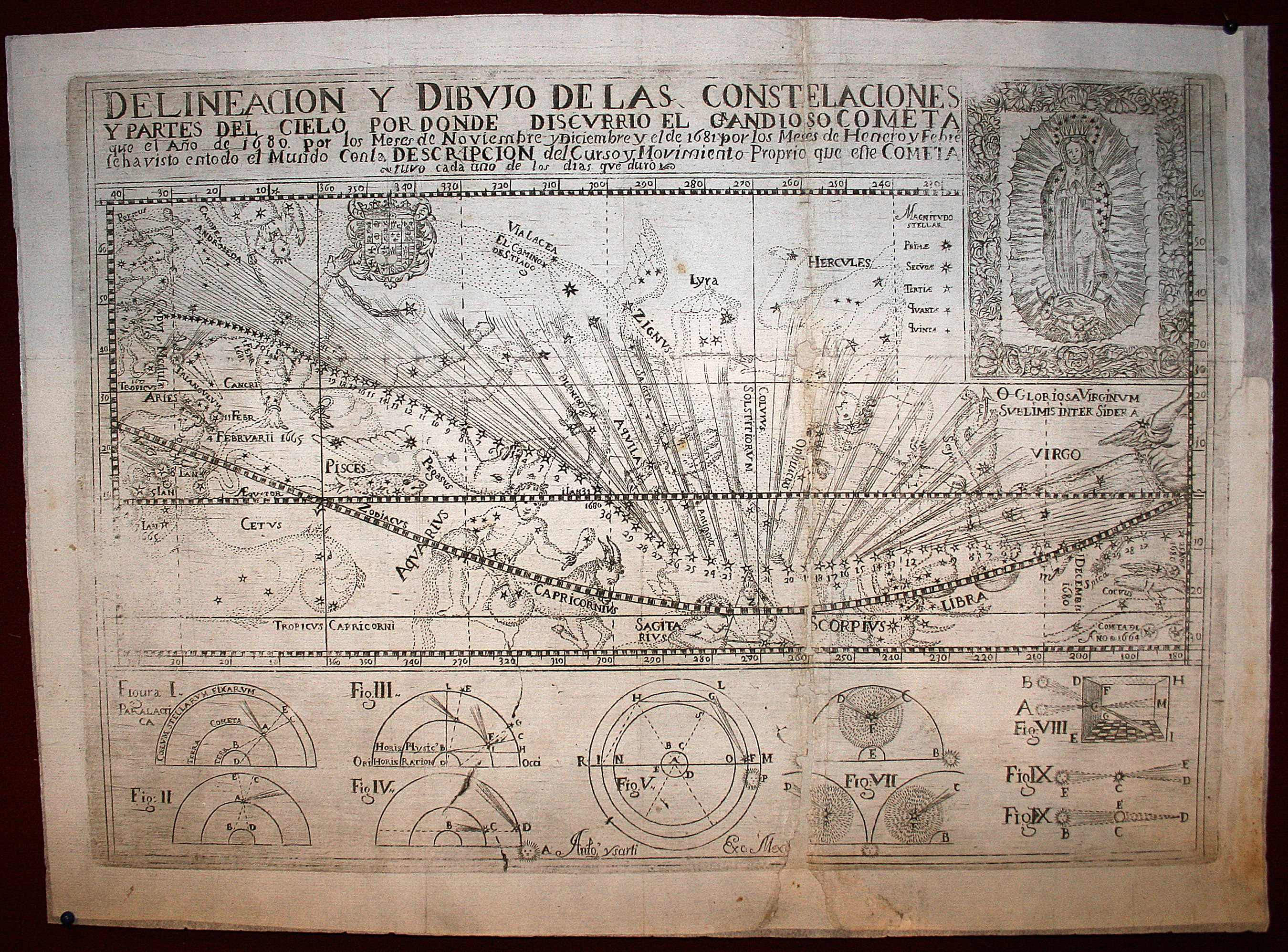
Kino, Eusebio, Exposicion astronomica de el cometa, que el año de 1680 : por los meses de noviembre, y diziembre, y este año de 1681, por los meses de enero y febrero, se ha visto en todo el mundo, y le ha observado en la ciudad de Cadiz, California Historical Society, Vault 523.6 K624e


Finally, one of my favorite books in the CHS Collection is the Jesuit missionary Eusebio Kino’s astronomical treatise of 1681, Exposicion astronomica de el cometa, que el año de 1680…. Published in Mexico City in 1681, this work records Kino’s observations of the Great Comet of 1680, which he made in Cádiz as he was waiting to depart for the Americas. Kino’s work inspired praise and opprobrium—a sonnet by the great Mexican poet Sor Juana Inés de la Cruz and a fierce refutation by the scientist Carlos Sigüenza y Góngora—revealing a flowering intellectual culture in seventeenth-century Mexico. The Exposicion astronomica includes a beautiful celestial map charting the course of the comet. Kino’s impact on cartography was also significant; he was the first European to prove that California is a peninsula, not an island.


Marie Silva, Archivist & Manuscripts Librarian

Friday, March 31, 2017

Honoring César Chávez, March 31, 2017


Mural detail, Emigdio Vasquez, The Legacy of César Chávez (1997), Santa Ana College, California, http://chicanoartmovement.com 
César Chávez died with an art book in his hands.

This final image of the great visionary is appropriate and poetic — because he and his struggle for justice were intimately intertwined with creative expression by Chicano visual and performing artists.


—Max Benavidez, “Chávez Legacy: He Nurtured Seeds of Art,” Los Angeles Times, April 28, 1993
The life of civil rights activist and labor leader César Chávez is well documented and recognized every year on March 31. However, his legacy is also honored in art and murals throughout the region.

In recognition of César Chávez Day and of the many Chicana/o muralists who have preserved his legacy in their works, we offer a few examples from our forthcoming book, ¡Murales Rebeldes!—L.A. Chicana/Chicano Murals under Siege, copublished with LA Plaza de Cultura y Artes in collaboration with Angel City Press (September 2017). The book tells the stories of eight Chicana/o murals that were censored, whitewashed, neglected, and even destroyed and examines the impact on the artists and the Chicana/o communities in which they were painted—and, more broadly, on Los Angeles’s cultural and historical heritage.

Emigdio Vasquez, Memories of the Past and Images of the Present (1978), 1995
Photo: Gloria Ortiz; courtesy Emigdio Vasquez family

In 1978, Emigdio Vasquez, winner of the prestigious Maestro Prize, painted Recuerdos del pasado y imagines del presente (Memories of the Past and Images of the Present) on the wall of the Iberio American Market in Anaheim. The mural traces Mexican history from Zapata to César Chávez (far right). At 13 x 106 feet, it is the largest of nearly two dozen murals the celebrated Chicano fine art painter and muralist created in the barrios of Orange County where he lived. This mural, which still exists, illustrates the foreword of the book by Orange County journalist Gustavo Arellano.

Mural detail, Sergio O’Cadiz Moctezuma, Fountain Valley Mural (1974–76)
Courtesy Private Collection of the O’Cadiz Family, © O’Cadiz Family Private Collection

The logo of the United Farm Workers, co-founded by activists César Chávez and Dolores Huerta, was represented on one of the approximately twenty-five scenes that made up Sergio O’Cadiz’s 6 x 625-foot mural in Fountain Valley’s Colonia Juarez. The mural, which told the history of Mexican Americans, was destroyed in 2001, when a bulldozer razed the wall on which it was painted and a higher wall was built in its place. The UFW logo was conceived by Chávez’s brother Richard in 1962, when Chávez and Huerta founded the UFW.

Mural detail, Barbara Carrasco, L.A. History: A Mexican Perspective (1981)
Photo: Sean Meredith; LA Plaza de Cultura y Artes/CHS

Barbara Carrasco’s mural L.A. History: A Mexican Perspective was censored due to the artist’s inclusion of controversial aspects of the city’s history, particularly regarding its minority populations. In this section of the mural, César Chávez (far right, featuring the United Farm Workers logo on his shirt) is grouped with other city leaders and activists, including Mayor Tom Bradley, Jane Fonda, fellow muralist Yreina D. Cervantez, and Dolores Huerta, with whom he cofounded the UFW. 

Mural detail, Barbara Carrasco, L.A. History: A Mexican Perspective (1981)
Photo: Sean Meredith; LA Plaza de Cultura y Artes/CHS

Carrasco first met Chávez (far right) as a 19-year-old university student. “I immediately volunteered my services to him,” she recalled in an oral history. “I would work with him for fifteen years,” creating drawings, flyers, and banners for UFW conferences.

Shelly Kale
Publications and Strategic Projects Manager
skale@calhist.org

Sources
  • Eva Sperling Cockcroft and Holly Barnet-Sanchez, eds., Signs from the Heart: California Chicano Murals (Albuquerque: University of New Mexico Press, 1993)
  • Max Benavidez, “Cesar Chavez Nurtured Seeds of Art” Los Angeles Times, April 28, 1993; http://articles.latimes.com/1993-04-28/entertainment/ca-28278_1_chicano-art
  • Smithsonian Archives of American Art, Oral history interview with Barbara Carrasco, conducted by Jeffery J. Rangel, Los Angeles, CA, April 13–26, 1999 (Washington. D.C.: Smithsonian Institution, 1999)
______________________________________________________________________________


¡Murales Rebeldes!—L.A. Chicana/o Murals under Siege is part of Pacific Standard Time: LA/LA, a far-reaching and ambitious exploration of Latin American and Latino art in dialogue with Los Angeles, taking place from September 2017 through January 2018 at more than 70 cultural institutions across Southern California. Pacific Standard Time is an initiative of the Getty. The presenting sponsor is Bank of America.

For more information on ¡Murales Rebeldes!—L.A. Chicana/o Murals under Siege see: https://www.californiahistoricalsociety.org/exhibitions/upcoming_exhibitions.html

For more information about Pacific Standard Time: LA/LA, see: http://www.pacificstandardtime.org/

Monday, March 27, 2017

Murals: Creating a Legacy

David Alfaro Siqueiros observes the whitewashing of his controversial mural 
América Tropical (1932) in a detail from Barbara Carrasco’s censored mural, 
L.A. History: A Mexican Perspective (1981)
Photo: Sean Meredith; courtesy LA Plaza de Cultura y Artes and California Historical Society

There was a time in 1932 when patrons at the rooftop beer garden of the Italian Hall on Mexican-themed Olvera Street could admire an 80 x 18-foot mural painted on the building’s exterior second-story wall. When visitors to this newly opened Mexican outdoor marketplace could look up from the street and see part of the mural. When Los Angeles could claim the country’s first large-scale mural on an ordinary wall in a public place.

But the moment was brief. By 1934, América Tropical, created by the famed Mexican muralist David Alfaro Siquerios, was completely whitewashed—rejected by those offended and shocked by its political statement against American imperialism, rather than the benign ode to “tropical America” they expected. The contested section depicted an indigenous Mexican peasant tied to a double cross beneath an American eagle (a symbol of American imperialism). Siqueiros, in fact, titled the mural América Tropical: Oprimida y Destrozada por los Imperialismos (Tropical America: Oppressed and Destroyed by Imperialism).

Roberto Berdecio, a close associate of Siqueiros, stands in front of América Tropical shortly after completion in the 1930s
Photo: The Getty Research Institute, Los Angeles
Mural: © 2012 Artists Rights Society (ARS), New York/SOMAAP, Mexico City
http://www.getty.edu/conservation


Colored digital rendering of David Alfaro Siqueiros’s América Tropical
Courtesy Luis C. Garza
Mural: © 2012 Artists Rights Society (ARS), New York/SOMAAP, Mexico City

As the whitewash peeled off in the 1960s and 1970s, a “ghost” image of the mural was revealed. It is this “ghost mural” that the Getty Conservation Institute (GCI), in partnership with El Pueblo de Los Angeles Historical Monument, has been conserving since 1990. And it is the meticulous work of cleaning the mural that conservators addressed this month, nearly 85 years since the mural was painted.

The Getty Conservation Institute’s Monitoring Notebook and a visual of América Tropical on the roof of the Italian Museum at El Pueblo de Los Angeles National Monument, 
March 21, 2017
Photo: Shelly Kale; mural: © 2012 Artists Rights Society (ARS), New York/SOMAAP, Mexico City

In 1994, Luis Garza, the Getty Conservation Institute’s consultant coordinator for the América Tropical conservation project, observed: “América Tropical has come to epitomize the historical mistreatment of art.”

A conservator at work on the conservation of América Tropical at El Pueblo de Los Angeles National Monument, March 21, 2017
Photo: Shelly Kale; mural: © 2012 Artists Rights Society (ARS), New York/SOMAAP, Mexico City


¡Murales Rebeldes!—L.A. Chicana/o Murals under Siege

While the country overcame significant challenges in the years following the whitewashing of América Tropical—a devastating Depression, a world war—the fight for the civil rights of minorities simmered. As Sequieros’s mural “reappeared,” nationwide protests erupted, culminating in the social and political movements of the 1960s and 1970s, including the civil rights Chicano Movement. In the Los Angeles region, Chicana/Chicano muralists stepped into the public fray, becoming a primary vehicle of the movement’s message. But while valued by the communities they served, the fates of many of the murals they painted echoed Siqueiros’s experience decades earlier.

Chicano Moratorium (Mexican American anti-Vietnam War movement), Los Angeles, 1970
Photo: Oscar Castillo; © Oscar Castillo

Addressing these outcomes and the larger role murals play in public discourse and artistic contribution are the forthcoming publication and exhibition ¡Murales Rebeldes!: L.A. Chicana/o Murals under Siege, developed by the California Historical Society and LA Plaza de Cultura y Artes. Celebrating the work of seven muralists whose works were censored, whitewashed, neglected, and even destroyed from the 1970s to the 1990s, ¡Murales Rebeldes! examines these murals in the political, legal, and social climates of their time and raises important questions about how to understand and secure the legacy of murals as public art.

One muralist, Barbara Carrasco, saw parallels between her 1981 mural L.A. History: A Mexican Perspective and América Tropical. Both murals were censored—due to their “controversial” political and historical content—in years when Los Angeles hosted or was preparing to host national and international visitors to the city’s Olympics (the 1932 and 1984 Olympiads).

Barbara Carrasco, L.A. History: A Mexican Perspective, 2017
Photo: Sean Meredith; mural © Barbara Carrasco
Courtesy LA Plaza de Cultura y Artes/CHS

In 1984, fifty years after the whitewashing of América Tropical, Carrasco made a silk-screen print titled Self-Portrait. It was described in a 1966 issue of High Performance as “a screaming woman artist dressed as an Olympic runner, about to be whitewashed by a paint roller. Embedded in the white-on-white treatment of the roller are the letters ‘CRA—LA.’ The woman holds a paintbrush reading ‘Siqueiros No. 1,’ . . . [and] wears the number 2 (as if to say, ‘You’re next’).”

Barbara Carrasco, Self-Portrait, 1984
Courtesy of the artist; © Barbara Carrasco

Like Siqueiros’s América Tropical, the murals featured in ¡Murales Rebeldes! endured a lack of recognition—as works of art, as acts of personal expression, and as voices with social, historical, or political relevance. Some of the ¡Murales Rebeldes! muralists, such as Ernesto de la Loza and Willie Herrón, conserve their own and others’ murals.

¡Murales Rebeldes! not only recounts the time, place, and conditions under which the murals it features were created, but celebrates the artistic and personal contributions of these murals and muralists to public art and the historical record.

Shelly Kale
Publications and Strategic Projects Manager
skale@calhist.org

Sources

¡Murales Rebeldes!—L.A. Chicana/o Murals under Siege is part of Pacific Standard Time: LA/LA, a far-reaching and ambitious exploration of Latin American and Latino art in dialogue with Los Angeles, taking place from September 2017 through January 2018 at more than 70 cultural institutions across Southern California. Pacific Standard Time is an initiative of the Getty. The presenting sponsor is Bank of America.

For more information on ¡Murales Rebeldes!—L.A. Chicana/o Murals under Siege see:
https://www.californiahistoricalsociety.org/exhibitions/upcoming_exhibitions.html

For more information about Pacific Standard Time: LA/LA, see http://www.pacificstandardtime.org/
https://getty.edu/foundation/initiatives/current/pst_lala/index.html


Saturday, March 25, 2017

Los Angeles Counterculture: Human Be-ins and Love-Ins

Bruch H. Cox (photographer), “Couples dancing amongst crowd at love-in held at Griffith Park, Los Angeles, Calif.,” July 24, 1967
Courtesy Los Angeles Times Photographic Archive, Department of Special Collections, 
Charles E. Young Research Library, UCLA

The year 1967 was a ground-breaking year for California’s counterculture movement, with Be-ins/Love-ins; sex and drugs; peace and love; rock and roll and anti-war protests.

The year first exploded in San Francisco: On January 14 a “Human Be-in” was held at Golden State Park, attracting national media attention and putting the Haight-Ashbury counterculture on the map. Tens of thousands of people arrived to hear the Grateful Dead, Big Brother, Timothy Leary, among others, speak and perform. As the Los Angeles Times noted in its 2007 article “‘Human Be-In’ begat the ’60s’ Summer of Love”: “In many ways, the ’60s as we know them began Jan. 14, 1967.”

That same day, about 400 miles south, a Human Be-In simultaneously occurred in Los Angeles. As one blogger recalls:
The first of the Griffith Park Be-ins or Love-ins just seemed to happen: 500 youths gathered around the Griffith Park Merry-Go-Round, the iconic carousel that inspired Walt Disney in the early 50s to create Disneyland. It was a simple affair; the music was someone's guitar or someone else's transistor radio, and unlike the tens of thousands who, on the same date, attended San Francisco’s Human Be-in, the L.A. affair was pastoral and carried with it a sense that maybe, finally, the clash of cultures, the frenzied reactions by the city and the LAPD, had finally waned.”
One attendee remembers:
Los Angeles was a great place to be in 1967. I made the natural transition from beatnik to flower child. The sit-ins to protest the escalating war in Vietnam led to the first Human Be-Ins, held simultaneously in San Francisco and Los Angeles. I was in attendance at the Be-In in Griffith Park and felt a part of the whole scene—the music, the free-spirited people, the psychedelic clothing and general good vibes. 
Jerry Hopkins, “Human Be-In in the Park,” The Los Angeles Free Press, January 20, 1967
Courtesy Los Angeles Free Press Archives
http://losangelesfreepress.com/2017/01/the-tribes-gathered/

Both the Los Angeles and San Francisco Human Be-Ins were planned together informally, the Los Angeles Free Press noted. “This marked for the first time this city’s public parks have been used for such a unique function, long a custom in cities like New York and San Francisco,” the paper reported. In posters advertising the event during the previous week, “people had been asked to bring ‘the color gold, incense, flowers, and pictures of your favorite guru. . . . Many distributed incense and flowers all afternoon. They also exchanged cookies wrapped in colorful paper, tangerines, African thumb pianos, sandwiches, bells, and dozens of trinkets and amulets.”

The idea caught on, and this first Los Angeles Be-In soon led to others. Here’s a look back at some of them.

February 25, 1967 Griffith Park


Poster, Human Be-In #2, 1967
Courtesy http://10-am.blogspot.com/2017/01/human-be-in.html

Crowds at Los Angeles’s second Be-In were far greater than the first. “Approximately 5,500 people are in attendance and enjoy a continuous stream of bands throughout the day-long event,” including the Doors, according to the Doors Interactive Chronological History. As Simon Rycroft  notes in “Global Undergrounds: The Cultural Politics of Sound and Light in Los Angeles, 1965–1975,” “. . . the music festival was proclaimed by some as a new development for the city, a turning point in the local politics of dissent from the city’s characteristic form of theater of cruelty to the theater of love.”

Easter Sunday, March 26, 1967
Griffith Park

Easter Sunday Love-In, Griffith Park, Los Angeles, March 26, 1967
Courtesy The Original Glen Buxton 

Another one of the city’s first large "Love-Ins" (which many hail as the most successful to date in early 1967) that helped establish a pattern of weekend Love Ins and Be-Ins that would continue until the early 1970s was held on Easter Sunday, March 26, in Griffith Park. As the West Coast Fog notes: “Beginning as impromptu Human Be-Ins over by the Greek Theater and Fern Dell, these pretty-much word-of-mouth gatherings were getting larger and larger and were moved to bigger areas like Elysian Park and the other side of Griffith Park by the merry-go-round. This one was the biggest one yet.”


Elysian Park "Love-In" March 26, 1967
Source: http://lahistory.tumblr.com/
Additional pictures for the event can be seen here and the poster for the event can be seen below:

Poster, Easter Sunday Be-in, 1967
Courtesy West Coast Fog; http://www.westcoastfog.com/west-coast-branch/

A BBC reporter covering L.A.’s hippie culture observed: “In Griffith Park Los Angeles, hippie tribes gather 20,000 strong for a Love-in. The new waves come bearing beads and blossoms and bells, looking for a new experience and new magic, wandering the woods like children of the children’s crusade, leaving only a trace of gentleness in their wake. . . . For the Love Generation, it’s just the beginning. Their numbers grow, their philosophies spread. If you can stand, or understand, this flowering segment of the younger generation, there’s little point in getting cross and calling it names. . . there’s no point at all in just wishing it would go away. You will go away first.”

May 30, 1967
Griffith Park 

Griffith Park Love-in, May 30, 1967
Courtesy Kent Kanouse

The peaceful nature of the Be-Ins and Love-Ins would give way to an era of protests and violence, and some attendees were arrested at a July Be-In. As thousands of youths flooded into Los Angeles, Rycroft writes, “an uneasy alliance between the city’s Hells Angels and the countercultural community was forged, causing problems with the police and resulting in a near riot at the July Be-In. . . . Eventually, the violence heralded the end of the Love-In era in L.A. . . . Even the global, tribal, and unifying phenomena of the Be-Ins as they were grafted onto the city seemed affected by the different character of L.A.’s underground community.”

Meanwhile, just as the Human Be-In and the media around it helped spread the influence of the counterculture through California and the United States, its impact was also being felt on the West Coast across the border in Vancouver where several hundreds hippies descended on the city's Stanley Park. This week, the Vancouver Sun looked back at that event here. And in New York City, more than 10,000 gathered in that city's famous Central Park.


Shelly Kale
Publications and Strategic Projects Manager
skale@calhist.org

Sources

  • Erik Bluhm and Paul Gammage, West Coast Fog blog, “West Coast Branch,” July 28, 2013; http://www.westcoastfog.com/west-coast-branch/ 
  • Steven M. Finger, “The Tribes Gathered . . . ,” January 19, 2017; http://losangelesfreepress.com/2017/01/the-tribes-gathered/
  • Lisa Leff, “Human Be-In' begat the ‘60s’ Summer of Love,” Los Angeles Times, January 14, 2007
  • A BBC Reporter uncovers the underground Hippie Culture in Los Angeles during a "Love In," https://gaming.youtube.com/watch?v=b97_9YMBebY&list=LLn6jMLs6giLyZWQgcHTTEIA 
  • Nancy Mehagian, Siren’s Feast: An Edible Odyssey (New York: Open Road Integrated Media, 2014)
  • Simon Rycroft, “Global Undergrounds: The Cultural Politics of Sound and Light in Los Angeles, 1965-1975,” in The Place of Music, eds. Andrew Leyshon, David Matless, George Revill (new York and London: The Guildford Press, 1998)


Wednesday, March 22, 2017

New grant for ¡Murales Rebeldes!: L.A. Chicana/o Murals Under Siege


Barbara Carrasco's L.A. History: A Mexican Perspective 

We are pleased to announce that our upcoming exhibition, ¡Murales Rebeldes!: L.A. Chicana/o Murals under Siege, has received a $40,000 grant from the Mike Kelly Foundation for the Arts in Los Angeles. This exhibition, created in partnership with LA Plaza de Cultura y Artes, will be part of the Getty Foundation’s Pacific Standard Time: LA/LA initiative this Fall.

The summary of the grant is below and included in this official release and here

¡MURALES REBELDES!
L.A. Chicana/o Murals Under Siege 

Jointly presented by the California Historical Society and LA Plaza de Cultura y Artes as part of the Getty’s Pacific Standard Time: LA/LA initiative, ¡Murales Rebeldes!: L.A. Chicana/o Murals under Siege explores the ways in which Chicana/o murals in the greater Los Angeles area have been censored, whitewashed, neglected, and even destroyed. Through the stories of seven muralists, the exhibition offers viewers insight into the powerful and radical messages that murals can carry, as well as the means by which these messages can be suppressed. The exhibition will be held at LA Plaza de Cultura y Artes in downtown Los Angeles.

A centerpiece of the project is Barbara Carrasco’s L.A. History: A Mexican Perspective (1981), a piece that typifies the struggles of Chicana/o muralists. Originally sponsored by the Community Redevelopment Agency (CRA) for the city’s bicentennial celebration, Carrasco’s 16-by-80-foot portable mural depicts Los Angeles's history from the perspective of its ethnic communities. The mural was censored by the CRA and became a symbol of the struggle over competing visions of the city's history. Since its creation, L.A. History: A Mexican Perspective has only been displayed once in its entirety, at Union Station in 1990. The exhibition will bring the mural back for public viewing for the first time in 25 years.

You can read more about the grant here:


Wednesday, March 15, 2017

California Historical Society endorses the History Relevance Value Statement

 CALIFORNIA HISTORICAL SOCIETY JOINS DOZENS OF ORGANIZATIONS AROUND THE COUNTRY ENDORSING VALUES OF HISTORY RELEVANCE
Urges History Fans to Support Effort with #HistoryRelevance Social Campaign

SAN FRANCISCO (March 15, 2017) — The California Historical Society today joins more than 100 historical organizations around the country to endorse the History Relevance Value Statement and declare the importance of teaching and learning history.
To celebrate, California Historical Society is urging history fans to post a selfie of them enjoying their favorite historical spot, and use the hashtag #HistoryRelevance.
The Value Statement is comprised of seven distinct tenets delineating critical ways the study of history is essential to individuals, communities, and our shared future. The full Value Statement can be found at https://www.historyrelevance.com/value-statement
Endorsement of the Value Statement sends a positive message to raise the value of history in American society and help history organizations of all kinds to better articulate the value of history with a common language. History studies create a sense of awareness and identity, cultivate critical thinking and analytical skills, and lay the groundwork for empowered communities. They preserve the past and spark inspiration for the future.
History Relevance comprises over 150 like-minded organizations around the world, from the Smithsonian Institution and National Archives to historical societies and archivists; associations and nonprofits; and museums, trusts, estates, and local institutions. The Value Statement is endorsed by organizations that promote and encourage a sense of awareness, identity, and interconnectivity in a multicultural world through history-driven courses of study.
“We are thrilled with California Historical Society’s endorsement in our Values Statement,” said Tim Grove, History Relevance spokesperson. “History – including knowledge as well as the processes of research and reflection – is critically important to our society, culture, and the individual citizens who live it each and every day.”
Visit CHS online at www.californiahistoricalsociety.org. For more information about History Relevance, go to www.historyrelevance.com.
###
About the California Historical Society
Founded in 1871, the California Historical Society (CHS) is a non-profit organization with a mission to inspire and empower people to make California's richly diverse past a meaningful part of their contemporary lives. In 1979 Governor Jerry Brown designated CHS the official Historical Society of the State of California. Today, CHS enacts its mission with a wide range of library, exhibition, publication, education, and public outreach programs that explore the complex and continuing history of the State and represent the diversity of the California experience, past and present. Our treasured collection—documenting the history of the entire state from the Spanish Era to the present day—is brought to life through these innovative public history projects that expand and diversify our audience and broaden our public impact.
About History Relevance
History Relevance seeks to foster a dialogue regarding how study of the past links people to the present. The group serves as a catalyst for discovering, demonstrating, and promulgating the value of history for individuals, communities, and the nation. We believe that history can have more impact when it connects the people, events, places, stories, and ideas of the past with people, events, places, stories, and ideas that are important and meaningful to communities, people, and audiences today. For more information, visit www.historyrelevance.com.

Tuesday, March 7, 2017

The Forgotten Legacy of Los Angeles, the “City of Vines”

Los Angeles’s Original Seal (1854–1905), c. 1855
Courtesy Los Angeles Public Library

Los Angeles is where it all began, and where, for years, the main action was to be found. California wine meant Los Angeles wine. The whole California wine establishment descends directly from Los Angeles.
—Thomas Pinney, The City of Vines: A History of Wine in Los Angeles 

Before oil, before Hollywood, before aerospace, there was wine. Even before California became a state in 1850, Los Angeles was known for its wine-making, due initially in great part to the missions—particularly Mission San Gabriel—established by the Franciscans.

1900 photograph of an 1832 painting by Ferdinand Deppe depicting Mission San Gabriel as it looked in 1828
California Historical Society Collections at University of Southern California

Vineyards (lower right) blanket the area between the City of Los Angeles and the Los Angeles River) in Marshall J. Miller’s 1931 model of Sonora Town, the first plaza area in Los Angeles, as it appeared in 1850
California Historical Society Collections at University of Southern California

The city’s first seal (featured above) shows the impact of grapes and the wine-making industry on the city’s identity and economic growth. First proposed to city leaders, it was recorded in the city’s records—the Minutes of the Common Council (the predecessor of today’s City Council)—on January 30, 1854. Written originally in Spanish and later translated, these minutes document a request that “The City provide a seal with which to authenticate their public Acts. . .” The seal was to depict a “bunch of grapes surrounded by leaves of the vine and around the border the following inscription, ‘The Common Council of the City of Los Angeles.’”

Translation, p. 62 (detail), Record of Acts of the Common Council of the City of Los Angeles,
May 13, 1853–April 24, 1855 (Los Angeles: Bureau of Printing, 1936)
Courtesy City Archives and Records Center, Los Angeles

Shortly afterward, on February 6, the minutes record a change to the inscription: from the “Common Council of the City of Los Angeles” to the “Corporation of the City of Los Angeles.” Finally, on March 7—163 years ago today—“the Secretary presented the Seal of the Corporation, which he had been requested to procure, accompanied by an account for thirty dollars, the value of the same, whereupon the Council resolved that the same be paid. . . .” The transactions for Los Angeles’s first city seal now completed, the seal was ready for use on all required documents.

A receipt from the City of Los Angeles—authorized with the new City Seal—for payment of $5.00 to furnish water, May 1, 1864
Courtesy City Archives and Records Center, Los Angeles

Certificate of Possession of Lot 3 with City Seal, June 27, 1855
Courtesy City Archives and Records Center, Los Angeles

In its recognition of the importance of wine-making to the region on a seal, Los Angeles led the way. As Los Angeles City Archivist Michael Holland points out, “Our seal depicting the grapes was first. The County created its cluster and leaf seal in 1887 and the Los Angeles Vineyard Society—a cooperative venture founded by Germans in San Francisco to grow grapes in Anaheim, then part of Los Angeles County—created its seal shortly after its formation in 1857.”

Seal of the Los Angeles Vineyard Society, founded 1857
Courtesy Thomas Pinney

First and Original Seal (1887–1957) of Los Angeles County
Courtesy www.laalmanac.com

Until the turn of the twentieth century, the city and county of Los Angeles overwhelmingly provided the winemaking in Southern California. But by 1905, city leaders felt that a seal representing more than the industry of grapes was needed. This new seal—the present City Seal—was authorized on March 27, 1905.

Los Angeles City Seal (1905–Present)
Courtesy Thomas Pinney

Shelly Kale
Publications and Strategic Projects Manager
skale@calhist.org

Sources

  • Interviews with Michael Holland, Los Angeles City Archivist
  • Thomas Pinney, A History of Wine in America: From the Beginnings to Prohibition (Berkeley: University of California Press, 1989)
  • Pinney, The City of Vines: A History of Wine in Los Angeles (forthcoming, San Francisco: Heyday/California Historical Society, 2017)
  • Record of Acts of the Common Council of the City of Los Angeles, May 13, 1853–April 24, 1855 (Los Angeles: Bureau of Printing, 1936)

______________________________________________________________________________

Join Us for These Wine-Related Events!
In Los Angeles


September 14, 2017, 3:00–6:00 pm
Book Launch, Thomas Pinney’s The City of Vines: A History of Wine in Los Angeles (Heyday / California Historical Society)
Avila Adobe, El Pueblo Historical Monument
Meet wine historian Thomas Pinney, author of The City of Vines: A History of Wine in Los Angeles—the 2016 California Historical Society Book Award Winner—at Avila Adobe, where vines nearly 150 years old are still producing grapes. Join us for wine-tasting, book selling, and good conversation under the boughs where City Archivist Michael Holland harvests grapes each September.

In San Francisco


March 15, 2017, 6:00 pm
The History of California Wines in 20 Labels

From humble roots, how did California’s wine industry grow into the international powerhouse it is today? Join us as UC Davis wine historian James Lapsley takes us on a journey from the earliest days, when the Gold Rush drove a new thirst for domestic wine, to a world of seemingly endless consumer choice — a world in which wine has become an integral part of American culture.


April 13, 2017, 6:00 pm
What Is the Future of Wine Label Design?
Join designers, lawyers, and executive directors of label design companies for presentations and a discussion around the future of the wine label. From long time label makers to start ups to law, this event will highlight the possible innovations, challenges, and potential futures for the wine label design industry.

_________________________________________________________________________________
Don’t Miss Our New Exhibition!
Vintage: Wine, Beer, and Spirits Labels from the Kemble Collections on Western Printing and Publishing


December 10, 2016–April 16, 2017
California Historical Society, 678 Mission, San Francisco