Redirect to CHS blog

Showing posts with label framework. Show all posts

Monday, July 15, 2019

Uncovering remarkable documents through Teaching California

The California Historical Society often relies on scholars in the field to illuminate new areas of collection and research. When exploring primary sources for our new Teaching California project, we came across two remarkable documents from our manuscripts collection that will soon be incorporated into our growing set of K-12 instructional materials. The first, a Spanish diary entry from California’s Mission period, and the second, a Chinese newspaper published in San Francisco shortly after the Gold Rush, both offer an insight into the daily lives of those living and working in two significant periods of California’s history. Below, we hear briefly from the two scholars who helped us translate these documents, including why these particular sources are important to them.
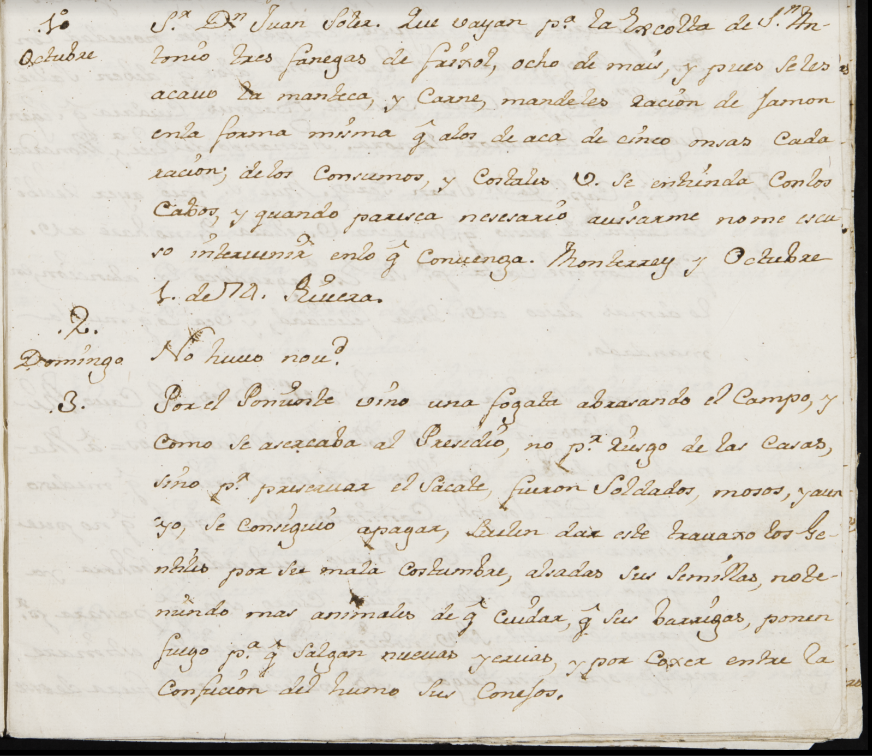
Diary entry of Captain Fernando Rivera y Moncada at Monterey on October 3, 1774; Fernando Rivera y Moncada diary, 1774-1777, MS Vault 48; California Historical Society.
The first document, highlighted for fourth graders studying the Mission period, is one of many brief, daily entries by Rivera y Moncada, the Spanish military commandant of Alta California, 1774-1777. Written a few years after the second Franciscan mission and presidio in the Californias was established in present-day Monterey county, the diary includes a list of soldiers, craftsmen, and other non-native people living in California at the time.

Rose Marie Beebe, Professor of Spanish based at Santa Clara University, California, undertook the translation of the 18th century Spanish-language document. She wrote about the entry’s significance:

“On October 3, 1774, Fernando de Rivera y Moncada, commander of the Monterey Presidio,
reported that the native peoples had started a large fire to the west of the fort. He knew what they
were doing: “They set fire to the field so that new growth will sprout up from the ashes.” Yet a
number of soldiers went out to extinguish the fire. They did so, Rivera wrote “to preserve the
Fields.”

Rivera’s remarks dramatically highlighted the different forms of food production that were present in colonial Alta California. The Spanish introduced European-style agriculture and were concerned that the crops that they had introduced into the region would not be able to grow in a charred landscape. The indigenous people, however, had lived for centuries from the food provided by the natural environment. They understood that fire was an important means of rejuvenating the soil that produced the fruits, berries, acorns, and other sustenance on which both they and the other living creatures with which they shared the California environment depended. Europeans were quickly exposed to this indigenous method of resource management. For example, Juan Rodríguez Cabrillo sailed into San Pedro Bay in 1542 and was greeted by thick fires onshore, causing him to name the place La BahIa de los Humos-- the Bay of Smoke. He may well have been witnessing a series of controlled burns. As contemporary scholar M. Kat Anderson has written, “Fire was the most significant, effective, efficient, and widely employed vegetation management tool of California Indian tribes.” (M. Kat Anderson, Tending the Wild: Native American Knowledge and the Management of California’s Natural Resources (Berkeley: University of California Press, 2005), 136). Rivera’s diary demonstrated that over 200 years later, Europeans in California still did not fully understand the ecological wisdom that was an essential part of the indigenous Californians’ way of life.”

Below is Beebe’s English translation of the Moncada’s diary entry:


October 1         Señor don Juan Soler: Have three fanegas1 of beans and eight of corn sent to
the escolta2 at San Antonio. Because they have run out of lard and meat, send
them the same amount of rations of ham given to the men here, that is, five
ounces per ration. With regard to the cost [of the food] and the sacks [for
transporting the food], you and the corporals can come to an agreement on that.
And, if you should deem it necessary to notify me about any issue, I shall not
hesitate to intervene in whatever manner is most appropriate. Monterey, October 1, 1774. Rivera


[October] 2
Sunday             Nothing to report.

[October] 3       A large fire was set west of us. It was burning the countryside and was drawing
closer to the presidio. Soldiers, young men, and even I, went out and managed
to extinguish the fire, not because the homes were at risk, but rather to preserve
the fields. The gentiles3 have a bad habit of creating this kind of work for us.
After their seeds have all been gathered and because they have no animals to
take care of, their main concern is their bellies. They set fire to the fields so
that new growth will sprout up from the ashes. It is also a way to catch rabbits
that are trying to escape from the dense smoke.

1 One fanega is equivalent to about 1.6 bushels.
2 The escort or squad of soldiers assigned to protect a missionary at a mission.
3 Non-baptized Indians.


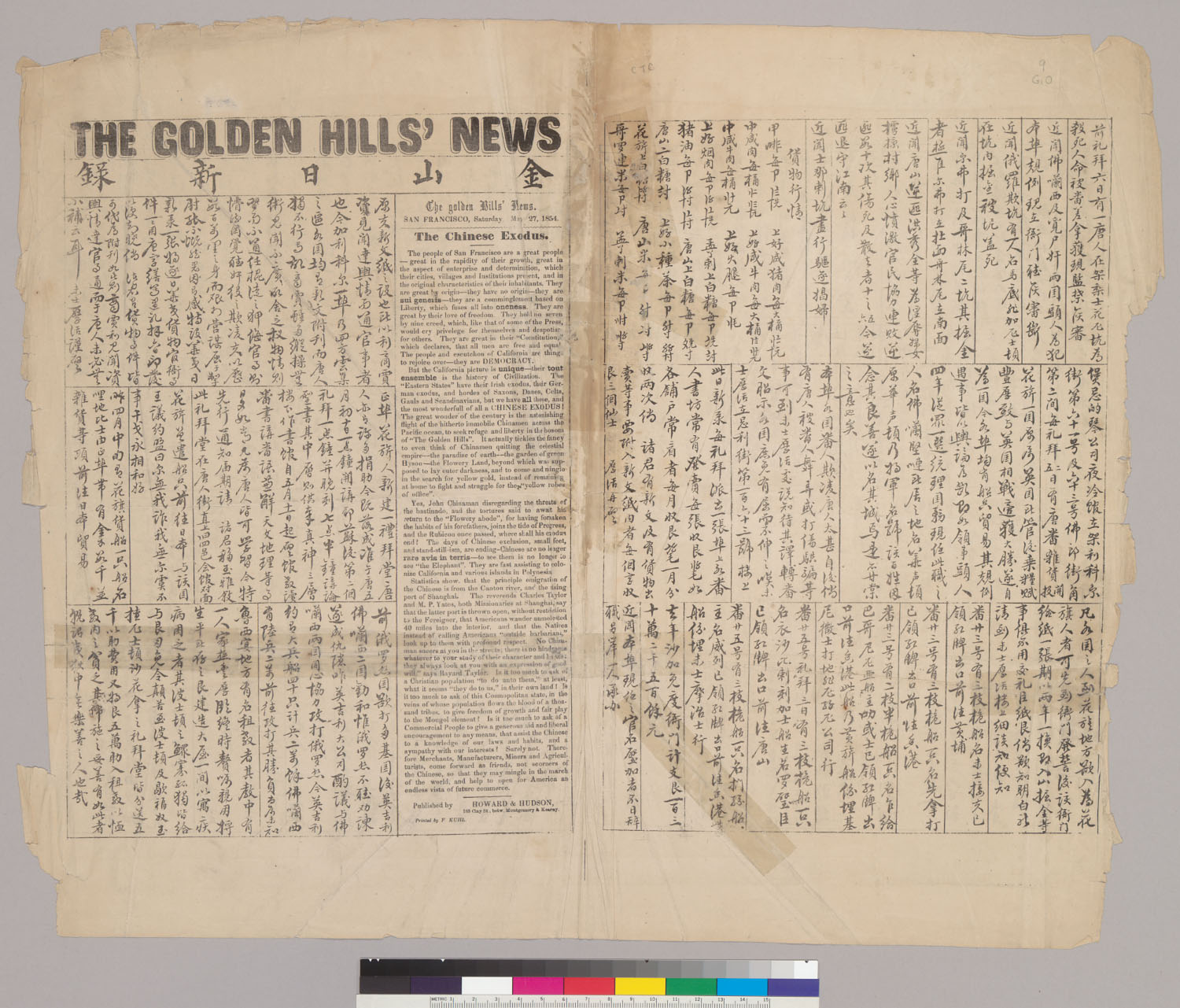
The Golden Hills News. May 27, 1854. California Historical Society, Chinese in California Virtual Collection, Newspaper Collection, Box 2.
For seventh graders, Teaching California authors chose this Chinese newspaper from our collections for an inquiry set exploring San Francisco as a Site of Encounter. The front page of the May 27, 1854 edition of the Golden Hills News features both Cantonese language characters and one column of English text. The publisher's welcome note in English reads: "Merchants, Manufacturers, Miners, and Agriculturists, come forward as friends, not scorners of the Chinese, so that they may mingle in the march of the world, and help to open America an endless vista of future commerce."

Roland Hui, an independent historian based in San Francisco who helped with the English translation, had this to say about this special document:

“The Golden Hills' News is a very special newspaper. In the words of the famed historian Him Mark Lai, it was the first Chinese-language weekly in the world that embodied all the ingredients of a modern newspaper. And for me to play a part in sharing this treasure with a wider audience is extremely gratifying. In doing the translation, I had a fun time trying to figure out the original English names of places, people, and ships from which the Chinese versions were transliterated. The contemporary issues of the Daily Alta California helped me ascertain most of them. For those few that I could not find any reference, it will be hilarious to know how widely I missed the target.”

Below is an excerpt from Hui’s English translation of the Chinese portion of the newspaper:

[Front page, Purpose of the Newspaper] The purpose of publishing a newspaper is to promote commerce, provide knowledge, convey public sentiments, and communicate government regulations. Now, California is the meeting place of people from all over the world, and various countries have published their own newspapers except the Chinese. Therefore, although there are many Chinese merchants, they lack the skills to run their businesses, have limited general knowledge, and are powerless to make decisions. They do not fully understand business conditions, and are easily manipulated by tricksters; they are ignorant of government regulations, and are bullied by those with evil intensions. It is a pity that they, despite having years of experience, are struggling in their business and facing so many obstacles. This has prompted me to start this Golden Hills’ News, and use the Chinese language to describe daily happenings about Chinese and American business and government and legal affairs. It will be published every Saturday, so that people will know what is going on. If you have business news, we can advertise it here. That way, business will flourish, knowledge will expand, public sentiments will be felt, and government regulations will be understood; and to the Chinese this is by no means a small benefit. - Mr. Howard 
...
Food prices: 
Coffee: 18¢ per pound 
Fine salted pork: $27/per large barrel 
Medium salted pork: $22, $23 per barrel 
Fine salted beef: $18, $20 per large barrel 
Medium salted beef: $20 per barrel 
Fine ham: 20¢ per pound 
Fine bacon: 15¢, 16¢ per pound 
Manilla fine sugar: 7¢, 8¢ per pound 
Lard: 15¢, 16¢ per pound 
Fine Chinese sugar: 9¢ per pound 
Second-rate Chinese sugar: 8¢ per pound 
Fine black tea: 50¢, 55¢ per pound 
American fine sugar: 12.5¢ per pound 
Chinese rice: 5¢, 6¢, 6.25¢ per pound 
Carolina Rice: 6¢ per pound 
Manilla rice: 3¢, 3.5¢ per pound 
…
In this city, barbarians of different nationalities bully the Chinese too much. From now on, if a Chinese is harassed, beaten, or cheated, he can report it to Mr. Howard so an English notice can be translated and sent to all countries. Chinese do not have to suffer mistreatments in silence. Mr. Howard is located at 163 Clay Street, upstairs. 

...
People from different countries who come to America and wish to become Americans can first go to court and take an oath. The court will issue a paper which can be renewed every two years. With that they can go to the hills to dig gold and do other things without having to pay for a license. If you wish to learn more, please visit Mr. Howard upstairs for a more detailed discussion.
...

Our Teaching California collections team has been busy researching and preparing documents like these over the past year, including working with our partners at the California History-Social Science Project to carefully incorporate over 60 primary sources from our collections into the project’s instructional materials.

Excitingly, we are creating newly-digitized copies of these primary sources for inclusion in Teaching California, and teachers will find these documents and more when we launch the project website later this year (more details to come). In the meantime, visit teachingcalifornia.org for more details about the project, and follow along here on our blog for more updates.

We look forward to uncovering more stories as we dig deeper into the primary sources in our collections!

--
The California Historical Society is working in partnership with the California History-Social Science Project (CHSSP) at UC Davis to establish and implement Teaching California: a free and expansive online set of instructional materials to support the State’s new K-12 History-Social Science Framework. This post comes from Kerri Young, Teaching California Project Manager. You can reach out to her at kyoung@calhist.org.
Thursday, July 11, 2019

Teaching the Important, Honest, and Troubling History of Native California

This blog is reposted from the California History-Social Scient Project's blog. The original post can be found here. 

--
Editor's Note: As we travel around California, one of the most frequent concerns we hear from teachers is that they don’t feel prepared to teach students about the history of California Indians. Elementary teachers have explained that they don’t know enough about pre-contact California, especially the history of indigenous people in their local area. Eighth-grade teachers reflect that their current resources are incomplete and don’t fully document the perspective of native peoples during the 19th Century. And high school teachers often remark they don’t have anything on native history after 1900. We’ve heard these concerns and in response, we’ve brought together a new team of scholars and members of native communities to design a workshop specifically focused on teaching the history of California Indians. Historians Shelley Brooks and Michelle Lorimer will lead the workshop, aided by the important scholarly contributions of Benjamin Madley, Steven Hackel, Clifford Trafzer, Khal Schneider, and Gregg Castro. This workshop will debut at our new Framework Conference series, which starts on September 10 at UC Irvine. Read below for a special blog post about the workshop, and learn more about the Framework Conference series here.

Native Americans on Alcatraz Island during the 1969-1971 occupation to reclaim native land. 
In West Sacramento last month, Governor Gavin Newsom issued an executive order to apologize for California’s treatment of its Native population. As the governor explained, “That’s what it was, a genocide. No other way to describe it. And that’s the way it needs to be described in the history books.” In our new workshop, “Highlighting Native Californian History through the Framework,” we hope to guide teachers through this important, honest, and troubling investigation of California’s history.

California’s History-Social Science Framework calls for more complex examinations of California Indian history across grade levels and time periods. Our workshop will focus on ways to incorporate the history and culture of Native Californian peoples into lessons at both primary and secondary levels. Lessons that explore California Indian history provide teachers with unique opportunities to connect students with local history and contemporary Native communities that, historically, have been frequently misrepresented and not consulted in public representations of their groups.

Teaching about the history of California Indians also allows students to explore interdisciplinary themes that span the various fields of social and behavioral sciences, including history, geography, economics, civics (political science), anthropology, religious studies, and psychology. Investigations that focus on the lives of Native Californians both before and after foreign contact highlight important historical thinking strategies. Students learn to understand diverse perspectives, evaluate historical evidence, recognize continuity and change, assess cause and consequence, and unpack ethical considerations of the past.

We will investigate the experiences of Native peoples during transitional times in California’s history—guided by the major instructional shifts in the Framework. We will use inquiry to investigate primary source content from pre-contact, the California mission era, the Gold Rush, and the modern civil rights era. Teachers will receive classroom-ready materials for grades 3 (local history), 4 (California history), 8 (19th-century U.S. history), 10 (modern world history), 11 (modern U.S. history), and 12 (government). Many of these resources will come from our partnership with the California Historical Society and our shared Teaching California project, which will debut later this year.

--
Written by Michelle Lorimer, Ph.D., an historian and lecturer at California State University, San Bernardino, Shelley Brooks, Ph.D., and Beth Slutsky, Ph.D., who are both  Program Coordinators at the California History-Social Science Project.

Thursday, September 13, 2018

Teaching California, An Origin Story


Funded by a $5 million grant from the State Department of Education to the California Historical Society, Teaching California offers schools and teachers classroom-ready curriculum designed to engage students in exciting and inspiring investigations of the past. Comprised of curated primary source material from California's premier archives, libraries, and museums, this program provides a research-based approach to improve student reading, writing, critical thinking and civic engagement, all aligned with the State’s new K-12 History-Social Science Framework.

We sat down with the directors of the two organizations spearheading the project to find out how Teaching California came to be. A former high school history and government teacher, Nancy McTygue serves as the California History-Social Science Project's Executive Director. Anthea Hartig serves as Executive Director and CEO of the California Historical Society. She is a Ph.D. historian and former history and cultural studies teacher. 

               Anthea Hartig, California Historical Society
Nancy McTygue, California History-Social Science Project

1. What is Teaching California and what prompted this collaboration between CHS and CHSSP?

Nancy:
When complete, Teaching California will offer K-12 teachers an innovative, free, online collection of instructional resources, organized by grade level, standard, and investigative question, to support the implementation of California’s History-Social Science Framework.

The inspiration for Teaching California actually came from K-12 teachers who were excited by the new Framework but lacked the appropriate resources to implement the instructional approach outlined in the document. I told Anthea about conversations I had with teachers across the state as part of the Framework rollout – teachers who wanted access to engaging and relevant primary sources, organized to specifically (and easily) address the inquiry-based instructional model we had outlined in the Framework.

Anthea and I had met years before; she served on advisory committee for our History Blueprint initiative. We continued to talk even after that development period ended because our organizations share a commitment to public history and a desire to provide teachers with the most engaging and up to date resources for their students. When I heard this request for resources again and again at Framework rollout events, I mentioned it to Anthea, who immediately connected the dots to CHS’s archive and their desire to have it accessed widely. At that point we thought about what our organizations do best and how working closely together could lead to an important synergy that would mean we could produce something that neither of us could do alone and all for a relatively small investment from the state. We’re deep in development right now, but I think we’re both getting excited about what this may actually offer to teachers and more importantly, California’s students.

Anthea:
The birth of Teaching California stemmed from the completion of the new Framework for K-12 history and the real need that we felt in the field from teachers. From CHS’s perspective, the creation of our new digital capacities, as well as raising funds and staff competencies in order to launch our digital library, was the other stream that joined this effort.

On a more global level, Teaching California was the result of a huge and unmet need to fulfill the dreams of those who have been pushing to teach with primary sources rather than with textbooks. This includes Sam Wineburg at Stanford, whose work “Historical Thinking and Other Unnatural Acts: Charting the Future of Teaching the Past” was groundbreaking in getting students to engage with primary sources. We also recognize the need to frame California experiences, peoples, and the phenomenal diversity of our past and to incorporate that into contemporary life and the dominate narrative of how history is taught.

We were very lucky to be able to find support from legislative leaders like Assemblymember Phil Ting as well as Tom Adams at the California Department of Education. We found willing partners all over the state but especially here at San Francisco Unified. The grant that we received not only allows for us to create a free online portal of discovery through primary sources, but also allows CHS to delve into the depths of our collection which is underused and somewhat unknown, and to continue to digitize it to make it accessible to everyone. We are creating partnerships with other archives across the state and the nation in order to help bring forth their material and make them available as part of Teaching California as well.

2. Why is this project relevant and needed now?

Nancy:
I don’t know if Teaching California could have happened in a prior time; I don’t think the conditions necessary to make it a reality existed. As I detailed above, the project originated in the minds of teachers tasked with teaching California’s new Framework. As the writers of the new Framework, we are obviously committed to its implementation and, knowing a lack of relevant resources could kill the momentum developed during its writing and adoption, we were especially keen to respond to those teachers asking for help.

In addition, although the business of education still lags behind its private and even non-profit colleagues, I think we’ve now reached at least the necessary minimum level of access to and effective use of digital resources in classrooms across the state. According to a recent newsletter from the Corporation for Education Network Initiatives in California (CENIC), 356 remote and underserved schools have just joined 100% of county offices of education, 87% of school districts (904), 83% (8,739) of schools, and over 5 million students who are already connected to CalREN, the California Research and Education Network, a high-capacity computer network with more than 8,000 miles of optical fiber. This number isn’t everything – many classrooms actually have fairly limited access to internet-connected technology and aren’t ready to scale up for wider access. However, it does bode well for our goal of providing access to our collection of classroom-ready materials, including never-seen-before primary sources from CHS’s archive.

Moreover, I believe that California’s Local Control Funding Formula (LCFF) contributed to the need for resources like Teaching California. Passed in 2013, LCFF gave local schools unprecedented flexibility in how they spend their money from the state. Although I’m sure this was not the authors’ intent, what this has meant, in practice, is that some schools have decided to prioritize their now flexible funding on costs that don’t directly address a teacher’s need for quality instructional materials. Instead of spending money adopting new textbooks or the latest instructional materials, for example, some schools and districts are investing their money in staff salaries and benefits, facilities, transportation, and any number of other important and necessary expenses. The whole purpose of LCFF was to allow schools to prioritize their spending to areas of greatest need and to put an end to the era of inflexible (and honestly, sometimes ridiculous) categorical spending. An unintended consequence of that, however, is that for some teachers in some schools, this has meant that they no longer can count on their districts buying new materials for their classrooms – even after the adoption of a new Framework that fundamentally reconsiders the instructional practice of classroom teachers. When completed, the Teaching California collection won’t take the place of a comprehensive and high quality instructional material package, but it will go a long way to helping teachers begin and - after time and additional support – truly achieve implementation of the new Framework.

Anthea:
I used to think that American popular discourse, especially American political popular discourse, was ahistorical and a-intellectual, that people didn’t really care about historical context. Now the tenor of the times is increasingly anti-intellectual and anti-historical and the need for a critical lens and the capacity to ascertain the real from the fake, the propaganda from the document, is more important than ever. We’ve seen this on the international stage, especially in relation to cyber security during the election of 2016.

I also think the need for us, as a people, to not forget our past in all of its beauty and all of its ugliness is more important than ever. America is careening towards its 250th year - what does that look like? What does mean for us? Understanding the basic materials of history as a doorway into discovery and learning is increasingly important. It’s also very important for our youth to see themselves reflected in the past and to comprehend that they too are part of a long, complicated set of movements, migrations, immigrations, and change. I hope that seeing themselves reflected in history inspires students to recognize that they can be agents of change. History is made by people and the choices that we make every day, whether it be yesterday or 10,000 years ago.

No one should be excluded from the richness of the past. A lot of teachers don’t have extensive training in history, especially in grades K-8 when they must teach a very broad range of subjects. Many high school teachers are incredible historians yet are feeling like they don’t have enough support or materials. We want to do everything we can to help these teachers access primary sources and powerful visuals so that all students, regardless of their literacy and language capacities, can find meaningful engagement with history. In the end this can truly bring about the kind of change that I and CHS would love to see in relation to history – that it increasingly becomes a vibrant and critical part of our contemporary lives and an empowering and enlightening tool of utility that creates a more just and informed world.

Portrait of seven young Japanese girls wearing kimonos at Mission School, ca. 1900_USC digital collections_CHS-5722

3. Why is it important that content from CHS’s collections (and from other repositories across the state) be included in Teaching California’s instructional materials?

Nancy:
My former faculty advisor, Alan Taylor, a Pulitzer-Prize winning historian who is now the Thomas Jefferson Foundation Chair at the University of Virginia, told me a story years ago that really sticks with me. He had recently moved to Davis from the East Coast to work in the history department. One day in his early American history class, while lecturing on colonial history (which primarily focuses on English colonies on the East Coast), a student raised her hand and asked, “Professor Taylor, what was happening out here in California at that time?” With tongue firmly in cheek, Alan apparently replied, “nothing,” and after getting a laugh and then acknowledging his joke, he went on with the lecture. Although short-lived, that exchange stuck with him.

American history didn’t just happen on the East Coast and students living here in California have a right to know about their state’s role in our nation’s beginnings, as well as the rest of our collective history. Alan became so committed to this pursuit – to widening the traditional geographic borders of America’s beginnings – that he reorganized his curriculum and even penned a book on the subject, American Colonies, in 2001. American Colonies offers both historians and classroom teachers a much more comprehensive view of the past – beyond the Atlantic seaboard to the entire continent. And so while I’m very reluctant to compare our work to Alan’s, I do believe we share a commitment to California citizens. We deserve to know our state’s history and how that history helped define both the place where we live and our national narrative. Using sources from the CHS’s archive (as well as other state and national collections) can go a long way in making that a reality.

Anthea:
When you get to a textbook stage of production, the curation and the choice of primary sources have been through many variations with a lot of eyes and minds upon them. We don’t think of textbooks as being particularly curated but of course they are. A set of sources is used to inspire historians to write the text. When you think of something like the new Framework, it is an interpretation itself of the state’s standards. We haven’t changed the standards in a long time but we have changed the state Framework through a lot of people’s hard work. So, taking the Framework and using that foundation to consider all the different archival materials in all of the different repositories throughout the state, nation, and world, opens us up to a phenomenal range of possibilities in regards to picking these sources, curating them, and giving them to teachers, students, and their families to investigate and better understand.

The other key driver for me as a public historian is raising awareness of the needs and power of our collections and inspiring people to do research with our primary sources. Obviously digitization leads to a greater amount of accessibility but I hope it also leads people back to the actual archives because for everything we digitize, there’s always going to be more - more boxes and folders that we just didn’t digitize because they were too fragile or we didn’t have the funds. This kind of layered curation brings with it remarkable possibilities as well as honors other archives and libraries who have been working for years to collect, steward, preserve, and make accessible their collections. 

4. The Teaching California team is currently creating inquiry sets as part of the project. Can you break down what they are and what they consist of?

Nancy: 
We’re creating inquiry sets, which are basically a collection of primary sources, teaching resources, and literacy support, aligned to the new Framework. When the collection is completed and posted online, teachers will be able to visit CHS’s Teaching California website, and search by grade, standard, and investigative question from the new Framework. From there, they will be able to download a set of relevant primary sources, excerpted as necessary by grade-level, teaching resources, and at least one strategy designed to improve student reading, writing, and / or oral discourse ability.

Anthea:
What I think is interesting about the creation of inquiry sets is they are being created by archivists, librarians, historians, and educators together. We think this is a very different way than how other efforts to bring forth primary sources have been created. As a teacher, you generally don’t get to sit down with a reference librarian and really think about what works and what the students will be excited by. The historians and educators at CHSSP and the archivists, historians, and reference librarians at CHS are that core team. This makes the construction of the inquiry sets a really powerful and dynamic pathway into learning.

5. How do you envision teachers using what we create for Teaching California in the classroom? 

Nancy:
After selecting the appropriate source set, teachers will be able to download the individual sources to display online or print out for student review. They’ll be able to download classroom-ready handouts for their students, special “for the teacher” resources that situate each source in the larger historical narrative, a diverse collection of teaching suggestions, and literacy strategies, aligned with California’s English Language Development Standards.

Anthea:
My hope for teachers, having been one, is that they’ll trust in what we’ve created, that they will be engaged by it. They may have even helped pilot it and test it. By the time Teaching California comes to their classroom and it’s a busy Tuesday morning and they’ve reviewed the inquiry sets and lesson for that day, I hope that they’ll find within what we’ve produced a sense of wonder and discovery and newness. I hope they’ll find a story they’ve never heard before, a landscape they’ve never seen depicted, a letter they’ve never read, or a map they’ve never looked at or used. The teachers will be the conduits for bringing archives into the classroom and for helping those sources come alive. I hope the sparks of connection and learning fly and that a sense of belonging to the human continuum of experience is awakened. 

Man atop ladder in roots of tree at Mariposa Grove of Big Trees

6. What has been the most exciting part, or interesting discovery during the creation process so far?

Nancy:
We have a grant from the Library of Congress; we’re part of the Library’s Teaching with Primary Sources Consortium, which works to introduce K-12 teachers to the Library’s digitized resources which are available at loc.gov. When we first got the grant, my colleague Tuyen Tran (who coincidentally leads our Teaching California project) and I went to DC for the orientation meeting. During the meeting, the archivist pulled out a journal from Christopher Columbus – we actually got to hold it in our own hands and look through it. It was one of the most exciting things I’ve ever done in my professional career. I had a similar experience at CHS’s archive – Anthea’s archivist showed us a biography on Junipero Serra from 1787 – and again, I was struck by just how cool that was and how this gem from our own state should be easily accessible to California teachers and students. 

[Relacion historica de la vida y apostolicas tareas del venerable padre fray Junipero Serra … /escrita por el R.P.L. F.R. Francisco Palou, 1787]; [Vault 175]; California Historical Society.
Anthea: 
One of the challenging things that we’ve encountered so far as a team is taking our desires to use a California lens - which could be an archival lens, a lens of making sure we address native history, Spanish colonial history, and Mexican republican history - and bring all of that back into the broader way in which we teach American history and even world history. Let’s look at world history, which is taught in the 10th grade and a little bit of 6th and 7th grade. You learn about medieval and early modern times and you might ask what that has to do with California, but in our collection we have an early astronomical scientific treatise published in 1680 that talks about watching comets. This document makes all sorts of assumptions about what the comets were doing and on the frontispiece there is a stunning woodcut of our Lady of Guadalupe. If we can show that to students, and to anyone who connects with that image on a cultural or personal level, seeing her in 1680 appearing in the heavens is just incredible. There is also a stunning celestial map. I think this treatise helps us answer one of the questions which is what were the effects of 16th century exchanges between Spanish and native peoples of broader Mexico. If we have something published in 1680 from Mexico City, that just opens up this whole other way of thinking about what that exchange was. There are so many things like this in the collection that surprise you, take you deeper, or challenge assumptions you might carry with you. 

Kino, Eusebio, Exposicion astronomica de el cometa, que el año de 1680 : por los meses de noviembre, y diziembre, y este año de 1681, por los meses de enero y febrero, se ha visto en todo el mundo, y le ha observado en la ciudad de Cadiz, California Historical Society, Vault 523.6 K624e
----

The California History-Social Science Project (CHSSP) is a statewide network of scholars and teachers dedicated to improving K-12 student literacy and learning in history-social science. Each year the CHSSP serves more than 4,000 teachers in over 150 different professional learning programs at local schools and universities. The CHSSP also served as the primary writers of California’s History-Social Science Framework. The CHSSP is part of the California Subject Matter Projects, administered by UC Office of the President.

The California Historical Society, founded in 1871, is a nonprofit organization with a mission to inspire and empower people to make California's richly diverse past a meaningful part of their contemporary lives.

Funded by a $5 million grant from the State Department of Education to the California Historical Society, Teaching California offers schools and teachers classroom-ready resources designed to engage students in exciting and inspiring investigations of the past. Comprised of curated primary source material from California's premier archives, libraries, and museums, this dynamic tool presents a research-based approach to improve student reading, writing, critical thinking and civic engagement, all aligned with the State’s new K-12 History-Social Science Framework.

In summer 2019, the Teaching California website will launch with instructional resource materials for every grade. This curriculum is being developed by the California Historical Society and its partner, the California History-Social Science Project, two organizations dedicated to improving students’ understanding of the past and promoting inquiry, engagement, evidence-based interpretation, and language proficiency. Teaching California integrates both Common Core and English Language Development Standards.