 |
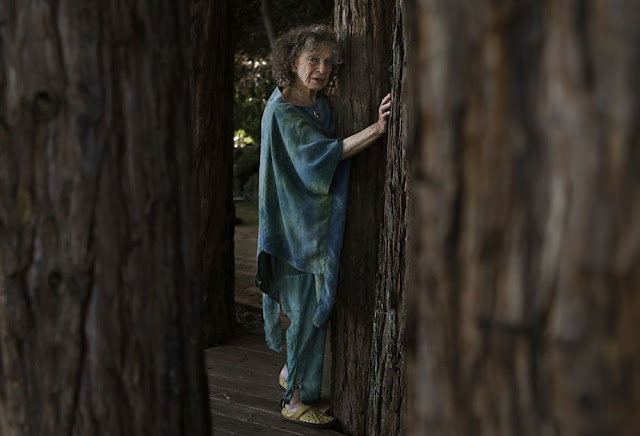
| Anna Halprin; photo by Liz Hafalia, The Chronicle |
San Francisco Magazine called her a “postmodern dance
legend.” The San Francisco Chronicle declared
that she “essentially
invented postmodern dance.” Today
dance pioneer Anna Halprin turns 95. To celebrate her birthday, fans worldwide in fifteen countries are staging hundreds of events this summer, including last week's "
95 Rituals" in San Francisco
Anna
Halprin has won numerous awards, most recently a Doris Duke Impact Award in
2014. That award—for artists who have influenced and are helping to move forward
the fields of dance, jazz and/or theatre—acknowledged
her work in revolutionizing dance and extending the impact of the performing
arts “to address social issues, build community, foster emotional healing, and
connect people to nature.”
Over
the decades, Anna has
created more than 150 dance-theatre works. She remains an arts educator through
workshops and the Tamalpa Institute, an international movement-based expressive
arts training program. As she has explained: “I want to integrate life and
art, so that as our art expands, our life deepens, and as our life deepens, our
art expands.”
Experiments in Environment
In
California, Anna and her husband, landscape architect Lawrence Halprin, created
a new way of thinking and moving through the physical environment. During the 1960s and
1970s—decades of experimentation and
radical social and political change—these two cultural leaders in their seemingly unrelated fields of
landscape architecture and dance were at the forefront of a sea change in how
we experience public spaces.
 |
(Left) Col. Arthur
Roth (Photographer), Hippies in Powell
and Hyde St. Phone Booth, San Francisco, c. 1969–70, California Historical
Society, CHS2013.1238; (right) Photographer
unknown, Vietnam
War Demonstration, February 19, 1965,
Federal Office Building, San Francisco, California Historical Society
|
In the explosive place and time that was San Francisco in the
1960s and 1970s, free love and drug cultures intersected with free speech and
antiwar sentiment. Experimentation
and open-mindedness ruled the day. The Halprins found common ground—the
environment—in which to explore their fields in a transformative way: a series
of experimental,
interdisciplinary workshops called Experiments in
Environment.
Set in
the streets of San Francisco, on the shores and cliffs of
Sea Ranch (a coastal community in Sonoma County designed by Lawrence), and on
the slopes of Mount Tamalpais in northern California, the Halprin workshops brought new
environmental awareness to artists, dancers, architects,
designers, and others.
From
movement sessions on a dance deck, to blindfolded awareness walks through the
landscape, to collective building projects using driftwood and choreographed
urban journeys, participants engaged in multisensory activities in alternating
environments. “We were trying to break down the
aesthetic barriers that we had inherited,” Anna told the Chronicle in 2013.
 |
Men’s Dance, Kentfield, CA. Experiments in Environment
Workshop, July 7, 1966. Courtesy Lawrence Halprin Collection, The Architectural
Archives, University of Pennsylvania.
|
 |
Blindfold Walk, Kentfield, CA. Experiments in
Environment Workshop, July 2, 1968. Courtesy of the Lawrence Halprin
Collection, The Architectural Archives, University of Pennsylvania.
|
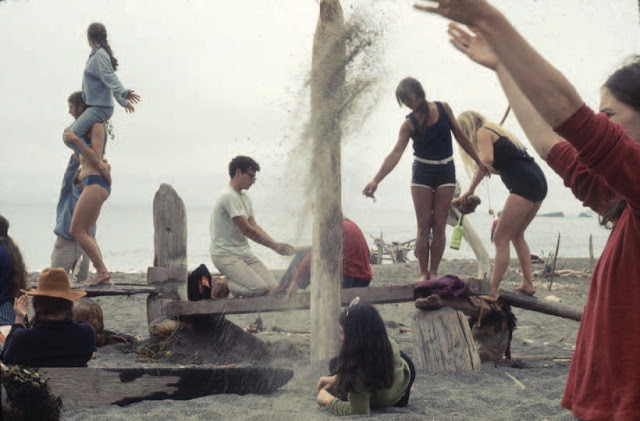 |
Driftwood Village—Community, Sea
Ranch, CA. Experiments in Environment Workshop, July 6, 1968. Courtesy
Lawrence Halprin Collection, The Architectural Archives, University of
Pennsylvania.
|
 |
Market
Street Walk, San Francisco, CA. Experiments in Environment Workshop,
July 8, 1966. Courtesy Lawrence Halprin Collection, The Architectural Archives,
University of Pennsylvania. Photograph by Joe Ehreth.
|
Impact
In January 2016 the California Historical Society (CHS) will examine this seminal period in our
history—50 years after the first Halprin workshops were held. The exhibition Experiments in
Environment: The Halprin Workshops, 1966–1971, along with a
series of public and educational programs and events, including dance
performances, will explore the impact of the 1960s counterculture on
California and the nation by examining the significant contributions the
Halprins made to their fields. CHS will
be collaborating with the Museum of Performance + Design, which houses the
Anna Halprin archives, and other groups on this effort.
At a
time when we are rethinking and reactivating our
public spaces—in our parks,
streets, plazas, business districts, and communities—and exploring the role of art and artists in
cities, a renewed awareness of the Halprins’ groundbreaking
creative process and their legacy on city planning
and the arts contributes to the ongoing public discourse about how we create,
use, and value public space.
Shelly Kale
Publications and Strategic Projects Manager
skale@calhist.org


