Redirect to CHS blog

Showing posts with label Book event. Show all posts

Monday, February 6, 2017

Buying a Bride, a complex California history


By Marcia Zug

Every Californian knows about the forty-niners, the daring fortune seekers who helped settle California. However, few people have heard of the brave young women who followed them out west. These women also came to seek their fortunes, but they didn’t come to mine for gold; they came to marry the miners.

Shortly after the forty-niners arrived in California, the first California mail-order bride expedition was proposed. Eastern reformers believed women would be a calming influence on the lawless, male mining towns and they enthusiastically supported plans to bring brides west. California’s many bachelor politicians also supported these plans both for themselves, and for their numerous single, male constituents. In fact, California was so eager for female immigrants that the state government quickly passed some of the most female friendly laws in the country.

California was the first western state to consider importing brides, but many other male heavy states quickly followed and by the end of the 19th century, thousands of eastern women had traveled west to seek their fortunes as mail-order brides. Unfortunately, finding wives for miners was not California’s only involvement with mail-order marriage. California pioneered the idea of bringing mail-order brides out west, but it was also at the forefront of a later movement to bar mail-order brides.  As the race of the arriving brides changed, California’s support for mail-order marriage quickly evaporated.

When mail-order brides were eastern white women, Californians lauded them as heroes and patriots. However, when Japanese mail-order brides began arriving in California, barely a generation after the forty-niners, these women were quickly branded as criminals, prostitutes and threats to America’s racial hierarchy. Eventually, the outcry against the Japanese picture brides lead to their complete exclusion from the United States. Moreover, the nativist arguments honed in the picture bride fight were soon echoed in other exclusionary immigration laws including The 1921 Quota Act, and The National Origins Act.


            Treatment of mail-order brides reflects America’s complicated and contradictory immigration history. America has both welcomed and encouraged immigration, but it has also restricted and even barred certain immigrant groups. California’s history with mail-order marriage reflects this history. Depending on the shifting politics of the time, California both welcomed and excluded mail-order brides. Nonetheless, for the women, the benefits of mail-order marriage have been surprisingly consistent. Throughout American history, mail-order marriage has been a way for women to change their circumstances and, like the men they followed and married, a way to seek their fortunes and improve their lives.


Marcia Zug is an Associate Professor of law at the University of South Carolina. She specializes in family law, immigration law and Federal Indian Law. She is the author of Buying A Bride: An Engaging History of mail-Order Matches
________________________________________________________________________________

UPCOMING EVENT

Marcia Zug’s Buying a Bride: An Engaging History of Mail-Order Matches is the first book-length treatment of the history of mail-order marriage, and it makes a powerful case for the reexamination of a practice that remains poorly understood. Mail-order brides have been part of American life since the founding of the first English colony in Jamestown, Virginia. Nevertheless, how they have been perceived has changed drastically over time. There were “Tobacco Wives,” in colonial Virginia, mail-order brides during the California gold rush, Japanese picture brides during the early twentieth century, and even same-sex mail-order grooms today.

She will talk about her book at the California Historical Society on Thursday, February 9th. To register, click HERE.
Saturday, February 9, 2013

Birds of Paradise Lost - book event with author Andrew Lam

This event takes place on Friday, March 1, 2013, 6:00pm

Reservations are required

Free event at the California Historical Society 
678 Mission Street
San Francisco

Join us for the evening as Andrew Lam shares excerpts from his new book Birds of Paradise Lost.

The thirteen stories in Birds of Paradise Lost shimmer with humor and pathos as they chronicle the anguish and joy and bravery of new Americans, the troubled lives of those who fled Vietnam and remade themselves in the San Francisco Bay Area. Past memories -- of war and its aftermath, of murder, arrest, re-education camps and new economic zones, of escape and shipwreck and atrocity --are ever present Andrew Lam’s wise and compassionate stories.

Andrew Lam is the author of Perfume Dreams: Reflections on the Vietnamese Diaspora, which won the 2006 PEN Open Book Award, and East Eats West: Writing in Two Hemispheres. He is an editor and cofounder of New American Media, an association of over two thousand ethnic media outlets in the US.

He was a regular commentator on NPR'’s All Things Considered for many years, and was the subject of a 2004 PBS documentary called My Journey Home. His essays have appeared in newspapers and magazines such as the New York Times, The LA Times, the San Francisco Chronicle, The Baltimore Sun, The Atlanta Journal, the Chicago Tribune, Mother Jones, and The Nation, among many others.

Please RSVP at andrewlamchs.eventbrite.com and we look forward to seeing you! 

Wednesday, January 9, 2013

An Evening with Deborah Miranda, author of Bad Indians

Thursday, January 17, 2013, 6:00pm

Reservations are required
Free event at the California Historical Society
678 Mission Street
San Francisco


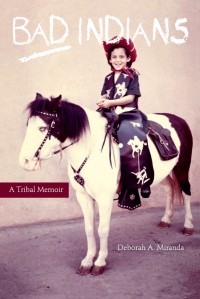
Join us for an evening with author Deborah Miranda. Her book,Bad Indians, part tribal history, part lyric and intimate memoir. Deborah A. Miranda tells stories of her Ohlone Costanoan Esselen family as well as the experience of California Indians as a whole through oral histories, newspaper clippings, anthropological recordings, personal reflections, and poems. The result is a work of literary art that is wise, angry, and playful all at once, a compilation that will break your heart and teach you to see the world anew. Deborah A. Miranda is an enrolled member of the Ohlone Costanoan Esselen Nation of California, and is also of Chumash and Jewish ancestry. The author of two poetry collections—Indian Cartography, which won the Diane Decorah Award for First Book from the Native Writer’s Circle of the Americas, and The Zen of La Llorona, nominated for the Lambda Literary Award—she also has a collection of essays, The Hidden Stories of Isabel Meadows and Other California Indian Lacunae, forthcoming from the University of Nebraska Press. Miranda is an associate professor of English at Washington and Lee University and says reading lists for her students include as many books by “bad Indians” as possible.

RSVP at mirandaatchs.eventbrite.com and we'll see you there! 

Wednesday, October 24, 2012

An evening with Matt Garcia, author of From the Jaws of Victory


Tuesday, November 13, 2012, 6:00 PM at the California Historical Society, 678 Mission Street, San Francisco


RSVP at http://jawsofvictory.eventbrite.com/.


Join us for an evening with author Matt Garcia. His book, From the Jaws of Victory: The Triumph and Tragedy of Cesar Chavez and the Farm Worker Movement is the most comprehensive history ever written on the meteoric rise and precipitous decline of the United Farm Workers, the most successful farm labor union in United States history. Based on little-known sources and one-of-a-kind oral histories with many veterans of the farm worker movement, this book revises much of what we know about the UFW. Matt Garcia’s gripping account of the expansion of the union’s grape boycott reveals how the boycott, which UFW leader Cesar Chavez initially resisted, became the defining feature of the movement and drove the growers to sign labor contracts in 1970. Garcia vividly relates how, as the union expanded and the boycott spread across the United States, Canada, and Europe, Chavez found it more difficult to organize workers and fend off rival unions. Ultimately, the union was a victim of its own success and Chavez’s growing instability.

From the Jaws of Victory delves deeply into Chavez’s attitudes and beliefs, and how they changed over time. Garcia also presents in-depth studies of other leaders in the UFW, including Gilbert Padilla, Marshall Ganz, Dolores Huerta, and Jerry Cohen. He introduces figures such as the co-coordinator of the boycott, Jerry Brown; the undisputed leader of the international boycott, Elaine Elinson; and Harry Kubo, the Japanese American farmer who led a successful campaign against the UFW in the mid-1970s. Copies of From the Jaws of Victory will be available for purchase at the event. 

Sunday, September 23, 2012

Soul Calling: A Photographic Journey through the Hmong Diaspora


Thursday, October 4, 2012, 6:30 p.m.

Soul Calling: A Photographic Journey through the Hmong Diaspora

Book signing and discussion with Joel Pickford

Free event at the California Historical Society, 678 Mission Street, San Francisco


In a lively and informative presentation, photographer and author Joel Pickford weaves the story of his personal journey through the Hmong Diaspora, showing photographs from his book, Soul Calling: A Photographic Journey through the Hmong Diaspora, and some that are not in the book. A Q&A session and book signing will follow his presentation. The result of five years of courageous and heartfelt commitment, Soul Calling opens our eyes to the beauty, resilience and daily lives of the Hmong people, so recently displaced from their traditional homeland by the traumas of the Vietnam War. From the rice harvests and funerals of remote Hmong villages in the mountains of Laos to the shamanic ceremonies and overflowing apartment-complex vegetable gardens of Hmong Americans living in Fresno, writer and photographer Joel Pickford leads us into a world of deep-rooted custom and the harsh realities of cultural adaptation. His exquisite photographs and intimate stories take us into living rooms and through the memories of a remarkable people.

San Francisco’s Chinatown: A History


Sunday, October 7, 2012, 1:00 p.m.

San Francisco’s Chinatown: A History

$5 suggested donation at the door, or free admission with LitQuake Museum Pass

Author and historian Philip P. Choy presents San Francisco Chinatown: A Guide to Its History and Architecture, an “insider’s guide” to one of America’s most celebrated ethnic enclaves. A history of America’s oldest Chinese community and a guide to its significant sites and architecture, the book traces development of the neighborhood from the city’s earliest days to its post-quake transformation into an “Oriental” tourist attraction as a pragmatic means of survival.

This is a part of LitQuake’s Words and Pictures: A Cultural Stroll through Yerba BuenaSan Francisco is a world-class city when it comes to literature…and cultural institutions. Litquake invites you to wander with us through an array of museums and galleries in the city’s Yerba Buena cultural neighborhood. We’ll explore art, language, culture, and all intersections between. Free entry to events at UC Berkeley Extension Art & Design Center and California Historical Society. $10 Litquake Museum Pass allows entry to events at CJM, MoAD, CHS, Cartoon Art Museum, and YBCA and can be purchased at litquake.org. This event is co-sponsored by the Chinese Historical Society of America.


Chinatown Sketches & Book Club of California's Centennial Party


Friday, October 19, 2012, 6:30 to 7:30 p.m.

Chinatown Sketches & Book Club of California's Centennial Party

Free event at the California Historical Society, 678 Mission Street, San Francisco

RSVP at bccatchs.eventbrite.com

The Book Club of California and the California Historical Society invite you to a party celebrating the Centennial of The Book Club of California and the release of Book Club of California’s publication number two hundred and thirty: Paul Frenzeny's, Chinatown Sketches, by award winning author, Claudine Chalmers with a preface by Philip P. Choy. Evening program includes a short talk by Claudine Chalmers. Artifacts and original artwork from the book will be on display. Refreshments will be served. Bring your friends and fellow bibliophiles.