Redirect to CHS blog
Thursday, March 1, 2018
#onthisday 50 years ago, the East L.A. Walkouts Began
#Onthisday 50 years ago, the influential East L.A. School Walkouts (Blowouts) began, transforming the Chicano movement in Los Angeles.
Over two weeks, tens of thousands of young Latino students took to the streets to protest conditions in their schools on the East Los Angeles. In many ways, the walkouts (primarily at Wilson, Roosevelt, Garfield, Belmont and Lincoln high schools) were the first public display of an urban Chicano rights movement that had begun among California farm workers in the previous several years. The walkouts were the first mass mobilization of Mexican-Americans in Southern California.
The East L.A. Walkouts and their impact are being remembered through over the next couple of weeks in a range of ways, from conferences to news articles. See some of these efforts below
http://www.latimes.com/nation/la-na-1968-east-la-walkouts-20180301-htmlstory.html
http://laschoolreport.com/50-years-after-the-walkouts-los-angeles-latino-students-are-still-fighting-for-educational-equity/
https://www.scpr.org/news/2018/03/01/81235/fifty-years-ago-thousands-walked-out-of-east-la-sc/
https://la.curbed.com/maps/east-los-angeles-walkouts-history
http://www.latimes.com/opinion/op-ed/la-oe-arellano-blowouts-20180228-story.html
https://www.kcet.org/shows/departures/east-la-blowouts-walking-out-for-justice-in-the-classrooms
http://www.boyleheightsbeat.com/cal-state-la-marks-50th-anniversary-of-east-l-a-walkouts-19432/
http://www.calstatela.edu/univ/ppa/publicat/walkin-2018
https://achieve.lausd.net/site/Default.aspx?PageID=14359
https://www.nbclosangeles.com/news/local/50th-Anniversary-of-East-LA-Walkouts-Highlights-Student-Activism-475609353.html
http://losangeles.cbslocal.com/2018/03/01/1968-walkouts-50th-anniversary/
https://www.huffingtonpost.com/entry/opinion-sanchez-east-la-walkouts_us_5a981ef2e4b07dffeb708bc5
http://www.latimes.com/local/education/la-me-edu-walkout-anniversary-garfield-20180228-story.html
https://home.lausd.net/apps/news/article/829816
https://daily.jstor.org/the-activist-students-of-1960s-east-los-angeles/?
Thursday, February 8, 2018
Who Tells Your Story? California Historical Society Extends Exhibitions about Colonial Histories on the East and West Coasts
The California Historical Society (CHS) has announced that it will extend its current exhibitions--- bringing the complex story of Alexander Hamilton to San Francisco as part of an initiative showcasing two versions of the United States’ colonial history: English and Spanish---through March 18th!
|
| The exhibitions are on view through March 18, 2018 at the California Historical Society, 678 Mission Street, San Francisco, . |
Saturday, December 16, 2017
Old Mint Restoration Project - Community Workshop Media Coverage
http://www.sfgate.com/bayarea/article/For-SF-s-Old-Mint-s-future-historical-12379119.php
http://abc7news.com/politics/san-franciscos-old-mint-ready-to-start-new-chapter/2758641/
http://www.sfweekly.com/news/suckafreecity/the-old-mints-new-chance/
https://www.sfstation.com/2017/11/13/seeking-input-how-should-the-city-use-the-old-sf-mint/
Friday, December 8, 2017
The First Red Scare
The first red scare occurred not in the 1950s but two
centuries earlier. In the midst of the
Seven Years’ War, Spain faced a new and unexpected threat from the Pacific
Northwest: The Russians. “The Muscovites
in California?” asked one Franciscan, with mock incredulity. “Yes. The very same.”[1] The Russian menace, he argued, was no
joke.
The scare originated in news of Russian expansion into
Alaska. Russian fur trappers, known as
promyshlenniki, had recently crossed the Bering Strait in search of sea otter
pelts and were now somewhere in America – but where exactly? Spain’s knowledge of the Pacific Northwest
was so poor that no one could be sure exactly how close the Russians were to
the heart of New Spain and its capital, Mexico City.
The alarm of Spanish officials was made worse by their
stubborn belief that a river as large as the Mississippi must empty into the
Pacific somewhere along the California coast.
Whichever European power possessed it would be able to seize control of
the American West and, eventually, of northern New Spain. In 1760, Mikhail Lomonosov, described by one
scholar as a Russian da Vinci who could do everything but paint, captured the spirit
of the times:
Russian Columbuses, scorning sullen Fate,
Through the ice will open a new way to the East,
And our power will reach as far as America.
A few years later, Pedro Calderón y Henríquez, a high-ranking
judge who had served for many years in the Philippines, illustrated the Russian
menace on a map, which he forwarded to one of the king’s most powerful
ministers. This marvelous product of geographic
ignorance and imperial anxiety now sits in the collections of the California
Historical Society.
Even by the standards of the time, the map was wildly
inaccurate and uninformed. “Tartary of the Muscovites,” or Kamchatka, hangs
menacingly over the Pacific Ocean and appears as large as the entire North American
coast from the tip of Baja California up to the Russian discoveries. The details are even more bizarre. Calderón plotted the Aleutians in a straight
line between Kamchatka and Mendocino, California. He labeled the easternmost island “Tukoskoi”
(confusing it with Siberia’s Chukchi Peninsula) and placed it a mere
seventy-five miles from Cape Mendocino.
As a result, the Russians appeared to have stepping stones leading
directly from Kamchatka to Spanish California.
Arriving in the vicinity of Mendocino, he wrote, they would find a “very
copious river.” “By this river,” he
warned, “they can have access to New Mexico or the lakes along the course of
the St. Lawrence River, both of which are of the greatest importance.”
In the age of Google Maps, European ignorance of American
geography seems comical, yet it had serious consequences for the two hundred
thousand people who lived along the West Coast at the time. Spurred by the red scare, Spain pushed into
California, establishing a string of presidios from San Diego (1769) up to San
Francisco (1776) and setting in motion an invasion of missionaries, soldiers, livestock,
and viruses that devastated indigenous communities and reduced individuals to
starvation.
by Claudio Saunt
Author of West of the Revolution: An Uncommon History of 1776
________________________________________________________________________________
Claudio Saunt at CHS!
As part of its special end-of-year bookstore programming, Dr. Claudio Saunt will be at CHS on December 21 discussing his book, West of the Revolution: An Uncommon History of 1776.
To register for this event, click HERE.
________________________________________________________________________________
Claudio Saunt at CHS!
As part of its special end-of-year bookstore programming, Dr. Claudio Saunt will be at CHS on December 21 discussing his book, West of the Revolution: An Uncommon History of 1776.
To register for this event, click HERE.
Monday, November 27, 2017
Images of the California Gold Rush on exhibit at the San Francisco Opera
On November 21st, the San Francisco Opera presented the world premiere of Girls of the Golden West, by composer John Adams and director and librettist Peter Sellars. (The opera runs through December 10th.) Sellars’ libretto was inspired by primary sources, including the celebrated Gold Rush letters of Louise Clappe, which were published in 1854-55 under the pseudonym Dame Shirley. To many, the Shirley letters represent the pinnacle of Gold Rush literature.
Sadly, there is no known photograph of Dame Shirley extant. The California Historical Society Collection, however, includes stunning daguerreotype photographs documenting the cities, towns, and people of the California Gold Rush. Reproductions of some of these photographs are now on exhibit at the Opera House lobby—along with artifacts from the Collections of Levi Stauss & Co., the Museum of Performance + Design, and the Society of California Pioneers—through December 10th. Selections are presented below.
Pictured in this exquisite tinted daguerreotype is a young Rosalía Vallejo de Leese, sister of Mariano Guadalupe Vallejo. Rosalía married the American trader Jacob Leese in 1837, making her one of the earliest non-Native residents of the pueblo of Yerba Buena, now San Francisco. Like many Native and Californio women, Rosalia lived through a period of traumatic change, beginning with the California Gold Rush. Leese later deserted Rosalía and her children, and, in an 1874 interview, Rosalía expressed her unrelenting hatred for the Anglo American intruders who first humiliated her family during the Bear Flag Revolt of 1846.
Women were not only the subjects of early California daguerreotype portraits, they were also photographers. According to photography historian Peter Palmquist, Rosalía’s niece Epifania "Fannie" de Guadalupe Vallejo may have been California's first photographer, acquiring a daguerreotype camera around 1847.
The invention of the daguerreotype was announced in Paris in 1839, only nine years before the discovery of gold at Sutter’s Mill. This new photographic process—which enjoyed a relatively short heyday between 1845 and 1860—coincided with the spectacular and disruptive boom that transformed San Francisco from a small Mexican pueblo into a modern metropolis.
Although photographers flocked to California during the Gold Rush, the California Historical Society’s seven-plate panorama is one of only six surviving daguerreotype panoramas of San Francisco. Standing on sand dunes now at the corner of First and Howard Streets, the unknown photographer captured a vivid urban tableau, from the clapboard houses of Happy Valley to the shipbuilding works at Rincon Point. A washerwoman can be spied in the fifth panel (shown above), sitting in the doorway of her shack as laundry flutters in the spring breeze.
Sadly, there is no known photograph of Dame Shirley extant. The California Historical Society Collection, however, includes stunning daguerreotype photographs documenting the cities, towns, and people of the California Gold Rush. Reproductions of some of these photographs are now on exhibit at the Opera House lobby—along with artifacts from the Collections of Levi Stauss & Co., the Museum of Performance + Design, and the Society of California Pioneers—through December 10th. Selections are presented below.
![]() |
Rosalía
Vallejo de Leese, after 1847, photographer unknown, daguerreotype,
courtesy, California Historical Society
|
Women were not only the subjects of early California daguerreotype portraits, they were also photographers. According to photography historian Peter Palmquist, Rosalía’s niece Epifania "Fannie" de Guadalupe Vallejo may have been California's first photographer, acquiring a daguerreotype camera around 1847.
![]() |
San Francisco
panorama [fifth panel], spring 1851, photographer unknown, daguerreotype,
courtesy, California Historical Society
|
Although photographers flocked to California during the Gold Rush, the California Historical Society’s seven-plate panorama is one of only six surviving daguerreotype panoramas of San Francisco. Standing on sand dunes now at the corner of First and Howard Streets, the unknown photographer captured a vivid urban tableau, from the clapboard houses of Happy Valley to the shipbuilding works at Rincon Point. A washerwoman can be spied in the fifth panel (shown above), sitting in the doorway of her shack as laundry flutters in the spring breeze.
![]() |
Group
of miners, circa 1850s, photographer unknown, daguerreotype,
courtesy, California Historical Society
|
This full-plate portrait of a group of Gold Rush miners is
one of the most spectacular and moving daguerreotypes in the California
Historical Society Collection. Nine miners, perhaps forming a company, pose
together in various attitudes of affection, insouciance, and camaraderie. Four of
the men proudly display the tools of their trade, a shovel, pick, sluice box,
and claim.
![]() |
|
Diamond
Springs, El Dorado County, 1854, photographer unknown,
daguerreotype, courtesy, California Historical Society
|
This daguerreotype of a street scene in Diamond Springs
captures the look and feel of a young Gold Rush town. In addition to the
offices of the Advocate newspaper and
Wells Fargo & Co., many charming details are visible, including a broadside
for a theatrical performance by the Bateman children. Eleven figures paused to
pose for the shot; only one (to the left, leaning against a post) failed to
remove his hat.
Marie Silva, Archivist & Manuscripts Librarian
Thursday, November 23, 2017
Thanksgiving in Los Angeles and San Francisco 100 years ago
![]() |
| Los Angeles Public Library |
http://www.lapl.org/collections-resources/blogs/lapl/what-we-were-eating-100-years-ago-thanksgiving
![]() |
| Henry Voigt Collection, via SFGATE |
http://www.sfgate.com/food/article/Thanksgiving-historic-menus-restaurants-archives-12377511.php#photo-14591336
And historic menus from the California Historical Society collection:
http://digitallibrary.californiahistoricalsociety.org/object/2854
Wednesday, November 8, 2017
#Onthisday in 1967, the first issue of Rolling Stone was published
With a publication date of November 9, 1967, the first issue of Rolling Stone hit the streets of San Francisco and beyond exactly 50 years ago. The world of rock music and cultural journalism as well as the counterculture would never be the same after the publication of the first issue. Under the leadership of youthful editor Jann Wenner, and guidance from music critic Ralph Gleason, Rolling Stone would soon become a media force that would transform the music and media industries and help catalyze an American youth culture as a distinct and powerful cohort with its own mores, interests, language and priorities.
Published a month after the 'Summer of Love' unofficially ended in San Francisco's Haight-Ashbury neighborhood, Wenner's publication's bold mission stated that the publication was "not just about music, but also about the things and attitudes that the music embraces." With offices in an industrial building in San Francisco's SoMa District, Rolling Stone would remain a California-based publication until Wenner moved the magazine's offices to New York in 1977.
![]() |
| Jann Wenner in the original Rolling Stone office |
Coinciding with the 50th Anniversary of the publication, a new biography on Wenner and documentary on Rolling Stone have focused attention on many aspects of the publication (and its editor) and its influence on American culture. Of particular note, the new book on Wenner brings attention to the magazine's own history and how it was inspired by two California publications that get less attention than Wenner's magazine: Mojo Naviagtor R&R News, the West Coast's first rock and roll publication, and Ramparts, an aggressively political magazine published in Berkeley.
![]() |
| MoJo Naviagtor R&R News, CHS Collection |
Thursday, November 2, 2017
Who Tells Your Story: Native American Heritage Month at CHS
Yesterday was the start of Native American Heritage Month, an annual time to honor Native culture and history in California and the country. The California Historical Society's current exhibition, Meanwhile Out West: Colonizing California, 1769–1821 (one of two exhibitions at CHS's San Francisco headquarters) looks, in part, at the fate of California Indians under Spanish rule.
Two programs this month will explore these issues further. Click the program titles to learn more and reserve tickets!
1) California History Through an Indigenous Lens - Telling Creation Stories -
Join the California Historical Society (CHS) and Heyday Books for a night of indigenous storytelling that explores how California’s history has been told for generations. Our speakers are Greg Sarris, Chairman of the Federated Indians of Graton Rancheria and author of the new book, How a Mountain was Made, and William Bauer, professor of American Indian Studies at University of Nevada, Las Vegas and author of California Through Native Eyes: Reclaiming History. The event will close with a short performance from Word for Word Performance Company, who will be performing one of the creation stories from Chairman Sarris’ new book.
2) Telling the Hard Stories of Native American Life - 1760s-1860s
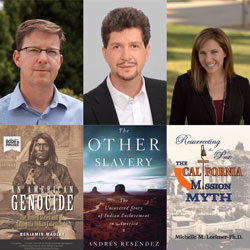
Join the California Historical Society for a night that explores the darkest parts of California's history from 1760-1860 relating to California's native population. Hear from three authors (Benjamin Madley, Michelle Lorimer, Andres Resendez as they present on topics including the Mission era, Indian slavery and genocide, and then participate in a q&a session. Books by all three authors will be sold.
Please join us for both events!
Two programs this month will explore these issues further. Click the program titles to learn more and reserve tickets!
1) California History Through an Indigenous Lens - Telling Creation Stories -
Join the California Historical Society (CHS) and Heyday Books for a night of indigenous storytelling that explores how California’s history has been told for generations. Our speakers are Greg Sarris, Chairman of the Federated Indians of Graton Rancheria and author of the new book, How a Mountain was Made, and William Bauer, professor of American Indian Studies at University of Nevada, Las Vegas and author of California Through Native Eyes: Reclaiming History. The event will close with a short performance from Word for Word Performance Company, who will be performing one of the creation stories from Chairman Sarris’ new book.
2) Telling the Hard Stories of Native American Life - 1760s-1860s
Join the California Historical Society for a night that explores the darkest parts of California's history from 1760-1860 relating to California's native population. Hear from three authors (Benjamin Madley, Michelle Lorimer, Andres Resendez as they present on topics including the Mission era, Indian slavery and genocide, and then participate in a q&a session. Books by all three authors will be sold.
Please join us for both events!
Friday, October 27, 2017
Who Tells Your Story? Alexander Hamilton’s 230-year-old Federalist Papers: A Story for Our Time
![]() |
|
The Federalist: A Collection of Essays, written in Favour of the New
Constitution
Courtesy baumanrarebooks.com
|
“Who Tells Your Story?” is a central theme in Lin-Manuel Miranda’s Broadway blockbuster Hamilton: An American Musical, currently touring in California. It also thematically links CHS’s current exhibitions Alexander Hamilton: Treasures from the New-York Historical Society and Meanwhile Out West: Colonizing California, 1769–1821—two colonial stories, eastern and western, that provide perspectives beyond unbiased and objective historical records.
Two hundred thirty years ago today, on October 27, 1787, a story with considerable impact on our new nation began, not in the halls of entertainment but in the theatre of political writing and discourse. It was a passionate story of support for the newly conceived United States Constitution—a document proposing a unique though unexpected way to govern our newborn union.
The story opens with the publication of the first of eighty-five articles in The Federalist (later The Federalist Papers), which promoted the ratification of the Constitution. Authored by Founding Fathers Alexander Hamilton, John Jay, and James Madison under the pseudonym Publius (Latin for “public”), The Federalist was written over ten months, between October 1787 and May 1788, to influence the ratification debate primarily in New York.
![]() |
|
Title page, Publius, The
Federalist, vol. 1, 1788
Rare Books and Special Collections Division, Library of Congress
|
Alexander Hamilton (c.
1755–1804) wrote a majority of the articles, including the General Introduction, in
which he urged his fellow New Yorkers and countrymen to adopt the Constitution: “I am convinced that this is the safest
course for your liberty, your dignity, and your happiness.” Ratification,
he wrote, “speaks its own importance; comprehending in its consequences nothing
less than the existence of the UNION, the safety and welfare of the parts of
which it is composed, the fate of an empire in many respects the most
interesting in the world.” He further explained:
“For nothing can be
more evident, to those who are able to take an enlarged view of the subject than
the alternative of an adoption of the new Constitution or a dismemberment of
the Union.”
![]() |
|
John Trumbull (American artist), Alexander Hamilton, after 1804
New-York
Historical Society, Gift of Thomas Jefferson Bryan, 1867.305 |
The Constitution's sole signatory from New York, Hamilton had returned to the state from the Constitutional Convention in Philadelphia facing strong opposition from Governor George Clinton, his widespread anti-Constitution followers, and his threatening political machine. Undeterred, Hamilton engaged Madison and Jay in the herculean effort ahead of him.
Despite
The Federalist’s high-brow approach, Hamilton,
Madison, and Jay achieved their goal three weeks after their last paper was
published, when on July 26, 1788, in the Poughkeepsie Court House, the State of
New York ratified the Constitution and became the eleventh state of the Union.
![]() |
Signatures of the United States Constitution, detail of page 4
Courtesy National Archives and Records Administration
|
Even
before New York’s ratification, Hamilton was honored during the city’s July 23,
1788, Federal Procession, a celebration following the Constitution’s ratification
by New Hampshire. His image, as reported in a history of the city, “was carried
aloft on banners in every part of the procession, the Constitution in his right
hand and the Confederation in his left. He had to all appearances turned the
scale for the Union, and fame was indeed crowning him with well-earned and
enduring laurels.” The procession’s centerpiece, the Federal ship Hamilton, fired 13-gun salutes, one for
each state, from its position on a platform drawn by ten horses. The ship anchored
at the Bowling Green, “amidst the acclamations of thousands,” remaining on view
until June 30, 1789.
![]() |
|
Unknown artist,
The Federal Ship Hamilton, c. 1877
Courtesy https://www.nyhistory.org
|
As biographer Ron Chernow has written, “Americans often wonder how this moment could have spawned such extraordinary men as Hamilton and Madison. Part of the answer is that the Revolution produced an insatiable need for thinkers who could generate ideas and wordsmiths who could lucidly expound them.” Indeed, Hamilton served as General George Washington’s aide during the Revolutionary War, the nation’s first Secretary of the Treasury under President Washington, and New York State assemblyman; he was founder of the Bank of New York, a designer of the two-party system, and a proponent of ending the legality of the international slave trade.
The
impact of The Federalist was
immediate. Not only did it influence ratification, the publication’s title
became the name of the pro-Constitution movement and, later, Hamilton’s
political party (1789–1824). To this day, The
Federalist Papers is considered a masterpiece of political thought,
renowned, Chernow points out, “as the foremost exposition of the Constitution.”
In
today’s volatile political climate, when we weigh what seems like multiple
interpretations of our nation’s rules of law, we might think of the story of The Federalist as one of indefatigable patriotism.
But politics aside, we are, Chernow reminds us, “indisputably the heirs to
Hamilton’s America, and to repudiate his legacy is, in many ways, to repudiate
the modern world.”
![]() |
| Two Bay Area students look at the Federalist papers in the current California Historical Society exhibition, Alexander Hamilton: Treasures from the New-York Historical Society |
Shelly Kale
Publications
and Strategic Projects Manager
Sources
Ron Chernow, Alexander Hamilton (New York: Penguin
Books, 2004)
Martha J. Lamb, History of the City of New
York: Its Origin, Rise and Progress, vol. II (New York: A.S. Barnes & Co.,
1877; reprint 1921 by Valentine’s Manual, Inc.); books.google.com
Nation at the Crossroads: The Great New
York Debate over the Constitution, 1787–88; https://www.nyhistory.org/web/crossroads/gallery/celebrations/federal_ship_hamilton.html
The Project Gutenberg EBook of The Federalist Papers, by Alexander
Hamilton and John Jay and James Madison; http://www.gutenberg.org/cache/epub/18/pg18-images.html
Subscribe to:
Posts (Atom)