|
Opening Day at the Grand Central Public
Market, October 27, 1917
Courtesy of Grand
Central Market Collection via https://www.kcet.org/ |
“Years ago the only reason people went to downtown Los
Angeles was to dump a body.
But that’s all changed. This is LA’s Brooklyn now.
The place is bustling with new reasons to go there. One of those reasons is
about a hundred years old.” —Phil Rosenthal
The Grand Central Market Cookbook: Cuisine
and Culture from Downtown Los Angeles (2017)
In
Los Angeles, the simplest pleasures—a sunset, a symphony, food and drink—are
destinations. And this week, one destination stand outs, as it has been
for the last 100 years. Downtown Los Angeles’s Grand Central Market, the
city’s largest and oldest public market, celebrates its centennial. Once a
convenient market for the residents of upscale Bunker Hill, today the Grand
Central Market is, in food critic Jonathan Gold’s estimation, “an essential
food center.”
Like San Francisco’s Ferry Building, the market’s transformation
is part of a culinary trend sweeping the nation. Today’s food halls feature a
variety of vendors whose products—local, exotic, and artisanal—cater to the
hunger for variety that diverse populations have come to know and appreciate.
We celebrate Grand
Central Market’s 100th anniversary this Friday, October 27, with a photo essay
of the marketplace and its neighborhood over the years.
 |
Homer Laughlin Building, c. early 1900s
Courtesy eileenlanza.com |
The
Grand Central Public Market opened in the Homer Laughlin Building, designed by architect
John Parkinson and built in 1897 by potter and businessman Homer Laughlin. Its
ground floor location was also home to a dry goods company owned by merchant and
clergyman B. F. Coulter and to the San
Francisco-based Ville de Paris dry goods company. In 1905, an adjoining
building was constructed that extended the original building to Hill Street. One
of downtown’s oldest commercial structures in continuous use and the city’s
first fireproofed and steel-reinforced structure first steel-reinforced and
fireproofed concrete sculpture, the Beaux Arts-style building also leased
office space to famed architect Frank Lloyd Wright, who constructed a number of
concrete residences in the Los Angeles area.
 |
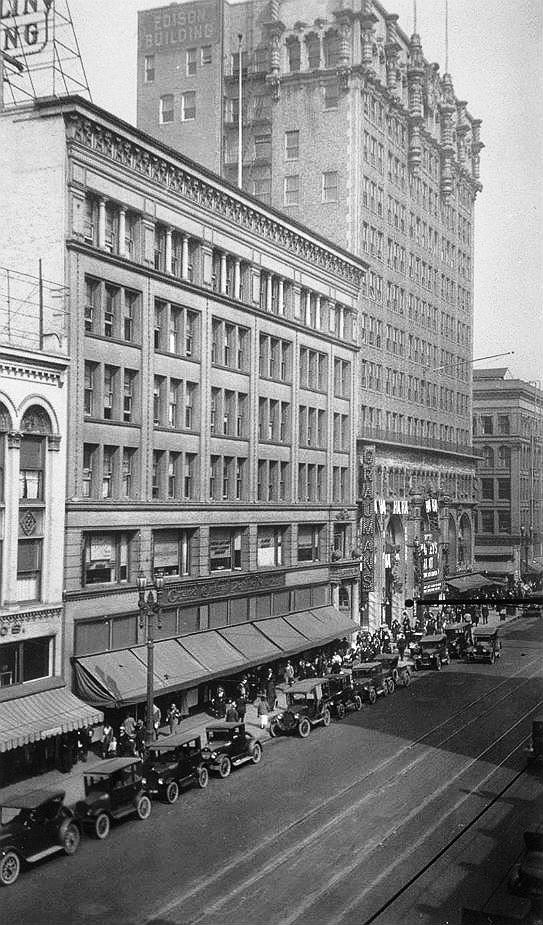
Broadway
North from 4th Street, Los Angeles, Cal., c. 1900s
The
Haskell Post Card Emporium
By
the time the Grand Central Public Market opened, Broadway was downtown Los
Angeles’s main commercial and entertainment district. Above Broadway, on Bunker
Hill, lived some of the city’s most prosperous residents, who descended the
Angel’s Flight railway to shop at the market, only a few steps away. The residents
of the segregated Bunker Hill and the market’s all-white vendors bear little
resemblance to vendors and their patronage today.
Grand Opening of Angel's Flight, December 31, 1901
Courtesy Water and Power Associates
Angel’s Flight (called
Los Angeles Incline Railway when built) began at the west corner of Hill and
Third Streets and ascended two blocks to Olive Street on Bunker Hill. One of
its highly touted features was the observation tower, whose view was described
in a brochure by J. W. Eddy, the railway’s financier, as “grand beyond compare,
overlooking city, sea and mountains.” The railway was relocated half a block
south in 1996. Following numerous closures, Angel’s Flight was restored and another
grand opening was held on August 31, 2017—exactly 116 years after its 1901
opening.
Grand Central Market, c. 1924–25
Courtesy The Bancroft Library
By 1920, Los Angeles
had surpassed San Francisco in population (both over the half-million mark). Two
years later, a promotional brochure bragged that Grand Central Market was “Feeding
a Million People.” The market featured over 90 stalls, with vendors selling
fruit, baked goods, meats, and other products. Prepared foods and restaurants also
were available. Perhaps an unknown piece of its history is a visit by the State Department of Public
Health during an outbreak of bubonic plague in 1924–1925. It is not clear whether any
diseased rats were discovered from the writing accompanying the photograph above (housed
at The Bancroft Library), which most likely was taken by the health inspectors.
Interior of Grand Central Market,
c. 1930s
Courtesy
Grand Central Market Collection
Melton’s Fine Meats at Grand
Central Market, c. 1940
|
 |
Shoppers found their way by bright neon signs displaying wares and stall numbers, c. 1950s
Courtesy CitySleuth
|
As
described in The Grand Central Market Cookbook: “Grand Central Public
Market was true to its name—grand. It covered some 80,000 sq. ft., with 2
levels of retail space and a subterranean network of hallways lined with
storage rooms, walk-in freezers, and refrigerators large enough to park a Model
A Ford. Dumbwaiters from the basement to the street-level sales floor allowed
vendors to stock their stalls without ever having to venture into the crowded
aisles. It was a modern marvel.” Despite its grandeur, the post-World War II years and beyond were
not kind to the areas surrounding the market, including Bunker Hill, where slum
apartments arose as early as 1948.
Grand Central
Market Shoppers, 1966
Los Angeles Public
Library
As to the rest of
the nation, the 1960s brought change to Los Angeles. The Watts Riots and a new
immigration law brought “white flight” and a wave of new
immigrants from Asia and Latin America, who introduced foods and specialty
ingredients and lower prices to the market. A year before the decade began, the city adopted the Bunker Hill Urban
Renewal Project. The project brought an
end to the Bunker Hill neighborhood as Victorian homes and hotels were demolished to make
way for skyscrapers. Within a decade of the project’s adoption, the hilltop
community was gone.
 |
Grand Central
Market 75th Anniversary, December 5, 1987
Los Angeles Public
Library; photo: Mike Sergieff
|
In
the 1980s, real estate developer and lawyer Ira Yellin called Broadway a “bustling Hispanic secret.” With a
new vision for the market—connecting
Broadway, a major Latino shopping venue, and the upscale Bunker Hill district—he upgraded the space and began
the market’s renovation, the Grand Central Square Project, which was completed
in 1995. During the 2008 financial crisis, the market’s fate reflected the economic downturn in many parts of the city. By 2012, however,
a resurgence of downtown residential and commercial activity revitalized the
market, which only two years later was included in Bon Appetite magazine’s
“Hot 10” list of eateries nationwide. Today,
as Curbed Los Angeles observes, Grand Central Market “is a vibrant and thriving community
of multicultural stands and food stops. . . . Flashy new
food halls are marching into Los Angeles, but none can compete with the
enduring Grand Central Market.”
Happy
100th Birthday, Grand Central Market!
Shelly Kale
Publications and Strategic Projects Manager
Sources
Adele Yellin and Kevin West, The Grand Central Market Cookbook: Cuisine
and Culture from Downtown Los Angeles (New York: Clarkson Potter, 2017)
___________________________________________________________________________________